| Best for | Not for |
|---|---|
| Very broad asset and network coverage | — |
| Fixed and floating rate modes | — |
| No account for most basic exchanges | — |
| Useful API and integration ecosystem | — |
| Strong convenience for cross chain swaps | — |
Live market data via CoinGecko, for informational purposes only. Not financial advice.
Editorial independence: our scores and rankings are produced using the fixed criteria above and are not influenced by advertisers. This is an independent ranking site and is not operated by, or affiliated with, any provider we list.
Affiliate disclosure: some links on this page may earn us a commission at no extra cost to you. This does not affect our rankings.
| Criterion | Score | Note |
|---|---|---|
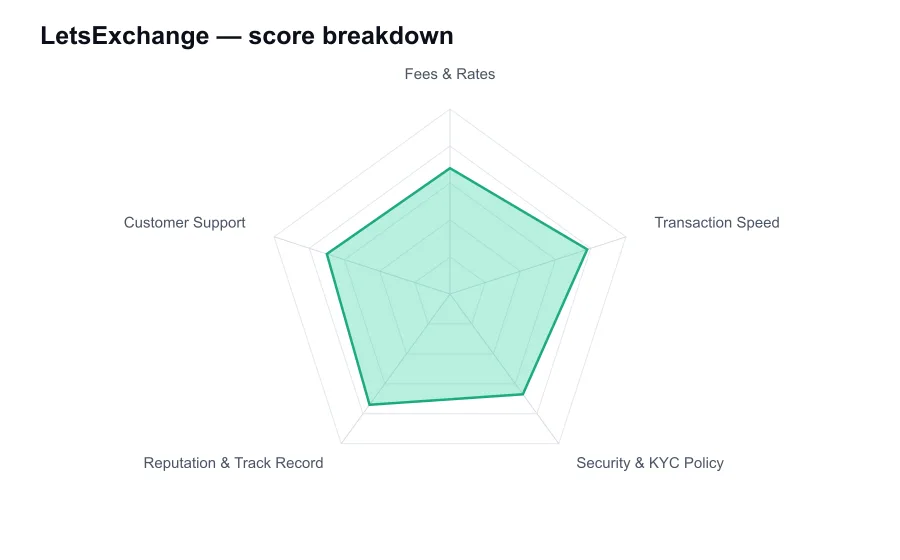
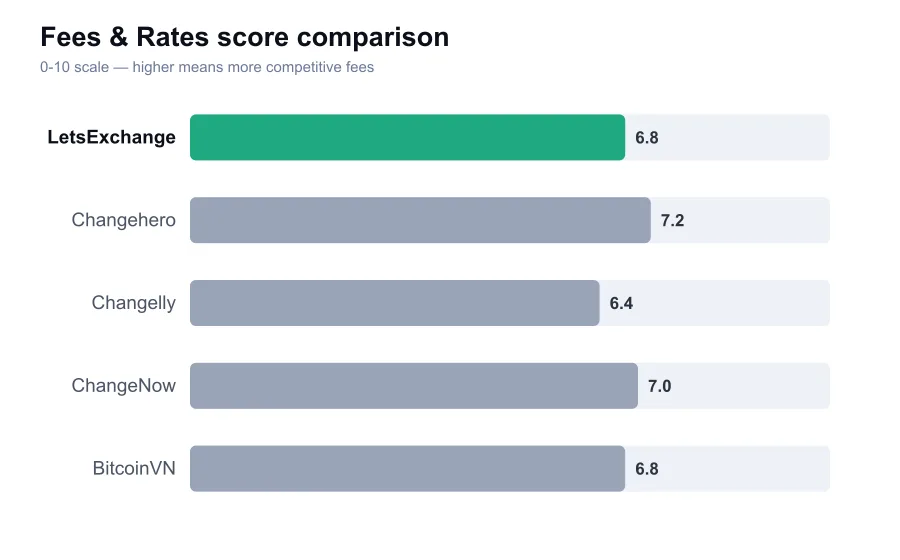
| Fees & Rates | 6.8 | Competitive quotes on some routes, but spreads vary and are embedded. |
| Transaction Speed | 7.8 | Fast normal processing, subject to confirmations and liquidity partners. |
| Security & KYC Policy | 6.7 | No standing balance, but AML checks and intermediary risk apply. |
| Reputation & Track Record | 7.4 | Longer operating history and broad market visibility than most peers. |
| Customer Support | 7.0 | Live support and documentation help, difficult cases can take time. |
LetsExchange is one of the larger instant crypto exchange aggregators, a service designed to route a swap without asking the user to operate a conventional exchange account. It supports a long list of coins, tokens, and networks, which is its main selling point. Someone holding an asset in a private wallet can exchange it and receive another asset in a different wallet. For ordinary users, that feels much easier than depositing to a centralized venue and placing a market order.
The company has built its identity around breadth. It advertises hundreds of assets and a large number of trading pairs, along with an API and affiliate infrastructure that suggest it is more than a small consumer facing swap page. That wider footprint makes it more credible than a brand new anonymous exchanger. It does not change the core reality, though: LetsExchange is a quote based conversion service, and the quality of a particular trade depends on the route, liquidity partner, asset, and network you select.
The first thing to understand is that LetsExchange is not usually the cheapest way to trade a mainstream pair. A user making a BTC to USDC conversion on Kraken or Coinbase Advanced can see the market price and a stated maker or taker fee. LetsExchange presents an expected output. The price incorporates a conversion spread, liquidity costs, and network fees. That is a reasonable model for convenience, but it is a poor fit for somebody who wants precise execution.
The service offers fixed rate and floating rate exchange modes. The floating quote is generally more flexible and can be attractive when markets are calm. It also leaves the user exposed to price movement between the quote, deposit confirmation, and execution. Fixed rate mode gives a stated output if the deposit arrives under the required conditions and within the payment window. For bills, merchant payments, or a swap where the receiving amount matters, fixed mode is the only responsible choice.
Fees are not expressed as a simple platform percentage across every transaction. That can frustrate experienced traders, but the final quote is still the number that matters. Compare input, output, and network cost with at least one rival. LetsExchange can be strong on one route and weak on another because its providers and available inventory vary. Do not assume a low quoted service fee means the conversion is cheap. A wider embedded spread can matter much more than the headline wording.
Its support for many networks is genuinely useful, particularly for users moving stablecoins. Yet stablecoin choice is also where careless customers get burned. USDT and USDC exist on several chains, and a cheap network can look appealing until the receiving wallet or exchange does not support it. LetsExchange displays network choices, but the user remains responsible for matching them. A successful blockchain deposit sent through an unsupported route can become a support ticket rather than a quick swap.
Normal execution speed is good. A liquid swap involving assets such as BTC, ETH, LTC, SOL, USDT, or USDC can be processed shortly after sufficient deposit confirmations arrive. Transactions on fast chains may feel near instant, while Bitcoin and Ethereum depend heavily on mempool conditions and confirmation requirements. A quoted processing estimate should never be read as a guarantee. External liquidity providers, blockchain congestion, wallet maintenance, and automatic risk checks can all slow the flow.
LetsExchange's fixed rate feature is one of its practical advantages over a basic aggregator that only offers a changing estimate. It reduces the anxiety of sending funds into a volatile market, especially in smaller cap assets that can move sharply during a few confirmations. But fixed does not mean the provider takes every imaginable risk. The customer must send the correct coin, on the correct network, in the exact requested amount, before the clock expires. Those details are part of the contract.
The no registration pitch needs a careful reading. LetsExchange generally allows users to initiate exchanges without creating a full customer account. It is not a promise of unconditional anonymity. The service has an AML and compliance process, and a transaction may be paused if its risk systems or partners identify an issue. In that event, identity verification and documentation can be requested. That policy is common and legally understandable, but it should be clear before any funds are sent.
From a custody perspective, LetsExchange is safer than keeping a permanent balance at an exchange because it does not require users to leave coins in an account. The funds are nonetheless transferred to an address associated with the exchange process. This is not an atomic onchain trade and it is not a self custody protocol. You are trusting the company and its routing partners for the duration of the conversion. Treat it as short term counterparty exposure, not as a purely decentralized transaction.
The platform's public reputation is comparatively solid for this corner of the market. It has operated long enough to accumulate meaningful user feedback, integrations, reviews, and industry visibility. I would still discount any review score that comes from a service's happiest completed swaps, because instant exchanges naturally collect fewer comments from people whose case has entered compliance review. The relevant reputation question is how a firm behaves when a trade goes wrong, not only how it handles a smooth five minute conversion.
Support is available through live chat and email channels, and LetsExchange has built a sizable help center around common issues. For routine cases, that is usually enough. The harder cases are deposits with a wrong memo, delayed provider settlements, flagged transactions, or output sent to a problematic destination. Users report both quick resolutions and frustrating delays, which is typical where an intermediary depends on outside liquidity and compliance partners. Save the exchange ID and transaction hash immediately.
Compared with ChangeNOW, LetsExchange is broadly competitive in coverage and usability. Compared with a liquid order book venue, it loses on fee transparency and execution control. Compared with a decentralized exchange, it can be much easier for cross chain users, but it introduces a company into the transaction. That is the fair frame. LetsExchange is not pretending to be a professional trading terminal, and buyers should not ask it to perform like one.
My take is positive but selective. LetsExchange is a sensible choice for a modest to medium sized swap, especially where token coverage, cross network convenience, or fixed output matters more than shaving every basis point. It is not my first choice for frequent trading, high value conversions, or transactions likely to attract compliance scrutiny. Check the quote, select the chain carefully, and test an unfamiliar route with a small amount first. Used that way, it is one of the more practical instant exchange services.
| Pros | Cons |
|---|---|
| Very broad asset and network coverage | — |
| Fixed and floating rate modes | — |
| No account for most basic exchanges | — |
| Useful API and integration ecosystem | — |
| Strong convenience for cross chain swaps | — |
LetsExchange suits wallet users who need access to many assets and prefer a one page conversion flow. It is particularly useful for stablecoin and cross network swaps, provided the receiving platform supports the chosen chain. Frequent traders, institutions, and users seeking exact order book execution should choose a major exchange. Anyone unable to tolerate a potential AML hold should not send a time critical payment through any instant exchanger.
No single fee applies to every route. The expected output reflects market pricing, liquidity costs, any service margin, and network fees. Compare the full quote before sending.
Most exchanges can be started without opening a traditional account. Compliance checks can still lead to a request for identity or transaction documentation.
A floating rate can change with the market before execution. A fixed rate aims to deliver the stated amount if you send the exact deposit on time and meet the quote conditions.
| Alternative | Score |
|---|---|
| Changelly Review | 7.0/10 |
| Changehero Review | 7.0/10 |
| ChangeNow Review | 7.2/10 |
| BitcoinVN Review | 7.2/10 |
| Godex Review | 6.9/10 |
| Nexo Review | 6.9/10 |