| Best for | Not for |
|---|---|
| Non-custodial wallet with user-controlled recovery phrase | — |
| Broad support for coins, chains, and token types | — |
| No wallet-level KYC for basic self-custody | — |
| Convenient in-app swap and purchase integrations | — |
Live market data via CoinGecko, for informational purposes only. Not financial advice.
Editorial independence: our scores and rankings are produced using the fixed criteria above and are not influenced by advertisers. This is an independent ranking site and is not operated by, or affiliated with, any provider we list.
Affiliate disclosure: some links on this page may earn us a commission at no extra cost to you. This does not affect our rankings.
| Criterion | Score | Note |
|---|---|---|
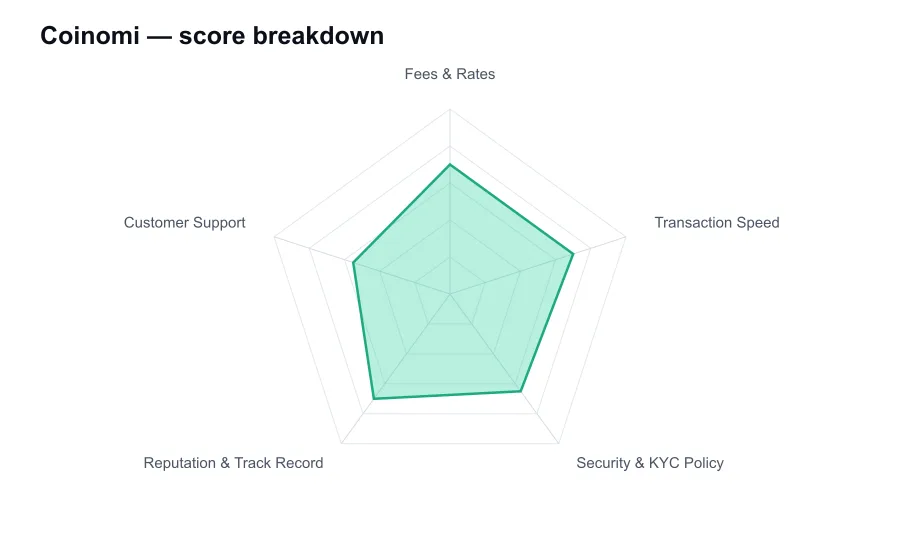
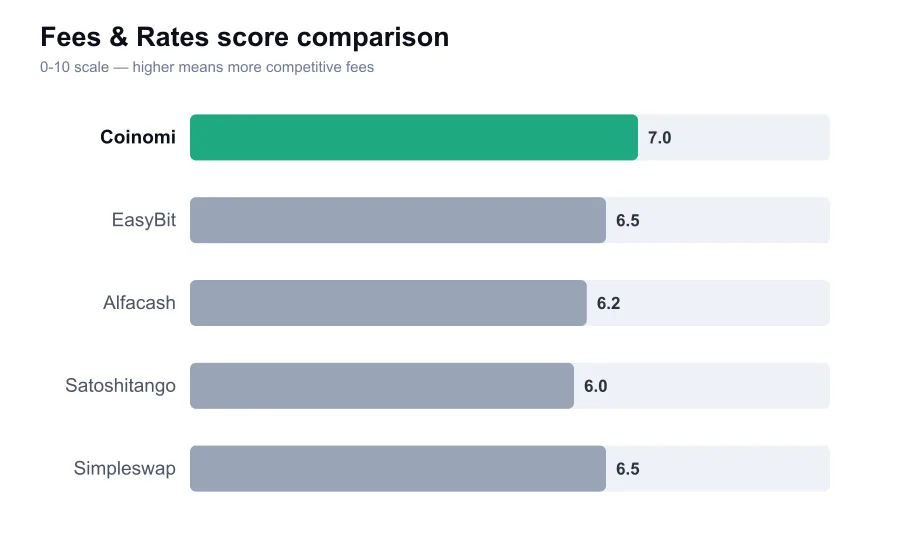
| Fees & Rates | 7.0 | Wallet sends use network fees, swap quotes vary by partner |
| Transaction Speed | 7.0 | Responsive wallet, settlement depends on chains and partners |
| Security & KYC Policy | 6.5 | Non-custodial control, but software-wallet risks remain |
| Reputation & Track Record | 7.0 | Multi-asset wallet established in 2014 |
| Customer Support | 5.5 | Helpful documentation, no recovery of lost keys |
Coinomi is not a conventional cryptocurrency exchange. It is a long-running non-custodial wallet, first released in 2014, that lets users hold a broad range of coins and tokens while connecting them to third-party swap and purchase services. That distinction is crucial. Coinomi does not normally take custody of your private keys, so its strengths and risks are fundamentally different from those of Coinmotion, Coinbase, or Kraken.
The wallet became popular because it arrived early, supported many chains, and made multi-asset storage less intimidating on mobile devices. Even now, its appeal is practical: one wallet interface can manage Bitcoin, Ethereum, many token standards, and a substantial list of other networks. For a user with a varied portfolio, that convenience is real. It can reduce the temptation to install a separate wallet for every asset.
Non-custody is Coinomi's central selling point. The recovery phrase is generated for the user and is intended to control the assets. Coinomi cannot simply freeze a balance in the way a centralized exchange can, because it does not hold that balance in its own customer account system. That gives the owner more sovereignty, but it also means there is no reset button if the recovery phrase is lost or exposed.
Fees are often misunderstood because Coinomi bundles wallet functions with exchange integrations. Sending a coin from the wallet incurs the relevant network fee. Coinomi itself is not acting like a retail broker charging a flat purchase commission for every on-chain send. But a swap made through the app is normally handled by an external provider, and the quote can include that provider's fee, spread, and network costs.
That means Coinomi is cheap for straightforward storage and can be reasonably economical for sending assets when network conditions are favorable. It is not automatically cheap for exchanging one asset for another. The convenience quote can be noticeably worse than placing a trade on a liquid exchange such as Kraken Pro and withdrawing afterward. Users should compare the exact amount received, not just the percentage fee displayed by any swap partner.
The same principle applies to card purchases. Third-party fiat gateways tend to charge much more than a bank transfer into a traditional exchange, especially for small purchases and customers in certain countries. Coinomi makes access convenient, but convenience is being sold by a partner and paid for by the customer. If you are buying regularly, use the wallet for custody and source the assets through a lower-cost venue.
Transaction speed is mostly determined by networks and swap partners, not Coinomi's interface. A Bitcoin send can be broadcast quickly but may take multiple confirmations. Ethereum transactions depend on the gas fee selected and current congestion. A cross-chain swap may require confirmations on one chain, a provider-side exchange, then a payout on another. Calling every in-app action instant would be misleading.
For normal wallet activity, Coinomi is responsive and easy to use. It can create addresses, present balances, and prepare transactions without the delays associated with an exchange's order queue or bank compliance review. Yet users should understand that an app showing a completed send does not mean the recipient has final settlement. For larger payments, wait for the recipient's required confirmation count and verify the transaction on a block explorer.
Coinomi's security model is best described as self-custody with software-wallet limitations. It supports a recovery phrase, password protection, and biometric access where the device allows it. Those are useful layers, but the phone or computer remains a potential attack surface. A compromised device, a phishing page, a copied malicious address, or a photographed seed phrase can defeat even a well-designed wallet interface.
The wallet has faced scrutiny before. In 2019, researcher Warith Al Maawali disclosed that Coinomi's desktop wallet could send seed-related text entered into a spell-check field to a Google service. Coinomi said the issue was fixed rapidly and said it did not result in stolen funds. The episode is relevant because seed material should never leave a user-controlled environment. It also illustrates why desktop wallet security deserves skeptical attention.
Coinomi says it has not suffered a hack of users' wallets, but any such claim needs context. A non-custodial wallet does not present the same central honeypot as an exchange, and many losses occur through user error rather than a company-wide breach. The right question is whether the product's architecture, update practices, privacy behavior, and recovery procedures deserve trust. Coinomi's long history helps, but it is not a substitute for careful wallet hygiene.
KYC is another area where the wallet and its partners must be separated. Creating and using the Coinomi wallet does not ordinarily require submitting identity documents. A third-party exchange or card provider accessed through the wallet may require KYC, particularly for fiat purchases or larger transactions. Users should read the partner's terms before entering personal data and should not assume an in-wallet button guarantees a privacy-preserving transaction.
Coinomi's reputation is respectable in wallet terms. It has been around since the early multi-chain wallet era and is known to many long-time users. Still, it has lost some mindshare to wallets with stronger hardware-wallet ecosystems, clearer open-source practices, or more specialized DeFi tooling. Coinomi is broad and convenient, but it is not the unquestioned gold standard for every chain or every security model.
Support is adequate rather than exceptional. Coinomi provides documentation and support channels, but it cannot reverse confirmed blockchain transactions or restore a lost seed phrase. Anyone demanding that kind of rescue service should not use self-custody in the first place. The support team can help with application behavior and transaction diagnosis, but users must retain responsibility for backups, addresses, and security decisions.
I like Coinomi most as a secondary multi-asset wallet for users who understand what it is. It is useful for managing supported assets, receiving payments, and holding moderate amounts with disciplined backups. I would not use it as the cheapest place to buy crypto, and I would not make it the sole home for a life-changing balance. For substantial holdings, a hardware wallet and a carefully tested recovery plan are more appropriate.
Coinomi remains relevant because it solves a mundane but important problem: managing many assets without handing every private key to an exchange. Its weaknesses are the familiar ones of software wallets, plus the variable pricing and KYC rules of integrated third parties. Use it for control and convenience, not because you expect exchange-grade liquidity or customer rescue. A capable wallet, yes. A substitute for careful self-custody, absolutely not.
| Pros | Cons |
|---|---|
| Non-custodial wallet with user-controlled recovery phrase | — |
| Broad support for coins, chains, and token types | — |
| No wallet-level KYC for basic self-custody | — |
| Convenient in-app swap and purchase integrations | — |
Coinomi suits experienced users who want a broad multi-asset software wallet and understand seed-phrase responsibility. It is useful for moderate balances, diversified portfolios, and receiving or sending supported assets. Beginners can use it, but only if they learn backup practices first. Large holders, security-maximalists, and frequent traders should pair a hardware wallet or an exchange with more specialized tools.
Coinomi is designed as a non-custodial wallet. You control the recovery phrase and private-key access, so losing that backup can mean permanently losing access to funds.
Swap pricing is set by integrated third-party providers and can include a spread, provider fee, and network costs. Compare the final amount received with alternatives before confirming.
Basic wallet creation does not ordinarily require KYC. However, third-party card purchase and exchange partners available inside the app may ask for identity verification.
For a substantial long-term balance, a reputable hardware wallet with an offline backup plan is generally the stronger choice. Coinomi is better treated as a software wallet.
| Alternative | Score |
|---|---|
| EasyBit Review | 6.7/10 |
| Alfacash Review | 6.8/10 |
| Satoshitango Review | 6.8/10 |
| Simpleswap Review | 6.8/10 |
| XGram Review | 6.6/10 |
| Ripio Review | 6.6/10 |