| Best for | Not for |
|---|---|
| Convenient wallet-to-wallet crypto swaps | — |
| No conventional trading account needed | — |
| Good fit for fast-chain transactions | — |
| Self-custody destination addresses | — |
Live market data via CoinGecko, for informational purposes only. Not financial advice.
Editorial independence: our scores and rankings are produced using the fixed criteria above and are not influenced by advertisers. This is an independent ranking site and is not operated by, or affiliated with, any provider we list.
Affiliate disclosure: some links on this page may earn us a commission at no extra cost to you. This does not affect our rankings.
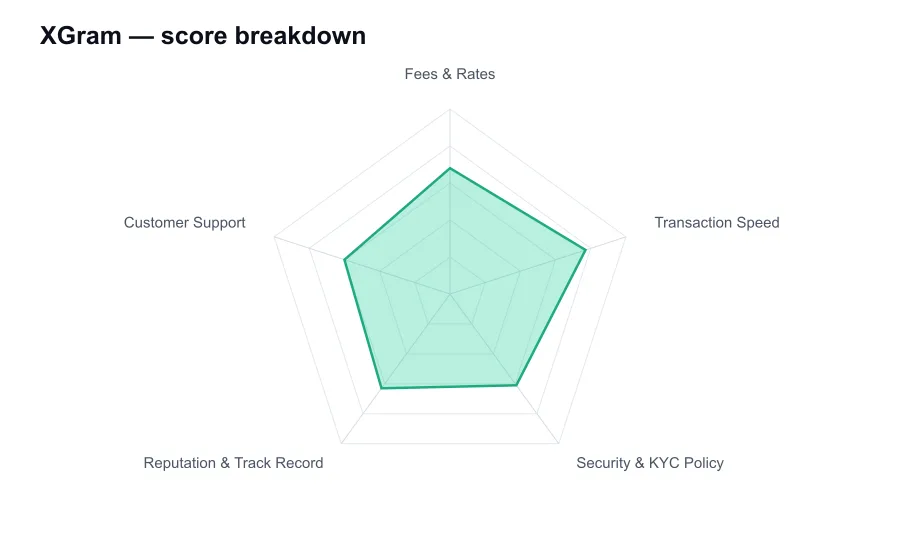
| Criterion | Score | Note |
|---|---|---|
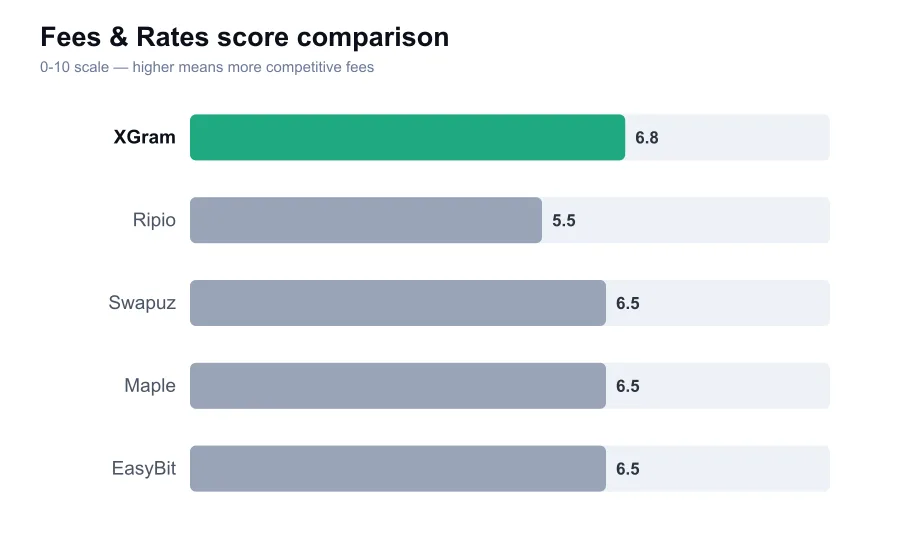
| Fees & Rates | 6.8 | Often practical for swaps, but the spread varies by pair and network. |
| Transaction Speed | 7.7 | Fast on routine wallet-to-wallet swaps after confirmations. |
| Security & KYC Policy | 6.1 | Noncustodial workflow helps, though public controls are limited. |
| Reputation & Track Record | 6.3 | Established enough to consider, not strong enough for blind trust. |
| Customer Support | 6.0 | Order data is essential if manual transaction help is needed. |
XGram is positioned as a fast cryptocurrency exchange service rather than a full-scale trading venue. Its audience is the person who wants to swap one digital asset for another with a short form, a destination wallet, and no account-management ritual. That puts it in direct competition with instant-swap brands such as ChangeNOW, SimpleSwap, and Changelly, although the real comparison should always be route-specific because the same provider can be excellent on one pair and mediocre on another.
The first thing to understand is that XGram is not an order-book exchange in the Binance or Kraken sense. You do not bring your own bids and offers to a visible market. You accept a quote generated from the service's liquidity arrangements and operational margin. That is easier for casual users, but it removes the price discovery and fee transparency available on a traditional exchange. Convenience is being purchased, and the customer needs to decide whether the premium is acceptable.
On popular swaps, especially assets with deep liquidity and inexpensive networks, XGram can be a sensible option. A user who wants to convert USDT, BTC, ETH, LTC, or another mainstream asset and withdraw directly to a self-custody wallet may value avoiding registration and a trading interface. The process can be substantially cleaner than depositing to an exchange, selling, buying the new asset, and withdrawing again. It also reduces the temptation to leave money sitting on a centralized platform.
Fees are not best understood as a fixed platform percentage. The all-in cost is normally embedded in the offered rate, while the network fee and liquidity conditions can change by asset and chain. This is the standard model for instant exchangers, but it makes a casual quote hard to evaluate. If Bitcoin is volatile, a quote with a modest visible gap can still lead to a disappointing final result if the rate is not locked or if the transaction takes longer than expected to arrive.
XGram users should pay close attention to whether an order is fixed-rate or floating-rate, where that choice is offered. A fixed-rate swap may cost a little more but gives a clearer expectation about the destination amount, subject to the terms of the order and timely payment. A floating-rate order can be cheaper in stable conditions, yet the received amount can move with the market. For a small experimental swap, floating execution may be fine. For a payment with a precise required amount, it is often the wrong risk to take.
The service's strongest score is speed, but even that needs a realistic reading. The exchange itself may process a routine conversion quickly after it receives the deposit, particularly on fast chains. It cannot control how quickly a wallet broadcasts a transaction, how many confirmations are required, or whether the destination chain is congested. Ethereum during a busy fee period and Bitcoin during a mempool backlog are not problems that a clean-looking exchange page can solve.
The usual smooth path is simple: create the order, send the exact cryptocurrency on the exact network, wait for confirmations, and receive the exchanged asset in the wallet provided. A discrepancy in amount, an incorrect chain, an omitted memo, or a late deposit after the quoted window can pull the order out of automation. That is why I prefer sending from a wallet with clear transaction controls rather than from another platform that may batch withdrawals or delay broadcasts.
XGram's no-account appeal deserves a little skepticism. Not requiring an ordinary customer account can improve privacy and reduce friction, but it does not eliminate compliance controls. Instant exchangers increasingly use blockchain analytics and risk screening. A transfer associated with sanctions exposure, hacks, darknet activity, or other flagged patterns may be paused and referred for verification. Anyone presenting this type of service as fully anonymous is overselling it.
There is also a difference between not collecting identity data up front and having a mature privacy architecture. XGram does not have the public reporting, regulatory standing, insurance disclosures, or independently audited custody narrative that a major exchange can point to. That is not unusual for an instant-swap provider, but it is a limitation. The customer is depending on the service to receive, convert, and forward the funds correctly with relatively little visibility into the infrastructure behind the quote.
For that reason, XGram is best used on a noncustodial basis. Supply your own receiving address, make sure you control the private keys, and do not use the service as a place to store assets. A swap service should be a bridge, not a vault. If you need fiat balances, recurring purchases, margin, tax exports, or account-level security controls such as hardware-key login, then you need a conventional exchange instead.
Reputation is decent within the narrower instant-exchange niche but not strong enough to justify blind confidence. XGram does not have the broad, battle-tested public profile of the largest global brands. That is especially relevant because smaller swap providers can rely on third-party liquidity, and the customer may not know which operational party is actually handling a particular route. The service can work well while still carrying counterparty risk that is hard to quantify from the front end.
I would look for recent, detailed customer reports before trusting XGram with a substantial amount. Generic praise is cheap. Useful reports mention the asset, network, approximate processing time, whether the received amount matched the quote, and how support handled an exception. Pay special attention to reports involving flagged transactions and delayed swaps, because those are the situations where a provider's real policies become visible.
Support appears to be built around transaction assistance rather than the high-touch service expected by corporate clients. That is reasonable for an automated swap business. It does mean that customers should retain the order ID, deposit address, transaction hash, amount, timestamp, and screenshots from the moment they create an order. If the swap does not complete, those details are more useful than a general message saying that funds have disappeared.
Compared with ChangeNOW or Changelly, XGram has to win through a better live quote, a supported route, or a notably smooth experience. It does not have enough public stature to win purely on brand confidence. This is a market where customers can and should shop around. Checking two or three reputable instant-swap services takes minutes and can reveal a meaningful difference in expected output, particularly for altcoins and cross-chain USDT routes.
My take is more favorable for XGram than for a typical fiat-focused small exchanger, because the noncustodial crypto-to-crypto model limits some payment-rail complications. Still, it remains a convenience service with opaque all-in pricing and limited public security disclosure. I would happily consider it for a modest wallet-to-wallet swap after checking the quote and network, but I would not route a life-changing amount through it merely to avoid opening an account. The right use case is a quick conversion, not a leap of faith.
| Pros | Cons |
|---|---|
| Convenient wallet-to-wallet crypto swaps | — |
| No conventional trading account needed | — |
| Good fit for fast-chain transactions | — |
| Self-custody destination addresses | — |
XGram suits self-custody crypto users who need an occasional swap and understand networks, confirmations, and destination-address checks. It is particularly useful for people who do not want to maintain an account at a centralized exchange. It is not for fiat cash-outs, professional trading, or anyone sending an amount they cannot afford to have delayed during a compliance review.
Its exchange flow is designed for direct swaps rather than a conventional trading account. However, risk controls can still lead to a request for verification on a particular transaction.
The answer depends on the order type and route. Check whether the quote is fixed or floating before paying, because floating swaps can produce a different final amount.
A routine swap can be quick after the deposit has the required confirmations. Actual timing depends on the source chain, destination chain, congestion, and any risk review.
It should be treated as a transaction service, not a wallet. Use a receiving address you control and avoid leaving funds in an unfinished or completed exchange flow.
| Alternative | Score |
|---|---|
| Ripio Review | 6.6/10 |
| Maple Review | 6.5/10 |
| Swapuz Review | 6.5/10 |
| EasyBit Review | 6.7/10 |
| Coinomi Review | 6.7/10 |
| Nexchange Review | 6.4/10 |