| Best for | Not for |
|---|---|
| Straightforward wallet to wallet conversions | — |
| No conventional exchange account needed | — |
| Useful for modest one off swaps | — |
| Longer niche history than unknown swap sites | — |
Live market data via CoinGecko, for informational purposes only. Not financial advice.
Editorial independence: our scores and rankings are produced using the fixed criteria above and are not influenced by advertisers. This is an independent ranking site and is not operated by, or affiliated with, any provider we list.
Affiliate disclosure: some links on this page may earn us a commission at no extra cost to you. This does not affect our rankings.
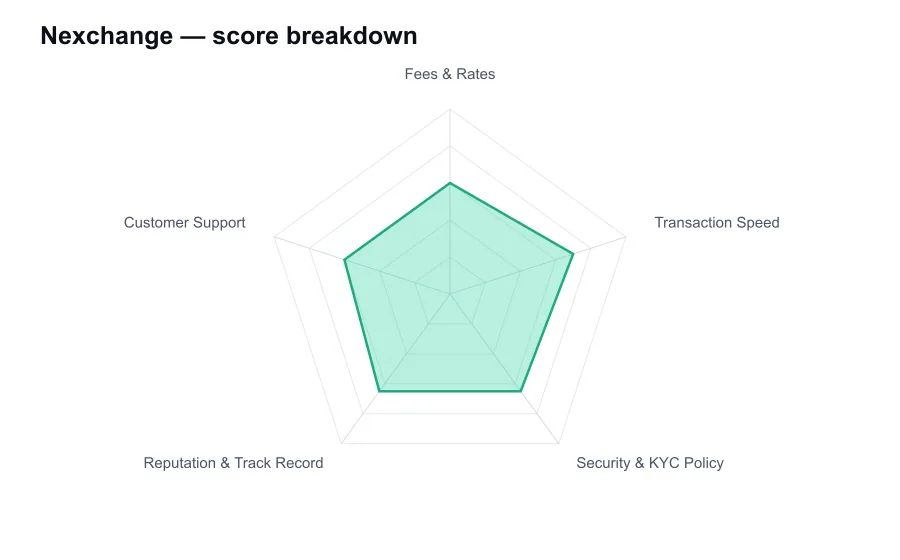
| Criterion | Score | Note |
|---|---|---|
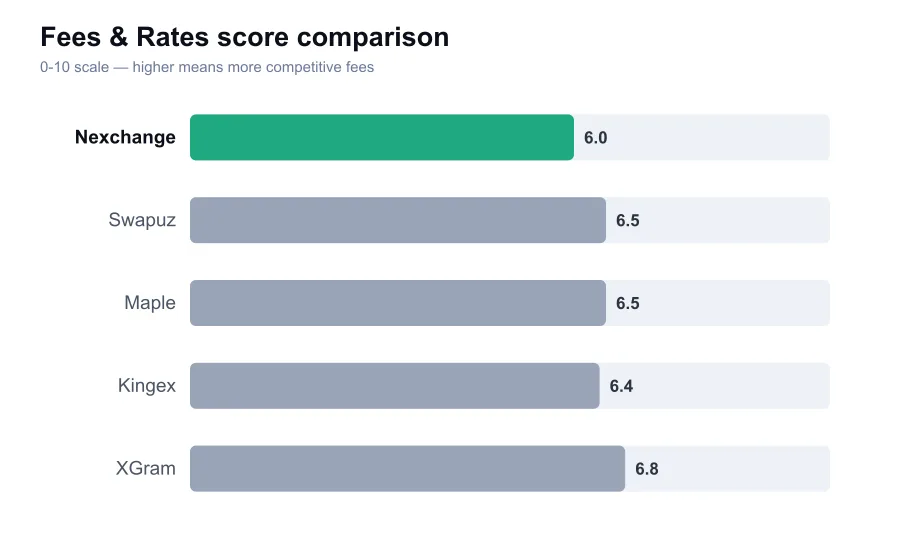
| Fees & Rates | 6.0 | Convenient quotes, but spreads need comparison |
| Transaction Speed | 7.0 | Routine swaps move promptly after confirmations |
| Security & KYC Policy | 6.5 | Short custody model, with normal swap counterparty risk |
| Reputation & Track Record | 6.5 | Established niche presence, but not top tier scale |
| Customer Support | 6.0 | Order support available, limited by blockchain finality |
Nexchange, usually presented through the n.exchange brand, is an instant crypto conversion service rather than a full scale centralized trading venue. Its pitch is familiar: select a pair, provide a receiving address, send the source asset, and receive the converted coin without building a conventional exchange account. It sits in the same broad category as ChangeNOW, SimpleSwap, SideShift, and other swap providers, though it has a smaller public profile than the market leaders.
The appeal of this model is real. People who already use self custody wallets often do not want to deposit coins, wait for an account review, navigate a trading screen, and request a withdrawal just to exchange one asset for another. Nexchange reduces those steps. It can be convenient for a one off conversion or for moving between networks, provided the user understands that the service temporarily handles the funds during settlement.
Nexchange should not be confused with a decentralized exchange. The customer keeps control until they send the deposit, but the service or its liquidity partners execute the conversion. That means rate quality, solvency, compliance rules, operational competence, and support responsiveness all matter. A clean no login checkout is nice. It does not remove counterparty exposure.
Fees are presented principally through the quoted exchange rate rather than a simple maker and taker schedule. This is common for instant exchanges, but it makes comparison harder. The quoted result can include the provider spread, liquidity costs, and network fees. The effective cost is the difference between the amount a customer could obtain through a liquid exchange and the amount Nexchange promises to deliver, after allowing for deposits and withdrawals.
For small, urgent conversions, paying a modest premium for convenience can make sense. For larger swaps, it often does not. Compare the Nexchange quote with at least two other instant providers and, if practical, the cost of trading on a reputable exchange. Stablecoin pairs and liquid major assets should be particularly easy to benchmark. If Nexchange's returned amount is materially lower, convenience is not a sufficient excuse.
Fixed and floating rate behavior deserves attention. A floating quote can change while your deposit is waiting for confirmations or while the market moves. A fixed quote can offer more certainty, but it may carry a wider spread or tighter deposit conditions. Users should read the order screen carefully and send the exact amount before the stated deadline. Underpaying, using the wrong network, or sending an unsupported token variant can turn an easy swap into a support case.
Speed is generally acceptable for the instant exchange model, but no provider can beat the underlying chains. Litecoin, Tron, and some faster networks can produce a quick end to end result. Bitcoin and Ethereum mainnet deposits may take longer due to confirmation requirements and congestion. A standard order should normally progress after the source transaction receives the required confirmations, though liquidity issues or a manual review can stretch the timeline.
The best way to use Nexchange is to plan around that uncertainty. Do not use it for an emergency payment where a missed hour creates a serious problem. Keep the order identifier, transaction hash, exact amount, and receiving address. If a transaction appears stalled, those details are what support needs. Repeatedly sending additional funds rarely helps and can make reconciliation more difficult.
Nexchange's security model is better than keeping a balance on a custodial exchange for days, because an ordinary swap is intended to be a short lived transaction. Still, the service sees the deposit before it forwards the output. Users should use a receiving address under their own control, verify it character by character, and never enter a seed phrase into any site. Its strongest safety benefit is limited custody duration, not the elimination of custody risk.
On identity checks, users should avoid simplistic claims that instant exchanges are permanently no KYC. Nexchange has historically promoted a low friction approach, but providers in this sector may apply anti money laundering screening, block certain jurisdictions, or request verification in exceptional cases. That can be frustrating, particularly after a deposit. It is also a reason to read the terms before using a pair or amount that would be painful to have paused.
Its reputation is middling rather than alarming. Nexchange has been known in the instant swap space for years and is more recognizable than a brand new, anonymous exchange page. It does not command the same scale, liquidity depth, or widespread independent scrutiny as the biggest centralized exchanges or the largest swap aggregators. That puts it in a reasonable but not elite category. A history of operation helps, yet it does not excuse a user from checking current reviews and current terms.
Customer support is a functional necessity with this business model because exceptions happen. Nexchange provides support channels and order based assistance, but users should calibrate expectations. Email or chat support can investigate a transaction, but it cannot make a slow blockchain confirm faster or guarantee an immediate answer during a busy period. The quality test is how clearly the provider explains an order status and resolves a documented issue, not whether a chat widget appears on the screen.
I would use Nexchange for a modest, routine conversion where the quoted amount is competitive and I have checked every network detail. I would not use it as my primary trading venue, as a place to store funds, or as a route for an unusually large transfer without first establishing confidence through smaller transactions. Businesses and high value users usually benefit from negotiated liquidity, stronger compliance clarity, and named account support that an instant swap service cannot easily provide.
Nexchange remains a practical tool, not a destination. It offers the useful simplicity people expect from a wallet to wallet converter and has a more established presence than many obscure swap sites. Its limits are the familiar limits of the category: spread based pricing, temporary counterparty risk, confirmation driven timing, and limited recourse if something goes wrong. Price shop before each order, use self custody addresses, and keep your transaction records. With those habits, it can do a straightforward job well.
| Pros | Cons |
|---|---|
| Straightforward wallet to wallet conversions | — |
| No conventional exchange account needed | — |
| Useful for modest one off swaps | — |
| Longer niche history than unknown swap sites | — |
Nexchange suits self custody users who need a modest crypto to crypto conversion and are comfortable comparing live quotes. It is a decent fit for people who value a simple checkout more than advanced trading tools. Active traders, large holders, and businesses should use a deeper exchange or professional liquidity provider. Anyone needing guaranteed timing should avoid relying on any confirmation based swap service.
Its standard swap flow is designed for direct wallet to wallet conversion rather than a traditional exchange account. Compliance checks may still be applied in certain cases, so users should read the current terms.
Timing depends on the source chain's confirmation requirements, network congestion, the chosen pair, and available liquidity. Faster chains may complete quickly, while Bitcoin or a reviewed order can take longer.
The cost is chiefly reflected in the quoted output amount and can include a spread plus network costs. Compare the final amount received with alternative providers before sending funds.
Before you send funds, simply do not fund the order. After the deposit is confirmed, cancellation may not be possible because the conversion can already be executing. Contact support with the order ID promptly.
| Alternative | Score |
|---|---|
| Maple Review | 6.5/10 |
| Swapuz Review | 6.5/10 |
| Kingex Review | 6.3/10 |
| XGram Review | 6.6/10 |
| Ripio Review | 6.6/10 |
| Vobmenka Review | 6.2/10 |