| Best for | Not for |
|---|---|
| Specialized onchain credit infrastructure | — |
| More conservative secured-lending direction | — |
| Public protocol history and documentation | — |
| Transparent wallet-based settlement | — |
Live market data via CoinGecko, for informational purposes only. Not financial advice.
Editorial independence: our scores and rankings are produced using the fixed criteria above and are not influenced by advertisers. This is an independent ranking site and is not operated by, or affiliated with, any provider we list.
Affiliate disclosure: some links on this page may earn us a commission at no extra cost to you. This does not affect our rankings.
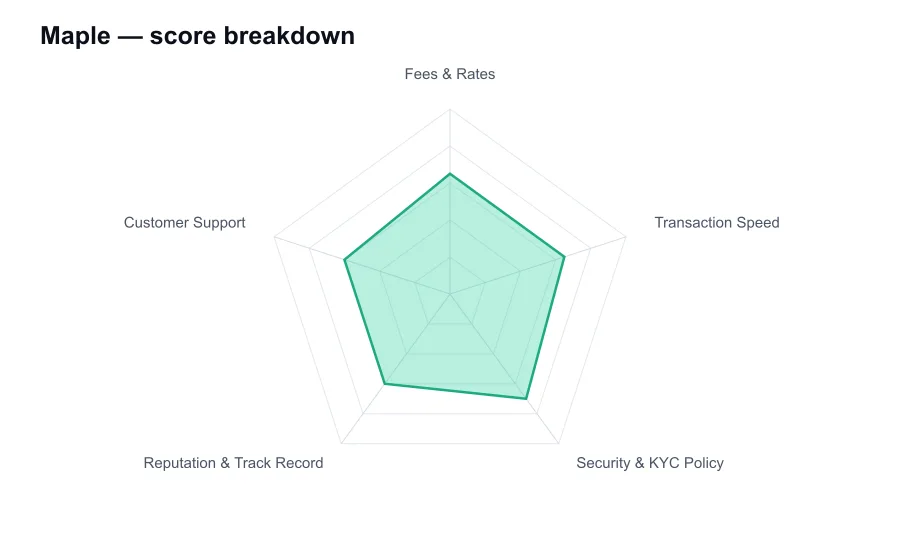
| Criterion | Score | Note |
|---|---|---|
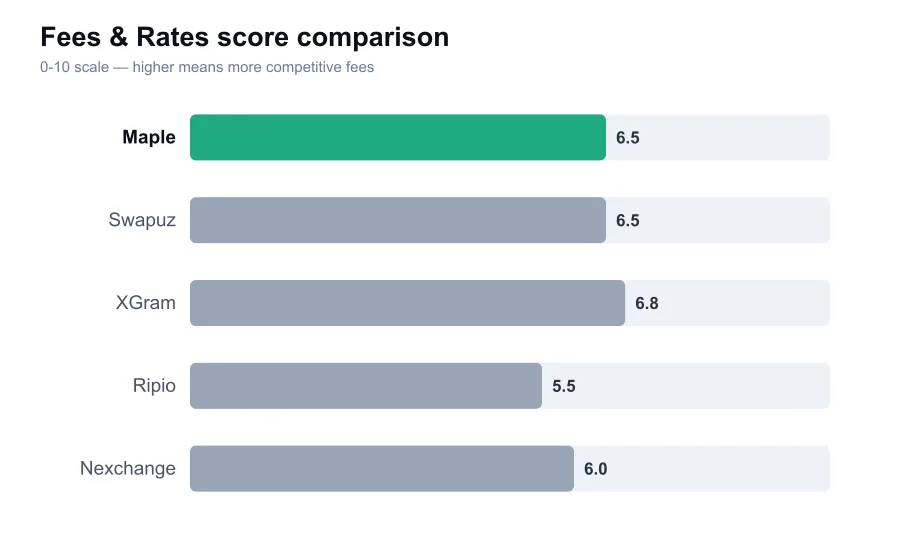
| Fees & Rates | 6.5 | Pool fees are disclosed but product-specific |
| Transaction Speed | 6.5 | Onchain settlement, redemption timing varies |
| Security & KYC Policy | 7.0 | Audited infrastructure, with credit risk remaining |
| Reputation & Track Record | 6.0 | Established protocol, marked by 2022 defaults |
| Customer Support | 6.0 | Useful documentation, no bank-style recovery |
Maple is not a conventional retail exchange, and treating it like one leads to bad decisions. It is an onchain credit marketplace built around institutional and secured lending, with its newer Syrup product opening access to selected yield opportunities for a broader DeFi audience. The project sits closer to private credit than spot trading. You are not paying a simple taker fee to buy bitcoin. You are supplying capital, accepting smart-contract and borrower risk, and expecting yield as compensation.
That distinction is Maple's strength. The protocol was designed to bring underwriting, credit pools, and transparent onchain settlement into a market that had often relied on opaque centralized lenders. Pool delegates and lenders have historically had a meaningful role in assessing borrowers and setting terms. The model can be more intelligible than handing coins to a black-box yield company, but it is still credit. A high displayed APY is never a savings-account rate.
Maple's public evolution also matters. Its first era exposed the weakness of undercollateralized crypto lending during the 2022 credit crisis. Defaults and impairment events damaged lenders and made the phrase institutional borrower far less reassuring than it had sounded in a bull market. Maple did not escape that chapter unscathed. Anyone reviewing the protocol should begin there, rather than repeating the old pitch that onchain transparency alone makes credit risk disappear.
The team subsequently shifted the product toward secured lending, more conservative pool structures, and clearer risk segmentation. That was the correct response. Maple's later offerings have placed more emphasis on collateral, borrower quality, and defined lending arrangements. The past cannot be erased, but a protocol that changes after a failure is more credible than one that pretends nothing happened. Still, the history should keep investors from treating current yield as risk-free.
Fees are less tidy than at a spot exchange because they depend on the specific product and pool. There can be management fees, performance fees, delegate economics, borrow-side costs, and token or network gas costs. Syrup users should read the live pool terms and transaction preview rather than rely on a promotional annual percentage yield. The relevant question is net return after fees, slippage where applicable, and the chance that capital is unavailable or impaired during market stress.
This is one area where Maple can confuse less experienced users. A displayed yield may be attractive, but it reflects a credit strategy with real counterparties and real default risk. Comparing it with a 0.1 percent spot trading fee at Coinbase Advanced or Kraken Pro is meaningless. Compare it instead with other onchain credit protocols, tokenized Treasury products, or the yield available on highly collateralized lending markets. The risks are different, and so are the reasons for the return.
On speed, Maple does well at what blockchain rails can do. Deposits, redemptions, and position updates settle according to the underlying network and the rules of the pool. A transaction can be confirmed in minutes, often faster on lower-cost networks than on Ethereum mainnet. But rapid onchain confirmation does not mean instant cash access. Loan terms, withdrawal windows, liquidity conditions, and redemption queues can matter far more than block time.
That liquidity distinction deserves emphasis. A lender can see a tokenized position in a wallet and still be unable to exit at the displayed value immediately. Credit is inherently less liquid than a spot asset, particularly in a stressed market. Maple is better judged by whether it makes those constraints visible than by whether it can promise instant redemption. Investors who may need funds this week should not lock them into a credit product designed around longer-duration lending.
Security is stronger than the average anonymous DeFi project because Maple has published technical material, used established onchain infrastructure, and operated long enough to face real scrutiny. Its smart contracts have been audited at various stages, but an audit is not an insurance policy. Contract upgrades, oracle dependencies, admin controls, external integrations, and borrower insolvency each create separate risks. The protocol's biggest historical lesson was that code can work as intended while the credit thesis fails.
KYC is nuanced here. Maple's institutional and permissioned lending arrangements have used borrower onboarding and compliance checks, which is appropriate for a credit protocol dealing with professional counterparties. Wallet-level access to public DeFi products has generally been more open, although geographic restrictions and interface terms can apply. Users should not confuse permissionless wallet interaction with a guarantee that every Maple-related product is available without identity checks or legal limitations.
Maple's reputation is mixed but materially more substantial than that of most DeFi yield brands. It has a recognizable history, public documentation, known founders, a governance token, and a record that includes both ambition and painful setbacks. That is not the same as a clean track record. The 2022 defaults are a major mark against the early model. Yet Maple's continuing development and move toward secured lending give it more credibility than platforms that vanished after similar failures.
Support is competent by DeFi standards, which is praise with limits. Documentation, community channels, and protocol announcements can help a user understand mechanics, but there is no bank-style phone desk that can reverse an onchain transaction. If you sign an approval to the wrong contract or send an asset to an unsupported address, support cannot simply undo it. Users need to be comfortable reading pool terms, wallet prompts, and transaction data themselves.
For the right user, Maple is interesting precisely because it does not pretend to be a frictionless trading casino. It offers a route into onchain credit with more structure than many yield farms. For the wrong user, it is a complicated way to discover that yield has a source. Beginners chasing a percentage number without understanding borrower, liquidity, and smart-contract risk should stay away.
My view is that Maple has earned cautious respect, not blind trust. The protocol's survival and redesign after a hard credit cycle count for something, and its secured-lending direction is more defensible than the loose undercollateralized lending that defined its earlier image. But this remains a specialist product. Use it only after reading the current pool documentation, sizing the position conservatively, and accepting that a fast blockchain does not make private credit liquid or guaranteed.
| Pros | Cons |
|---|---|
| Specialized onchain credit infrastructure | — |
| More conservative secured-lending direction | — |
| Public protocol history and documentation | — |
| Transparent wallet-based settlement | — |
Maple fits experienced DeFi users and credit-focused investors who can assess pool terms, collateral, and liquidity restrictions. It may also suit professionals seeking onchain private-credit exposure. It is a poor fit for newcomers, emergency cash reserves, and traders who simply want to buy or sell crypto instantly. Anyone needing guaranteed principal should look elsewhere.
Not in the usual spot-trading sense. Maple is an onchain lending and credit protocol, with products such as Syrup that provide access to lending yield.
The return compensates for borrower credit risk, smart-contract risk, liquidity constraints, and crypto-market risk. It is not a guaranteed deposit rate.
Permissioned institutional arrangements can require onboarding and compliance checks. Public wallet-based products may differ, and access can depend on jurisdiction and current terms.
| Alternative | Score |
|---|---|
| Swapuz Review | 6.5/10 |
| XGram Review | 6.6/10 |
| Ripio Review | 6.6/10 |
| Nexchange Review | 6.4/10 |
| EasyBit Review | 6.7/10 |
| Coinomi Review | 6.7/10 |