| Best for | Not for |
|---|---|
| Direct wallet based access without routine KYC | — |
| Transparent onchain borrowing mechanics | — |
| High capital efficiency for informed borrowers | — |
| Strong standing in Ethereum DeFi | — |
Live market data via CoinGecko, for informational purposes only. Not financial advice.
Editorial independence: our scores and rankings are produced using the fixed criteria above and are not influenced by advertisers. This is an independent ranking site and is not operated by, or affiliated with, any provider we list.
Affiliate disclosure: some links on this page may earn us a commission at no extra cost to you. This does not affect our rankings.
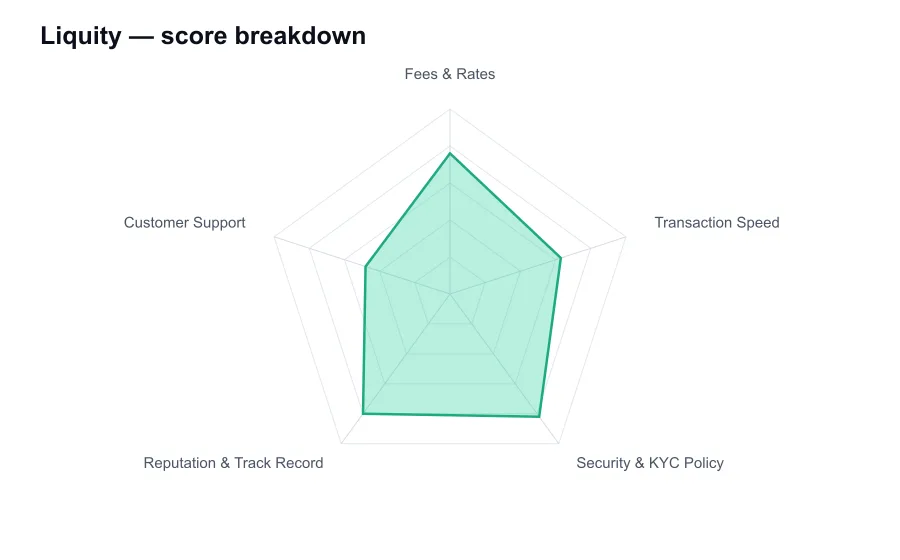
| Criterion | Score | Note |
|---|---|---|
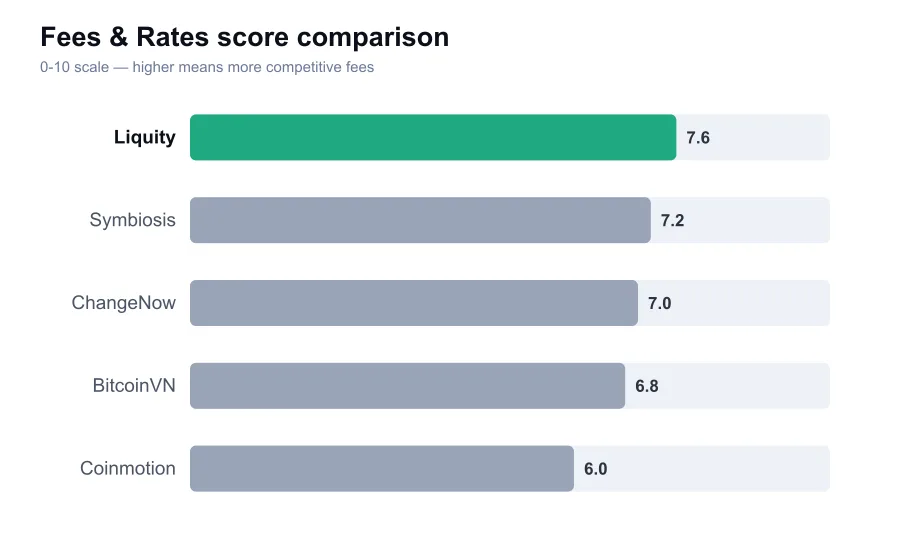
| Fees & Rates | 7.6 | Transparent protocol costs, but interest, gas, and liquidation economics matter. |
| Transaction Speed | 6.3 | Execution follows Ethereum block times and network congestion. |
| Security & KYC Policy | 8.2 | Decentralized and battle tested design, with smart contract risk remaining. |
| Reputation & Track Record | 8.0 | A respected DeFi protocol with a substantial technical track record. |
| Customer Support | 4.8 | Documentation and community help, not traditional customer support. |
Liquity is not an instant exchange in the Kingex or LetsExchange sense. It is a decentralized borrowing protocol built around overcollateralized stablecoins and Ethereum based collateral. That distinction is essential. You do not send coins to Liquity and ask it to convert them into another asset at a quote. You open a position against eligible collateral, mint a stablecoin, and retain exposure to your collateral while taking on liquidation, redemption, and smart contract risk.
The original Liquity system became well known for LUSD, a USD pegged stablecoin created by borrowing against ETH with a minimum collateral ratio of 110 percent. Rather than charging ongoing interest in the traditional lending sense, Liquity V1 used a one time borrowing fee that changed with protocol conditions, along with a liquidation reserve mechanism. It was an unusually capital efficient design, but 110 percent is not a safe target for a conservative borrower. It is merely the minimum before liquidation becomes possible.
Liquity's newer design direction, commonly described as Liquity V2, introduced BOLD and a different borrowing model that lets users set an interest rate within the protocol's framework. It also broadened collateral design to include ETH and certain liquid staking token collateral through separate markets. That is a meaningful evolution. It offers more flexibility than the original model, but it also makes the system harder to understand. Borrowers need to know which version, collateral market, and stablecoin they are actually using.
Fees are one of Liquity's strongest arguments, though calling it cheap without context would be misleading. There is no centralized exchange spread imposed by a corporate broker. Protocol costs are explicit in the borrowing mechanics, interest settings where applicable, liquidation rules, and Ethereum transaction fees. The absence of a conventional account fee is attractive. The cost of borrowing can still be substantial if you choose a high rate, repeatedly adjust a position, or transact during expensive Ethereum blockspace conditions.
The V1 borrowing fee was designed to vary based on redemption activity and the system's base rate. That could make borrowing inexpensive in quiet conditions and notably more costly after heavy redemptions. It was transparent onchain, which I prefer to a hidden retail spread, but it was not simple for newcomers. V2's user selected interest rates are easier to reason about in one sense, yet they introduce a new competitive risk: positions offering lower rates may face different redemption pressure than higher rate positions.
Anyone comparing Liquity with Aave, Spark, Maker, or a centralized lender should focus on the full economic picture. Liquity can provide high capital efficiency and avoids the account approval process of centralized credit. It does not provide a guaranteed low cost line of credit. Borrowing against volatile ETH at a thin collateral buffer is fundamentally risky, regardless of how elegant the protocol fee schedule looks. A low stated borrowing cost does not rescue a position from a fast market drawdown.
Transaction speed is determined by Ethereum and the interface used to access the contracts. Creating a position, adjusting collateral, repaying debt, redeeming stablecoins, or depositing into a stability mechanism requires an onchain transaction. During normal conditions, a few blocks may be all that is needed. During congestion, confirmation can be slow and gas can be expensive. That is very different from an exchange claiming a two minute swap, because there is no customer service desk that can manually accelerate a pending Ethereum transaction.
The protocol's liquidation mechanics are not a detail to skim past. If your collateral ratio falls below the relevant minimum, the position can be liquidated. In the original ETH market, that threshold was 110 percent, although sensible borrowers usually maintained far more collateral than that. A borrower who opens near the minimum is effectively betting that ETH will not fall sharply before they can add collateral or repay debt. Crypto markets have repeatedly shown why that is a dangerous bet.
The Stability Pool is another major component. Users can deposit the protocol stablecoin to help absorb liquidated debt and potentially earn collateral plus incentive rewards. It is not a savings account. Depositors can see their stablecoin balance reduced as liquidations are offset, receiving collateral exposure in return. The mechanics can be rewarding for users who understand them, but the risk profile is much more complex than holding cash equivalents. It should never be treated as a simple yield product.
Liquity's strongest security characteristic is that it is designed as a decentralized protocol rather than a platform holding a customer database. There is no ordinary KYC onboarding for direct contract interaction. A wallet connects to a frontend and the user signs onchain actions. That reduces identity collection and account takeover risk. It does not remove risk. Smart contract vulnerabilities, malicious frontends, wallet compromises, oracle assumptions, liquidity stress, governance changes around interfaces, and stablecoin depegs remain serious possibilities.
The protocol has earned a serious reputation in decentralized finance because its core mechanics have been extensively discussed, audited, and used through volatile market conditions. The original Liquity deployment's immutable contract philosophy was a notable differentiator. Immutability can reduce governance interference, but it also means a discovered issue may be difficult or impossible to patch at the contract level. Newer versions and collateral markets must be evaluated on their own technical and governance characteristics rather than borrowing V1's reputation automatically.
Support is where Liquity feels most unlike a retail provider. There is no traditional call center that can reverse a bad transaction, restore a seed phrase, or waive liquidation after a market move. Help is generally found through documentation, community channels, frontend operators, and developer resources. That is normal in DeFi, but it puts more responsibility on the user. If you are uncomfortable verifying a contract address or reading position health metrics, this is not an appropriate place to learn with meaningful money.
The biggest practical risk is user behavior. People see a stablecoin borrow button and mentally categorize it as cash. It is not cash. It is debt secured by volatile collateral, and the stablecoin itself can trade away from one dollar under stress or liquidity imbalance. You need a plan for ETH price declines, gas spikes, redemptions, and stablecoin liquidity before opening a position. If your plan is to react after the liquidation warning, you probably have too little buffer.
Liquity is a technically impressive protocol for experienced DeFi users, not a broad purpose exchange for beginners. Its transparent onchain mechanics and absence of mandatory KYC are real strengths. The price is responsibility. I like Liquity for borrowers who understand collateral ratios, maintain a generous safety margin, and can manage their own wallet security. For anyone seeking a simple purchase, a guaranteed dollar balance, or human support during a crisis, a regulated exchange or bank product is the better answer.
| Pros | Cons |
|---|---|
| Direct wallet based access without routine KYC | — |
| Transparent onchain borrowing mechanics | — |
| High capital efficiency for informed borrowers | — |
| Strong standing in Ethereum DeFi | — |
Liquity suits experienced DeFi users who want to borrow against ETH or eligible liquid staking collateral while retaining self custody. It can also fit users who understand stablecoin redemption, liquidation, and onchain transaction risk. Beginners should not treat it as a savings account or instant exchange. Anyone needing guaranteed support, simple fiat access, or protection from collateral volatility should look elsewhere.
No. Liquity is primarily a decentralized borrowing protocol. Users deposit eligible collateral and mint or manage protocol stablecoin debt rather than placing a conventional exchange trade.
Direct interaction through a self custody wallet generally does not involve traditional KYC. Frontends, local laws, and related services may have their own policies.
Yes. If your collateral ratio falls below the applicable minimum for your market, your position can be liquidated. Keeping collateral close to the minimum is high risk.
No stablecoin price is guaranteed. Protocol mechanisms seek to support the peg, but market liquidity, redemptions, and stress conditions can cause deviations.
| Alternative | Score |
|---|---|
| Symbiosis Review | 7.3/10 |
| ChangeNow Review | 7.2/10 |
| BitcoinVN Review | 7.2/10 |
| Coinmotion Review | 7.5/10 |
| Exolix Review | 7.5/10 |
| StealthEX Review | 7.5/10 |