| Best for | Not for |
|---|---|
| Noncustodial cross-chain swaps | — |
| No standard identity verification | — |
| Combines bridge and swap flows | — |
| Useful coverage across EVM ecosystems | — |
Live market data via CoinGecko, for informational purposes only. Not financial advice.
Editorial independence: our scores and rankings are produced using the fixed criteria above and are not influenced by advertisers. This is an independent ranking site and is not operated by, or affiliated with, any provider we list.
Affiliate disclosure: some links on this page may earn us a commission at no extra cost to you. This does not affect our rankings.
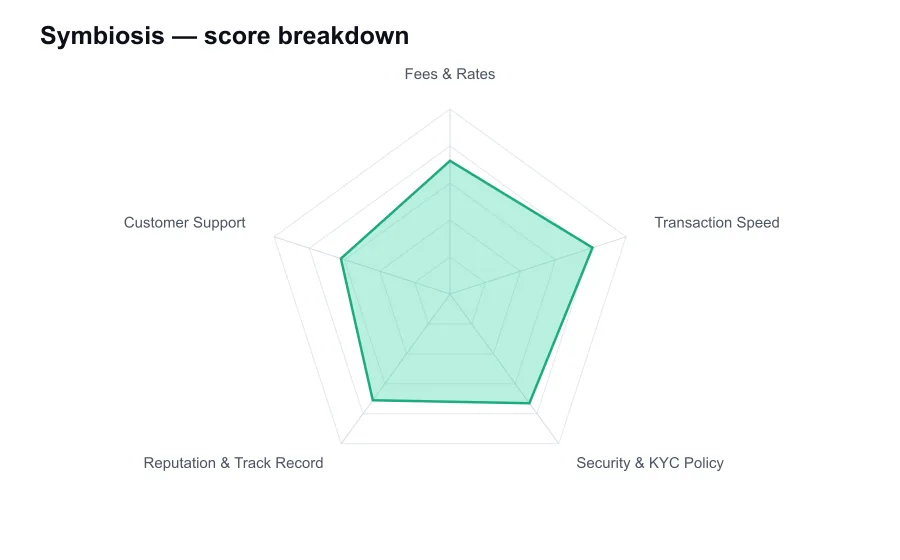
| Criterion | Score | Note |
|---|---|---|
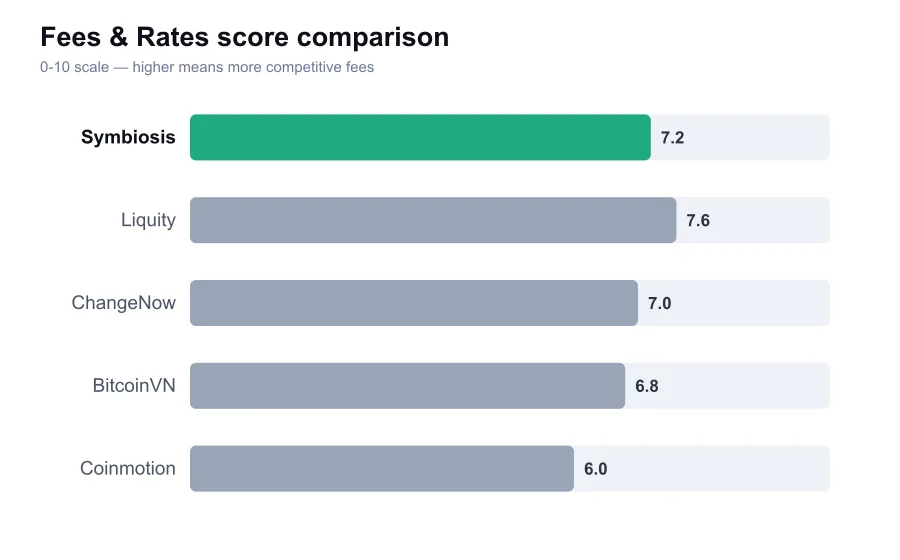
| Fees & Rates | 7.2 | Competitive routes, but gas and liquidity can raise the real cost |
| Transaction Speed | 8.1 | Many supported cross-chain routes settle in minutes |
| Security & KYC Policy | 7.3 | Noncustodial design, but smart-contract and bridge risk remain |
| Reputation & Track Record | 7.1 | Established DeFi protocol, though smaller than leading venues |
| Customer Support | 6.2 | Useful community support, not hands-on account support |
Symbiosis is a cross-chain liquidity protocol rather than a conventional centralized exchange. Its job is to move assets and execute swaps across networks without asking the user to open an account, deposit money with a company, or wait for a manual operator. That puts it closer to THORChain, Across, Stargate, and Socket than to a Coinbase-style trading venue. It is built for people already comfortable using a wallet.
The appeal is obvious if you've ever held USDC on one chain and needed it on another. Instead of separately bridging, switching networks, finding a swap route, and paying several interfaces along the way, Symbiosis attempts to turn that sequence into one transaction flow. The product is particularly useful for EVM users moving between networks such as Ethereum, Arbitrum, Polygon, BNB Chain, Optimism, Avalanche, and other supported ecosystems.
Its best feature is convenience without custody. You connect a wallet, approve the transaction, and the protocol routes the swap and cross-chain delivery. Symbiosis does not operate like a hosted exchange holding a customer balance. That removes a major class of exchange risk, but it does not remove risk altogether. You are still trusting smart contracts, bridges, liquidity pools, wallet permissions, and the destination address you enter.
Fees are not as simple as a single posted trading commission. A route can include a pool fee, a bridge or cross-chain execution cost, network gas on the source chain, and a spread caused by available liquidity. On inexpensive networks, smaller swaps can be quite competitive. On Ethereum mainnet, gas can make a modest transfer look unattractive regardless of Symbiosis's own protocol charge. The quote screen matters more than marketing language here.
For a user moving a few thousand dollars in stablecoins between lower-cost chains, Symbiosis can be cheaper and cleaner than withdrawing from a centralized exchange and redepositing elsewhere. For a tiny transfer, fixed network costs can dominate the transaction. For a large trade in an illiquid token, price impact can be the real expense. I would not treat any cross-chain aggregator as automatically cheap just because it advertises a low fee.
The interface does a reasonable job of displaying expected output before confirmation, which is essential. Still, the displayed amount is only useful if users understand the distinction between an estimated route and a rate that has been locked. Market movement, liquidity changes, gas conditions, and a failed approval can all alter the practical experience. Fixed-rate options, where offered through the route, are preferable for anyone who cannot tolerate a changing outcome.
Speed is usually good by cross-chain standards. A straightforward stablecoin route between well-supported networks often completes in minutes, not hours or days. That is the benchmark Symbiosis should meet, and in normal conditions it generally does. It is not magic, though. Finality times vary by chain, bridges can pause, relayers can be congested, and the receiving transaction may take longer than the initial wallet confirmation suggests.
Compared with manually using a canonical bridge and then a decentralized exchange, Symbiosis can save meaningful time and several clicks. Compared with a fast centralized internal transfer, it will often feel slower and more exposed to blockchain friction. The difference is that the centralized option depends on an account and a custodian, while Symbiosis depends on infrastructure that is visible on-chain but not necessarily easy for a casual user to troubleshoot.
The no-KYC model is a genuine advantage for privacy-minded users. Symbiosis does not generally ask a wallet user for passport scans or a source-of-funds questionnaire. That does not mean every interaction is anonymous in any absolute sense. Public-chain transfers remain traceable, wallet activity can be analyzed, and the protocol may use third-party infrastructure or routes with their own restrictions. No KYC should never be read as no compliance risk.
Security is the harder part of the verdict. A noncustodial architecture is preferable to leaving coins on a small centralized exchange, but smart-contract and bridge risk is substantial. Cross-chain protocols are complicated systems with many moving parts, and this sector has a long history of exploits. Symbiosis has published security information and has used external review processes, yet an audit is not an insurance policy. Users should keep allowances controlled and avoid treating it as a long-term vault.
The project's reputation is respectable within the multichain DeFi niche, but it is not in the same category of battle-tested recognition as the largest chains or the deepest decentralized trading venues. It has been around long enough to be more than an anonymous one-page swap widget, and its product has a real use case. Still, liquidity and route quality can vary sharply depending on chain and asset. That matters more than branding.
Support is functional but not luxurious. Expect self-service documentation, community channels, transaction identifiers, and waiting for a team member or moderator to investigate a stuck route. There is no bank-style phone desk that can reverse an on-chain transaction. A useful support interaction depends heavily on providing the source transaction hash, destination chain, token, wallet address, and time of the attempt.
The people who get the most from Symbiosis are experienced wallet users who value a single cross-chain transaction and can compare quotes intelligently. It is not a good first crypto purchase platform. A newcomer who cannot distinguish a token contract from a network should use a regulated exchange or a simple on-ramp first, then learn self-custody before experimenting with cross-chain tools.
My view is that Symbiosis is a capable piece of DeFi infrastructure, not a substitute for careful transaction planning. It earns points for being noncustodial, practical, and often quick. It loses points because cross-chain fees are variable, liquidity is route-dependent, and support cannot rescue a mistaken on-chain action. Use it for deliberate swaps between supported networks, check the final quote, and do a small test transfer before moving a serious amount.
| Pros | Cons |
|---|---|
| Noncustodial cross-chain swaps | — |
| No standard identity verification | — |
| Combines bridge and swap flows | — |
| Useful coverage across EVM ecosystems | — |
Symbiosis fits self-custody users moving stablecoins or major assets between supported chains. It is particularly useful for DeFi participants who can compare quotes and understand wallet approvals. Beginners buying their first crypto, users needing fiat withdrawals, and anyone seeking phone support should look to a regulated exchange instead. Large transfers deserve a test transaction first.
A standard wallet swap does not normally require account registration or identity verification. Blockchain activity remains public, and third-party route or network restrictions can still apply.
Many normal routes complete within minutes. Timing depends on source-chain confirmations, destination-chain conditions, bridge infrastructure, and the asset being moved.
The final economics can be affected by liquidity, price movement, route availability, gas, and whether the selected route offers a locked rate or an estimated rate.
| Alternative | Score |
|---|---|
| Liquity Review | 7.3/10 |
| ChangeNow Review | 7.2/10 |
| BitcoinVN Review | 7.2/10 |
| Coinmotion Review | 7.5/10 |
| Exolix Review | 7.5/10 |
| StealthEX Review | 7.5/10 |