| Best for | Not for |
|---|---|
| Potentially convenient for local payments | — |
| May offer personal service | — |
| Could suit small urgent purchases | — |
| — | Not suitable for holding balances |
Live market data via CoinGecko, for informational purposes only. Not financial advice.
Editorial independence: our scores and rankings are produced using the fixed criteria above and are not influenced by advertisers. This is an independent ranking site and is not operated by, or affiliated with, any provider we list.
Affiliate disclosure: some links on this page may earn us a commission at no extra cost to you. This does not affect our rankings.
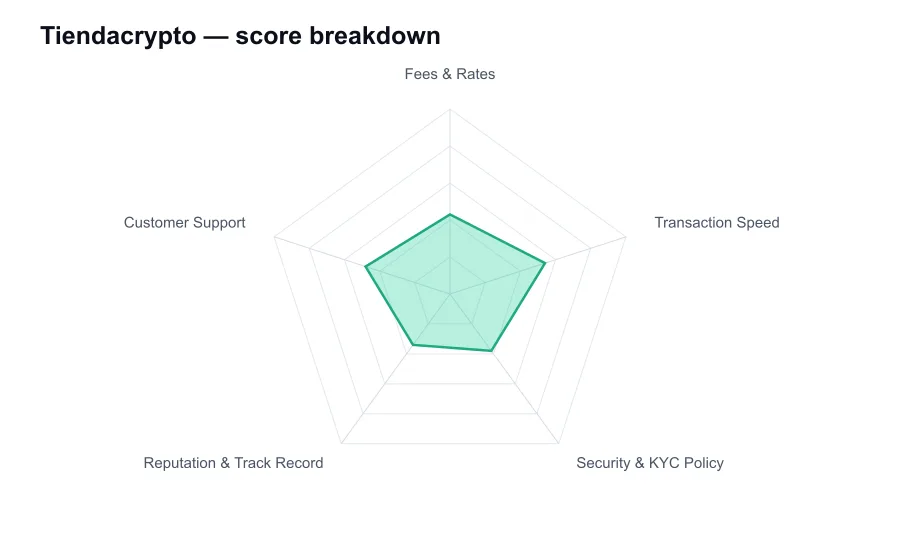
| Criterion | Score | Note |
|---|---|---|
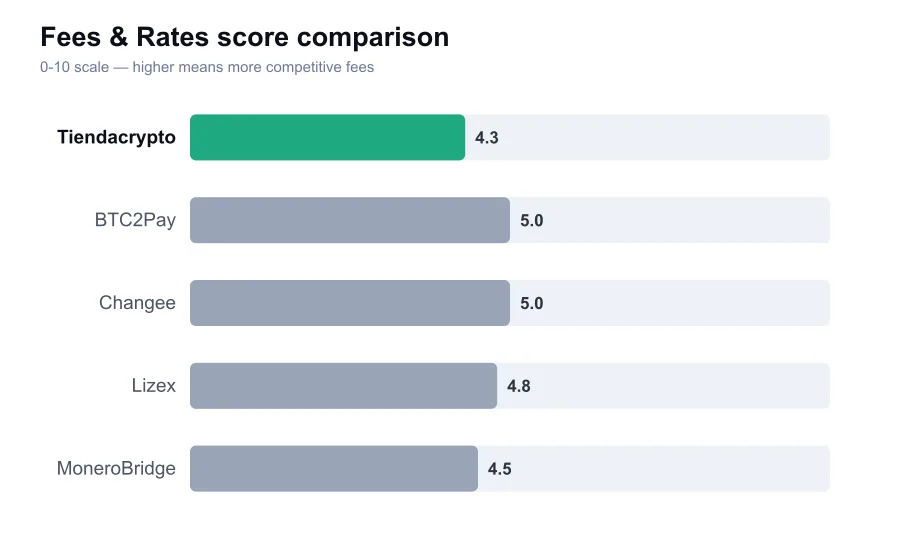
| Fees & Rates | 4.3 | All-in spreads and charges are not clearly documented publicly |
| Transaction Speed | 5.4 | Local settlement may be quick, but service levels are unclear |
| Security & KYC Policy | 3.8 | Limited public detail on custody, controls, and KYC handling |
| Reputation & Track Record | 3.4 | Thin independently verifiable public track record |
| Customer Support | 4.8 | Direct contact may exist, but escalation transparency is weak |
Tiendacrypto appears to operate in the broad category of local crypto buying and selling services, where accessibility and payment convenience matter more than advanced trading infrastructure. That is a very different market from global exchanges with deep order books. Services in this category can be useful for obtaining stablecoins or converting local currency, but they need much stronger disclosure than a slick purchase page to earn trust.
The first problem is verification. Tiendacrypto does not have the same public footprint, regulatory visibility, independent research coverage, or long operating record available for large names such as Bitso, Ripio, Coinbase, Kraken, or Binance. That does not prove wrongdoing. It does mean a careful buyer should refuse to fill the information gap with optimism. A provider handling money should be easy to identify, contact, and independently verify.
Before sending funds, I would want to see a clearly named legal entity, jurisdiction, current contact details, terms of service, privacy policy, complaint process, and transparent explanation of how client assets are handled. A social media account and a chat number are not enough. Local exchange businesses sometimes rely heavily on personal service, but that becomes a weakness if the transaction goes wrong and there is no documented escalation path.
Fee transparency is the central issue. Small local brokers often advertise a convenient purchase rate while embedding their compensation inside the quote. That can be acceptable if the final amount is clearly shown, but it makes comparison harder than on an exchange that lists maker and taker fees. A customer should compare the quoted buy price and sell price against a liquid market reference at the same moment, not just ask whether a service fee is listed.
The spread matters more than a headline fee. If USDT is offered at a price that is several percentage points above a well-known local market, convenience may be expensive. If the provider charges bank transfer fees, cash handling fees, withdrawal costs, or a different rate for urgent settlement, those need to be visible before payment. I could not find enough consistently documented public fee information to call Tiendacrypto a pricing leader.
Speed may be the service's practical attraction. A locally focused broker can sometimes confirm a domestic payment and deliver crypto faster than opening and verifying an account at a large exchange. But speed depends on staff availability, banking hours, payment rail delays, risk checks, and whether the requested asset is actually held in inventory. Promises of instant delivery should be treated as a service target, not a guarantee.
A customer should ask a direct question before paying: will the crypto be sent immediately after payment confirmation, and what is the written maximum settlement time? Ask for the transaction hash once it has been broadcast. If the answer is vague, or if the seller asks for additional payments after receiving funds, stop. Legitimate providers may perform checks, but they should state their process before taking the initial payment.
KYC policy needs more clarity than many small services provide. If Tiendacrypto accepts bank transfers, it may need identifying information for compliance or fraud prevention, even if its public messaging emphasizes convenience. That is not inherently negative. What matters is whether customers know what documents can be requested, how personal data is stored, and whether a transaction can be delayed or rejected after payment because of an unstated review.
Security is not only about passwords and encryption. With a broker, the important question is custody between payment and delivery. Does the service pre-fund orders, use a corporate wallet, rely on third parties, or handle customer assets in a pooled manner? Without transparent answers, users should assume they are taking counterparty risk. Do not leave coins with a small broker after the purchase. Withdraw to a wallet you control as soon as the transaction is complete.
The lack of a well-established public reputation is a material drawback. Large exchanges have their own flaws, including freezes, support complaints, and compliance friction, but they can usually be assessed through regulators, long-running user communities, public incident reporting, and substantial third-party coverage. With Tiendacrypto, the evidence base appears thinner. That lowers the amount I would be comfortable transacting until stronger proof of reliability is available.
Customer support could be responsive on a personal level, especially if the business is locally run. That can be better than being ticket number 400,000 at a global platform. Yet personal responsiveness is not the same as reliable support. The real test is whether there is a documented resolution process, a business address, an email trail, and someone accountable when a transfer is delayed or a payment reconciliation fails.
I would also be cautious about impersonation. Generic crypto business names are easy to copy across messaging apps, social platforms, and search ads. Confirm addresses and payment instructions through more than one official channel. Never send funds to a personal account merely because a chat agent says it is temporarily required. A reputable provider should be able to explain exactly why an account is used and provide matching business documentation.
Tiendacrypto may be useful for a small, time-sensitive local purchase if a customer has independently verified the business and has checked the all-in quote. That is a narrower recommendation than I would make for a mature exchange. It should not be the place for a first large crypto purchase, a long-term balance, or a transfer funded by money you cannot afford to have tied up during a dispute.
My take is blunt: the potential convenience does not compensate for weak public transparency. Tiendacrypto needs clearer fees, stronger legal and operational disclosure, and more independently visible track record before it can compete credibly with established regional exchanges. Use a small test order if you choose to use it at all. For meaningful amounts, I would choose a better-documented platform with published pricing and a verifiable support structure.
| Pros | Cons |
|---|---|
| Potentially convenient for local payments | — |
| May offer personal service | — |
| Could suit small urgent purchases | — |
| — | Not suitable for holding balances |
Tiendacrypto is only a tentative fit for experienced local buyers making a small, independently verified test purchase. It may appeal to people who prioritize a local payment method over exchange features. First-time buyers, institutions, high-value traders, and users who need clear compliance documentation should choose an established regulated exchange. Do not treat it as a wallet or savings platform.
Publicly verifiable fee detail appears limited. Compare the final buy or sell quote against a live market reference and ask about withdrawal, transfer, and settlement charges before paying.
No. With limited public information about custody arrangements, it is safer to withdraw purchased assets promptly to a wallet you control.
Verify the legal business identity, confirm payment details through official channels, obtain settlement terms in writing, and begin with a small amount you can afford to lose.
| Alternative | Score |
|---|---|
| BTC2Pay Review | 4.4/10 |
| Changee Review | 4.5/10 |
| Lizex Review | 4.5/10 |
| MoneroBridge Review | 4.1/10 |
| Allswap Review | 4.6/10 |
| 1Mile Review | 4.0/10 |