| Best for | Not for |
|---|---|
| Potentially simple conversion interface | — |
| May suit a small test transaction | — |
| Less complex than pro trading platforms | — |
| — | Not appropriate for long-term custody |
Live market data via CoinGecko, for informational purposes only. Not financial advice.
Editorial independence: our scores and rankings are produced using the fixed criteria above and are not influenced by advertisers. This is an independent ranking site and is not operated by, or affiliated with, any provider we list.
Affiliate disclosure: some links on this page may earn us a commission at no extra cost to you. This does not affect our rankings.
| Criterion | Score | Note |
|---|---|---|
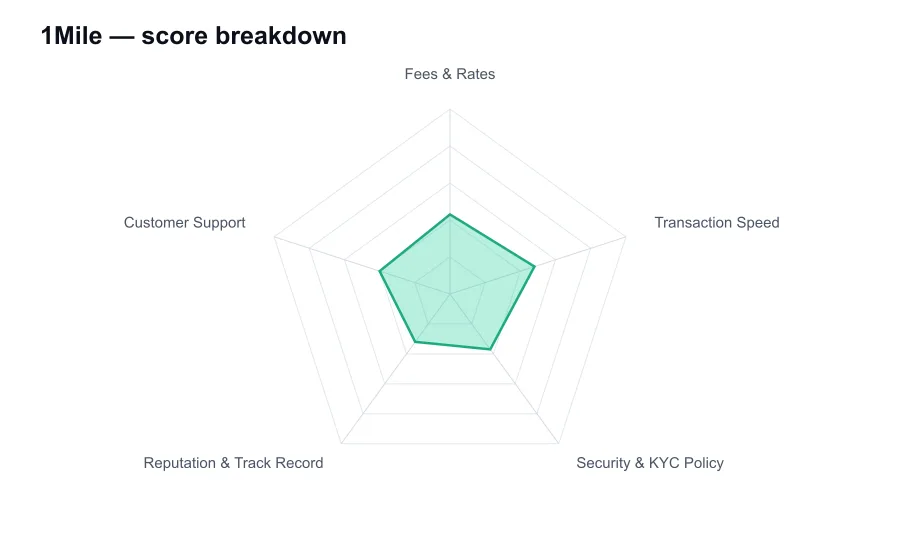
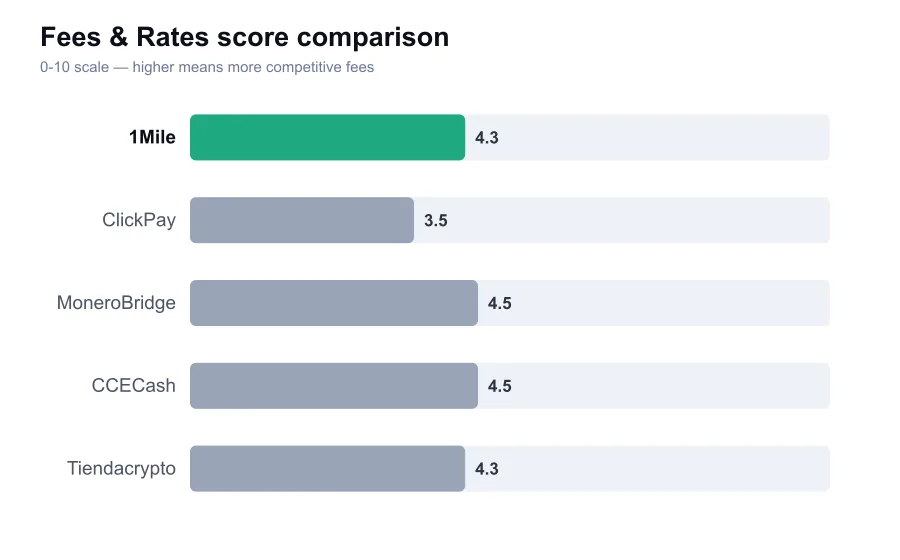
| Fees & Rates | 4.3 | Fee transparency needs close quote-by-quote checking. |
| Transaction Speed | 4.8 | External withdrawal timing needs a small live test. |
| Security & KYC Policy | 3.7 | Limited public evidence for institutional-grade safeguards. |
| Reputation & Track Record | 3.2 | Thin independently verifiable public track record. |
| Customer Support | 4.0 | Test responsiveness before sending funds. |
1Mile is a far less established name than the large exchanges or headline DeFi protocols, and that fact shapes this review more than any promotional claim could. Services using the 1Mile name are presented as cryptocurrency exchange or conversion products, but their public profile is thin compared with firms that have years of audited reporting, clear licensing disclosures, and extensive independent coverage. In a market full of lookalike brands, obscurity is a risk factor, not a charming underdog trait.
A user should first establish the exact website and legal operator before creating an account or transferring assets. Similar names are common in crypto, and search results can surface affiliate pages, cloned interfaces, old domains, and social media profiles with no verified connection to the operating business. A polished landing page does not prove ownership, reserves, regulation, or technical competence. It proves only that somebody paid for a landing page.
The basic pitch of a smaller exchange is usually convenience. It may offer a quick buy, sell, or swap flow, a limited asset menu, and fewer screens than a professional trading venue. That can be pleasant for someone making a small purchase. The problem is that simplicity does not erase the underlying requirements: reliable liquidity, secure custody, transparent pricing, coherent compliance controls, and support capable of handling an incident. Those are expensive things to build and demonstrate.
Fee claims from lightly documented providers deserve particular skepticism. A platform can advertise low or even zero trading fees while recovering its margin through a wide spread, withdrawal charge, poor conversion rate, or minimum-size rule. The only relevant comparison is the amount you receive after every charge. Check a live quote against a liquid market on Kraken, Coinbase Advanced, Binance where available, or a reputable DEX route for the same network and token.
Do not assume a card purchase is cheap because the displayed exchange rate looks close to the market price. Card processors, payment providers, and the platform can all add costs. The same applies to withdrawals. A service may charge a flat withdrawal fee that is modest for a large transfer but punishing for a small one. If the fee schedule is incomplete, hard to locate, or written in vague language, that is a reason to stop before funding an account.
Speed is another area where marketing often gets ahead of reality. Internal ledger transfers can appear immediate because no blockchain transaction has occurred. A real external withdrawal depends on the provider's approval queue, wallet operations, blockchain congestion, and any risk controls. New accounts, card payments, unusual IP addresses, and larger withdrawals commonly receive extra review. A promise of instant settlement should be read as a best-case scenario, not a contractual guarantee.
For a small provider, a test withdrawal is essential. Deposit a modest amount, trade or convert it if necessary, and send it to a wallet you control. Time the full process, including any verification request. This does not prove that a later large withdrawal will be equally smooth, but it can reveal the most obvious operational problems before you commit serious funds. It is a far better due-diligence step than trusting a banner that says fast payouts.
Security claims need similarly concrete evidence. I would look for a named legal entity, company registration details, a clearly stated jurisdiction, terms that identify the contracting party, a public security policy, supported two-factor authentication, withdrawal controls, and credible information about custody. If those basics are unavailable or contradictory, a user cannot meaningfully assess the platform. Vague references to bank-grade encryption are not a substitute for operational transparency.
KYC policy is not merely a privacy question. It tells you whether the provider has an intelligible compliance process or is improvising after deposits arrive. A platform might allow registration with minimal information but require identity documents before a withdrawal, especially if transaction monitoring flags activity. That can be legitimate, but it must be explained before money is sent. Sudden verification demands coupled with unclear timelines are where many disputes begin.
There is also a security tradeoff in no-KYC or low-KYC promises. They appeal to users who dislike handing over documents, yet the absence of a robust onboarding process can make a provider more exposed to fraud, payment reversals, and abrupt account restrictions. Reputable exchanges can be annoying precisely because their processes are more formalized. For fiat on-ramps and larger transfers, I would choose predictable compliance over a vague promise of frictionless access.
1Mile does not have the established public track record that would justify depositing funds on trust alone. I could not place it in the same reputation tier as Coinbase, Bitstamp, Kraken, or even well-known instant services with a substantial and independently observable transaction history. That is not an accusation of wrongdoing. It is a practical assessment of evidence. Reputation is accumulated through time, public accountability, and how a company behaves when something goes wrong.
Independent reviews must be read critically as well. A handful of five-star comments with nearly identical language says little. More useful evidence includes dated reports that describe successful withdrawals, support responses to specific problems, disclosure of fees, and a consistent history across independent venues. Complaints also need context, because users often blame a platform for blockchain delays or their own address errors. Patterns matter more than isolated praise or anger.
Support is where thinly documented providers tend to be exposed. Before depositing, ask a specific pre-sales question about a supported network, withdrawal fee, or verification process. The content and quality of the reply are informative. An agent who answers clearly, without pushing you to deposit first, is a better sign than a generic scripted response. Never accept support through an unsolicited direct message, and never share recovery phrases with anyone.
My opinion is deliberately conservative. 1Mile may be usable for a tiny, fully tested transaction if the exact operator, rate, and withdrawal process are independently verified. But there is not enough public assurance to recommend it as a main exchange, long-term custodian, or fiat gateway for serious money. Crypto gives users many choices. There is no compelling reason to accept extra opacity unless the service delivers a clearly demonstrable advantage that established alternatives cannot match.
| Pros | Cons |
|---|---|
| Potentially simple conversion interface | — |
| May suit a small test transaction | — |
| Less complex than pro trading platforms | — |
| — | Not appropriate for long-term custody |
1Mile is only suitable for highly cautious users prepared to verify the exact operator and test the full deposit and withdrawal route with a small amount. It is not a sensible first exchange for beginners. Investors holding meaningful balances, businesses, and users who need dependable fiat rails should use an established regulated venue or self-custody after purchase. If you cannot independently confirm the basics, skip it.
I would not treat a thinly documented provider as suitable for large deposits. Verify the legal operator, security controls, and withdrawal process, then keep custody exposure minimal.
Compare the final amount received, including spread, network costs, card charges, and withdrawal fees, with the same transaction on established alternatives.
Yes. If identity verification is available or may be required for withdrawals, complete it first and keep records of the stated limits and processing rules.
| Alternative | Score |
|---|---|
| ClickPay Review | 4.0/10 |
| MoneroBridge Review | 4.1/10 |
| CCECash Review | 3.8/10 |
| Tiendacrypto Review | 4.3/10 |
| 1WM Review | 3.7/10 |
| BtcChange24 Review | 3.6/10 |
