| Best for | Not for |
|---|---|
| May support regional merchant payment methods | — |
| Card checkout flows can be convenient | — |
| Potentially useful for business payment acceptance | — |
| — | Settlement and review terms depend on the agreement |
Live market data via CoinGecko, for informational purposes only. Not financial advice.
Editorial independence: our scores and rankings are produced using the fixed criteria above and are not influenced by advertisers. This is an independent ranking site and is not operated by, or affiliated with, any provider we list.
Affiliate disclosure: some links on this page may earn us a commission at no extra cost to you. This does not affect our rankings.
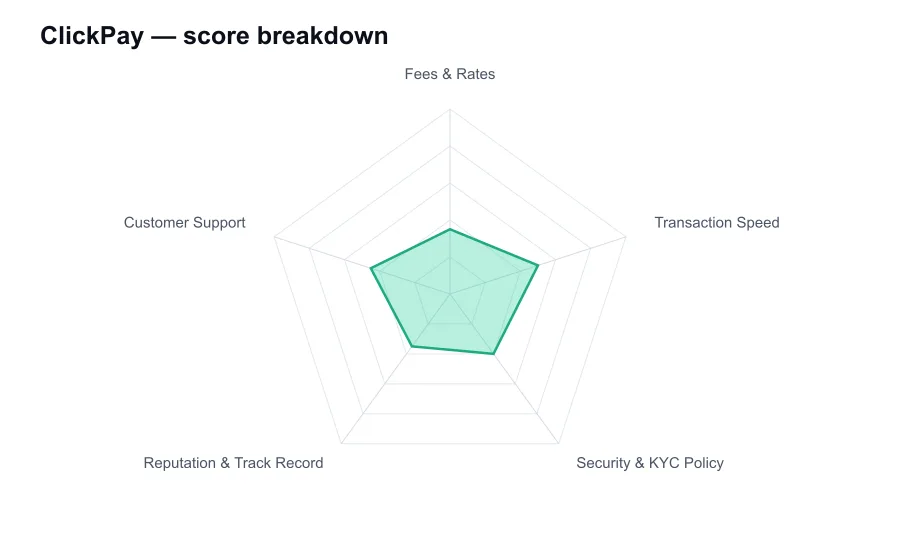
| Criterion | Score | Note |
|---|---|---|
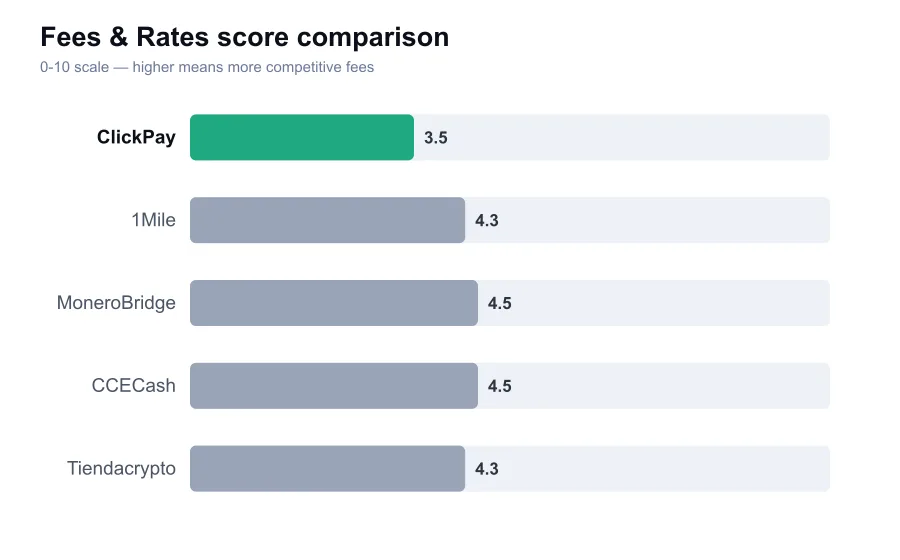
| Fees & Rates | 3.5 | No universal public retail crypto fee schedule found |
| Transaction Speed | 5.0 | Card approval can be fast, settlement depends on contract |
| Security & KYC Policy | 4.0 | Entity and crypto-specific policy need verification |
| Reputation & Track Record | 3.5 | Brand is ambiguous and lacks a clear exchange record |
| Customer Support | 4.5 | Appears more merchant-focused than retail-focused |
ClickPay is a difficult name to assess as a crypto provider because it is used by several unrelated payment businesses in different markets. The most visible ClickPay brands are conventional online-payment gateways rather than consumer cryptocurrency exchanges. That distinction matters. A reader searching for a place to swap Bitcoin, hold stablecoins, or cash out to a bank account should not assume that a company called ClickPay offers those functions simply because it processes online payments.
This review treats ClickPay cautiously because I could not establish a single, globally identifiable crypto exchange operation under that exact name with a transparent public fee schedule, a clearly documented custody model, and a long independent trading record. That is not a small administrative gap. Those are the basics a buyer needs before sending a payment provider money, crypto, or identity documents.
Where ClickPay operates as a merchant-payment gateway, its product can be useful in a narrow sense. It gives businesses a checkout layer, payment links, card acceptance, and in some regional versions support for local payment methods. That puts it closer to providers such as PayTabs, HyperPay, Checkout.com, or Stripe than to Binance, Kraken, Coinbase, or a fixed-rate crypto swap service.
The fee picture is the first major problem for a prospective crypto user. Publicly available ClickPay information is generally oriented around merchants, bespoke acquiring agreements, and sales-led pricing. I could not verify a universal retail crypto fee such as a maker and taker schedule, a published conversion spread, or a standard blockchain withdrawal charge. If a platform cannot show those numbers before onboarding, users cannot compare its real cost against established alternatives.
A merchant may reasonably receive a custom card-processing rate based on country, sales volume, business category, chargeback history, and settlement currency. That is normal in payments. It is not a good substitute for transparent exchange pricing. If ClickPay is being offered to you as a crypto purchase route through an intermediary, ask for the final fiat amount, the quoted asset amount, the exchange rate source, all processing charges, and any refund deduction in writing.
Speed should also be viewed through the payment-gateway lens. Card authorizations can be near-instant, but an authorized card payment is not the same thing as settled funds. Merchant settlement can depend on banking rails, weekends, reserve terms, fraud review, and the acquiring bank. A crypto transaction, if one is involved through a partner, adds another layer: the payment approval, the provider's release process, and the destination blockchain confirmation.
That means ClickPay cannot honestly be ranked alongside instant self-custody swap services without knowing the exact integration behind the checkout screen. A payment may look complete in seconds while the merchant waits days for settlement. Conversely, a blockchain transfer can be broadcast quickly but remain reversible only in the payment dispute sense if it was funded by card. That operational complexity is precisely why plain language and precise timelines matter.
Security documentation is another area where I would demand more than a logo strip and a generic promise of safe payments. A serious payment processor should identify its legal entity, relevant payment licenses, PCI DSS responsibility, fraud-monitoring practices, data-retention policy, dispute route, and customer-contact method. Those controls are more meaningful than marketing language about encryption, which nearly every payment site uses.
KYC is likely to arise in any legitimate payment flow, particularly for merchants and larger or suspicious transactions. The issue is not that verification exists. It should exist in regulated payments. The issue is whether ClickPay tells applicants what documents it needs, why it needs them, who makes a review decision, and how long a held payment can remain under review. I could not verify a single public, crypto-specific KYC policy that answers those points across the ClickPay name.
Reputation is therefore mixed rather than plainly bad or plainly strong. Payment gateways can be solid businesses while still having sparse consumer-facing feedback, because their real clients are merchants. But that business-to-business context does not automatically create a retail crypto track record. There is no clearly established ClickPay equivalent of Kraken's long operational history, Coinbase's public-company disclosure, or Bitstamp's multi-year exchange record that I can confidently attribute to this name.
Support appears to be geared toward merchant onboarding and transaction troubleshooting, not toward the anxious retail customer who has sent crypto to the wrong chain or wants an immediate swap status update. Sales contact forms and business support channels may work well for a store owner. They are less reassuring for someone trying to resolve a time-sensitive payment hold. Before relying on ClickPay, test the support route with a specific pre-sales question and see whether the answer is concrete.
I would be particularly wary of third-party websites, social accounts, or WhatsApp representatives using the ClickPay name to sell crypto services. Brand ambiguity is useful to impersonators because people see a familiar-sounding payments label and lower their guard. Verify the exact domain, legal company name, beneficiary details, and contractual terms independently. Never send a test payment that is larger than you can afford to have delayed while those checks are completed.
There is a legitimate case for a merchant choosing a regional ClickPay implementation if its bank, country, and customer payment methods are supported and the commercial agreement is clear. The merchant should still compare settlement timing, chargeback tooling, reserve requirements, and local support against established regional processors. For a private investor seeking exchange services, this is not enough information to recommend it as a primary venue.
My view is simple. ClickPay may be a workable payment-infrastructure name in the specific markets where its verified corporate operator is licensed and contracted, but it is not a transparently documented retail crypto exchange on the evidence available. The missing public information affects fees, speed expectations, custody, and redress. Until the exact ClickPay entity can show clear crypto terms and an independently verifiable operating record, better-known exchanges and payment providers are the safer choice.
| Pros | Cons |
|---|---|
| May support regional merchant payment methods | — |
| Card checkout flows can be convenient | — |
| Potentially useful for business payment acceptance | — |
| — | Settlement and review terms depend on the agreement |
ClickPay may suit a merchant evaluating a verified local payment-gateway entity with a written acquiring agreement. It does not suit a retail trader looking for a transparent spot exchange, self-custody withdrawals, or published swap pricing. Businesses should compare its exact regional contract with PayTabs, HyperPay, Stripe, and local acquirers. Crypto users should choose a clearly identifiable regulated exchange instead.
I could not verify a single, clearly documented global crypto exchange operated under the ClickPay name. Most visible uses of the name relate to merchant payment processing.
Pricing appears to depend on the specific ClickPay entity and merchant agreement. I could not verify a standard public retail crypto trading or withdrawal fee schedule.
Card authorization may be immediate, but merchant settlement and any crypto release can take longer due to bank processing, fraud checks, contract terms, and blockchain confirmations.
| Alternative | Score |
|---|---|
| 1Mile Review | 4.0/10 |
| MoneroBridge Review | 4.1/10 |
| CCECash Review | 3.8/10 |
| Tiendacrypto Review | 4.3/10 |
| 1WM Review | 3.7/10 |
| BtcChange24 Review | 3.6/10 |