| Best for | Not for |
|---|---|
| Straightforward swap-oriented model | — |
| Can suit a small mainstream-pair test | — |
| Avoids a complex trading interface | — |
| — | Poor fit for complex token or network transfers |
Live market data via CoinGecko, for informational purposes only. Not financial advice.
Editorial independence: our scores and rankings are produced using the fixed criteria above and are not influenced by advertisers. This is an independent ranking site and is not operated by, or affiliated with, any provider we list.
Affiliate disclosure: some links on this page may earn us a commission at no extra cost to you. This does not affect our rankings.
| Criterion | Score | Note |
|---|---|---|
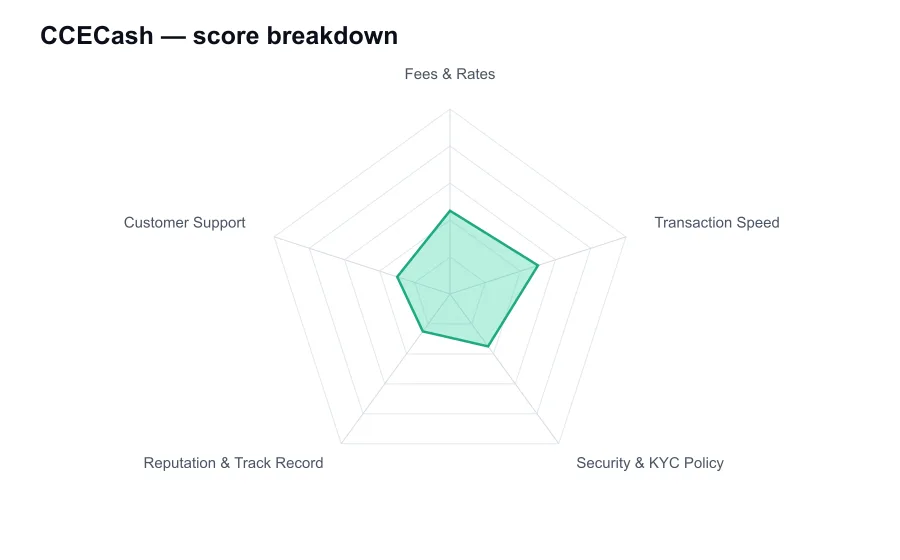
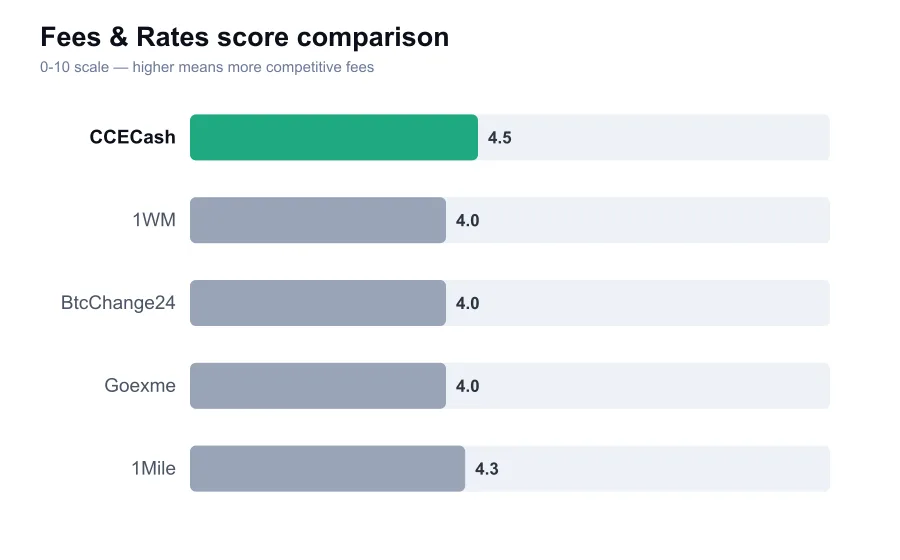
| Fees & Rates | 4.5 | Final quotes must be compared because detailed pricing methodology is not clear. |
| Transaction Speed | 5.0 | Common routes may process normally, but public consistency data is limited. |
| Security & KYC Policy | 3.5 | Short-term custody risk remains and policy disclosure is limited. |
| Reputation & Track Record | 2.5 | Insufficient long-term independent evidence for a higher trust score. |
| Customer Support | 3.0 | No robust public record of response times or complex-case resolution. |
CCECash is another small crypto conversion brand operating in a market crowded with instant exchangers, wallet swaps, and large centralized platforms. Its appeal is obvious enough. A user who wants a quick asset conversion may prefer a narrow service over a full exchange account, order book, and identity process. But CCECash does not carry the name recognition or independently visible operating record that would let a reviewer treat that convenience as low risk.
The right frame for CCECash is not whether it can generate a swap quote. That is the easy part of the business. The harder test is whether a customer can understand the price, trust the deposit route, get help during an exception, and recover funds if an order cannot be completed. The public information I could independently substantiate does not answer those questions as fully as it should.
Compared with a platform such as Coinbase or Kraken, CCECash is not built for recurring trading, audited public-company disclosure, extensive market data, or local payment methods. Compared with a mature swap service, it also has a much thinner visible pool of third-party discussion. That leaves users with a familiar crypto tradeoff, fewer steps in exchange for fewer safeguards. I don't think that trade is attractive for large transfers.
Pricing deserves close attention because the real charge on a conversion site is often hidden in the exchange rate. I could not verify a comprehensive public list of CCECash platform fees by asset, nor a durable explanation of whether quotes are fixed or floating across routes. The displayed receive amount is therefore the only figure that matters. If a site advertises low fees but gives a weak payout, it is still expensive.
A good discipline is to run the exact same proposed exchange through CCECash and two established alternatives. Check the send amount, destination network, expected receive amount, minimum, and expiry time. Do not compare only the number of coins shown in isolation. For stablecoins, the network can make an enormous difference. For BTC and ETH, fluctuating miner fees and price movement can turn a seemingly minor spread into a substantial cost.
CCECash may be acceptable on price for some routes, but I would not award it a strong fees score without transparent published methodology or broad, reproducible quote comparisons. There is no reason for a customer to guess. A provider that wants trust should state whether it adds a markup, how it treats refunds, and who absorbs price movement on a fixed quote. Those details are not optional fine print in a service handling irreversible transfers.
Transaction speed is similarly conditional. The first delay is the originating blockchain, then the provider's internal processing or liquidity partner, then the destination network. A fast chain does not guarantee a fast completed order. If a route is automated and liquid, a common pair can arrive soon after confirmation. If an order needs review or a partner lacks inventory, the customer can be left looking at an order page with very little leverage.
I would be particularly cautious with exotic tokens, cross-chain stablecoins, and transactions that require a memo or tag. These are the areas where a small service's documentation and support are tested. Sending USDT on the wrong network, omitting a destination tag, or depositing below the minimum can become a recovery problem rather than a routine swap. CCECash should not be used until the user is certain of the chain and address format.
There is no reliable security shortcut. A service may call itself noncustodial because it does not maintain user balances, yet the customer still sends coins into an address controlled for order fulfillment. That short exposure period is enough to create counterparty risk. I would verify the domain manually, use a fresh wallet address for the payout, avoid public Wi-Fi, and preserve the quote and transaction hash. Those steps are basic, but they matter most with lesser-known operators.
The KYC issue is also more complicated than many users expect. An exchange can have no mandatory sign-up for normal transactions and still demand verification for an order flagged by its controls or by a liquidity source. CCECash users should assume this possibility unless the live policy states otherwise. Anyone who cannot risk a hold due to documentation requirements should choose a provider with an explicit compliance process before they deposit.
CCECash's reputation is its largest weakness. I could not establish the level of independent, long-term customer reporting that supports confidence in a financial service. There is a meaningful difference between no obvious scandal and a positive record of resolving difficult cases. The former is merely absence of evidence. The latter is earned through years of public operation, detailed responses, and verifiable user experience.
Support gets a cautious score for the same reason. A contact address or chat button is not proof that a case will be answered quickly or competently. What matters is whether staff can trace an order, explain a delay, deal with a refund, and communicate in plain language. I found insufficient public evidence to make that claim for CCECash. Before using it, ask support a specific pre-sale question and judge both speed and substance of the reply.
For anyone determined to try CCECash, the sensible approach is deliberately boring. Use a minor amount, select a mainstream asset pair, send the exact amount, and wait until the order is complete before trying another. Do not split a large holding into several concurrent orders in the hope of speeding up delivery. That only multiplies the number of things that can go wrong and makes support reconciliation harder.
My view is that CCECash is a speculative convenience option, not a dependable exchange relationship. It might complete a modest, simple swap without trouble, but the lack of transparent fee detail and a strong independently observable track record prevents a positive recommendation. Users who value privacy should understand that accountless does not necessarily mean review-free. Users who value certainty should use a provider that has earned it publicly.
| Pros | Cons |
|---|---|
| Straightforward swap-oriented model | — |
| Can suit a small mainstream-pair test | — |
| Avoids a complex trading interface | — |
| — | Poor fit for complex token or network transfers |
CCECash may suit advanced wallet users testing a small, non-urgent conversion between common assets. It is not suitable for newcomers, large portfolio moves, business payments, or users who need predictable compliance handling. Those users should favor a regulated exchange or an instant-swap brand with a longer public record.
The important figure is the final receive amount shown in the quote. I could not verify a detailed public fee table, so compare that quote with alternatives before sending.
Timing depends on the deposit chain, confirmations, available liquidity, and the payout network. A simple route may be quick, but there is limited independent evidence of consistent performance.
Users should assume a compliance or risk review is possible unless the current policy clearly says otherwise. Do not send urgent funds if a hold would create a problem.
| Alternative | Score |
|---|---|
| 1WM Review | 3.7/10 |
| BtcChange24 Review | 3.6/10 |
| Goexme Review | 3.6/10 |
| 1Mile Review | 4.0/10 |
| ClickPay Review | 4.0/10 |
| MoneroBridge Review | 4.1/10 |
