| Best for | Not for |
|---|---|
| May offer a straightforward transaction flow | — |
| Can be tested with a small amount | — |
| Potential option for a specific supported route | — |
| — | Not fit for significant custodial balances |
Live market data via CoinGecko, for informational purposes only. Not financial advice.
Editorial independence: our scores and rankings are produced using the fixed criteria above and are not influenced by advertisers. This is an independent ranking site and is not operated by, or affiliated with, any provider we list.
Affiliate disclosure: some links on this page may earn us a commission at no extra cost to you. This does not affect our rankings.
| Criterion | Score | Note |
|---|---|---|
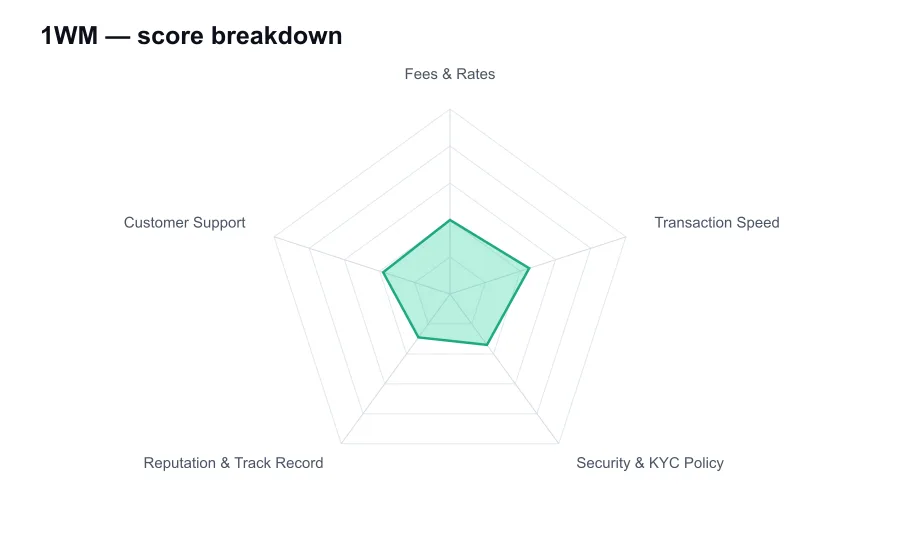
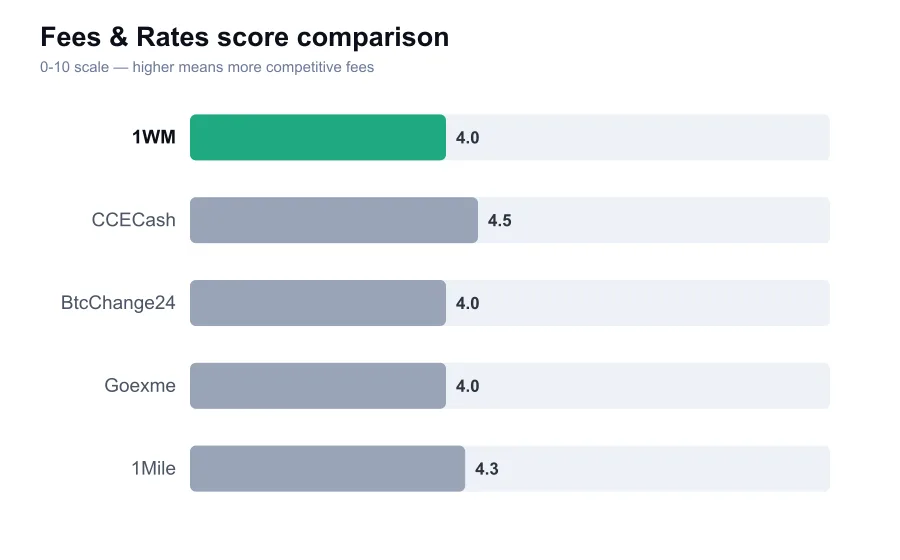
| Fees & Rates | 4.0 | True cost must be checked through final received amount. |
| Transaction Speed | 4.5 | Withdrawal handling should be tested before larger use. |
| Security & KYC Policy | 3.4 | Publicly verifiable control and custody evidence is limited. |
| Reputation & Track Record | 2.9 | Insufficient broad public track record for confidence. |
| Customer Support | 3.8 | Pre-deposit responsiveness is an essential screening test. |
1WM belongs to the long tail of crypto brands that require more scrutiny than the famous exchanges. Publicly available information around the 1WM name is limited, and that creates an immediate assessment problem: users cannot safely infer the quality of custody, liquidity, legal accountability, or support from a logo and a swap form. In cryptocurrency, unknown does not automatically mean fraudulent, but it does mean the user should demand evidence before transferring funds.
The service should be approached as a potentially small exchange or conversion provider, not as an established market infrastructure company. That distinction affects the standard of proof. With Coinbase or Kraken, there is extensive public documentation, regulatory history, media coverage, and a deep archive of customer experiences. With a lightly documented provider, the user must do more of that verification work personally. That effort is not paranoia. It is ordinary financial hygiene.
Start by confirming the precise domain, the company behind it, its terms of service, privacy policy, and contact details. Check that the legal entity named in the terms matches the entity named in any compliance policy. Look for a real jurisdiction and a support channel that responds from the official domain. If a provider makes it difficult to identify who is taking custody of funds, there is no sensible basis for trusting it with a meaningful deposit.
The fee question is unlikely to be answered by a single headline number. Small exchanges and exchangers can charge through conversion spread, trading commission, payment processing, network withdrawal charges, or unfavorable minimums. A claim such as zero commission says very little if the platform's buy price is substantially above the market. The right calculation is simple: compare the exact amount of crypto delivered to your external wallet with the amount another service delivers for the same payment.
This matters especially for stablecoins. A user may see USDT, USDC, or another token quoted close to one dollar, assume there is little room for cost, and overlook the combined spread and withdrawal expense. On smaller platforms, the network choice can add another complication. A cheap transfer on one chain is not useful if the recipient only supports another. Make sure the asset ticker, chain, and contract address all align before starting.
Transaction speed depends on what 1WM actually controls. An internal balance update can be instant. An external deposit requires blockchain confirmations. An external withdrawal may be automatic, manually reviewed, batched, or paused for compliance and wallet maintenance. The provider's website cannot force Bitcoin blocks to arrive faster, and it cannot guarantee an Ethereum transaction will clear cheaply during congestion. Any speed claim should be viewed in that operational context.
A prudent user should run a complete test rather than relying on a small internal credit. Deposit a minor amount from a wallet, complete the intended action, and withdraw to a wallet under your control. Record the quoted amount, actual receipt, transaction hash, and elapsed time. That one test can reveal whether the platform's stated network support and withdrawal policy match the real experience. It still cannot replace a long public record, but it is a necessary first filter.
Security is the category where 1WM has the most to prove. A credible exchange should make basic protections visible: strong password controls, two-factor authentication, withdrawal address protection, suspicious-login alerts, and clear statements about custody. A user should also be able to find an honest explanation of what happens during a security review. Generic claims about encryption are routine and do not answer the key question, which is who can move customer assets and under what controls.
No-KYC marketing, if present, needs to be read carefully rather than celebrated automatically. A provider may permit an initial transaction with limited information but still request verification after risk screening. That is not inherently improper. What matters is whether the policy is disclosed upfront, whether users know the limits, and whether there is a documented way to resolve a review. Hidden verification requirements are particularly damaging because they can trap users between a completed deposit and an unavailable withdrawal.
Self-custody provides a cleaner answer for users whose priority is control. Buy through a reputable, well-understood venue if needed, then withdraw promptly to a hardware wallet or other wallet where you control the keys. An unknown provider becomes less dangerous when it holds no meaningful balance for long. This does not protect against a bad conversion or a delayed withdrawal, but it sharply limits the amount exposed to operational failure or an account restriction.
Reputation is not built by claims, badges, or affiliate rankings. It is built by a consistent history of honoring withdrawals, communicating through disruptions, publishing accurate terms, and surviving difficult market conditions. I cannot assign 1WM a strong reputation score on the evidence normally expected from a provider handling financial assets. There is simply too little broadly verifiable history to put it beside known brands with years of public accountability.
That restraint is important because positive comments can be manufactured and negative comments can be misleading. Look for detail. A credible report mentions the payment method, asset, network, date, amount range, and outcome without exposing sensitive information. Repeated reports of unexplained verification delays, changed rates, or support silence deserve attention. So do reports that appear copied or that aggressively push referral links. Independent research should include more than one review site.
Support can make or break a smaller service. Send a clear question before funding, such as whether a particular stablecoin network is available for withdrawal and what verification threshold applies. A competent reply should answer the question directly, not simply tell you to register or deposit. Preserve any written answer. If a dispute occurs later, transaction IDs and the provider's own messages are far more useful than a vague memory of what a chat agent promised.
My final view is cautious rather than hostile. 1WM might be usable for a small, independently tested transaction by someone who understands the risks and has a specific reason to use it. It has not earned a recommendation for substantial deposits, everyday trading, or long-term custody. The crypto market is not short of alternatives with clearer fee schedules, better-known teams, stronger security disclosures, and more proven support. Until 1WM supplies comparable evidence, caution is the sensible default.
| Pros | Cons |
|---|---|
| May offer a straightforward transaction flow | — |
| Can be tested with a small amount | — |
| Potential option for a specific supported route | — |
| — | Not fit for significant custodial balances |
1WM is only for experienced users who can independently verify the exact operating entity and are willing to treat the first transaction as a test. It does not suit beginners, large investors, businesses, or anyone who needs dependable customer escalation. Users seeking regular purchases or serious custody should choose a larger regulated exchange and withdraw to self-custody. If there is no unique advantage, there is little reason to take the extra risk.
I would not use a lightly documented provider for long-term custody. Withdraw to a wallet you control after a successful, small test transaction.
Compare the final external-wallet amount, including spread, network fee, card charges, and withdrawal fee, with multiple established providers.
Yes. Many providers can request verification after transaction monitoring. Read the limits and compliance policy before depositing any funds.
| Alternative | Score |
|---|---|
| CCECash Review | 3.8/10 |
| BtcChange24 Review | 3.6/10 |
| Goexme Review | 3.6/10 |
| 1Mile Review | 4.0/10 |
| ClickPay Review | 4.0/10 |
| ETZ Review | 3.4/10 |