| Best for | Not for |
|---|---|
| May offer a simple exchange flow | — |
| Potentially useful only for small test transactions | — |
| No broad exchange account may be required | — |
| — | Not suitable for meaningful balances |
Live market data via CoinGecko, for informational purposes only. Not financial advice.
Editorial independence: our scores and rankings are produced using the fixed criteria above and are not influenced by advertisers. This is an independent ranking site and is not operated by, or affiliated with, any provider we list.
Affiliate disclosure: some links on this page may earn us a commission at no extra cost to you. This does not affect our rankings.
| Criterion | Score | Note |
|---|---|---|
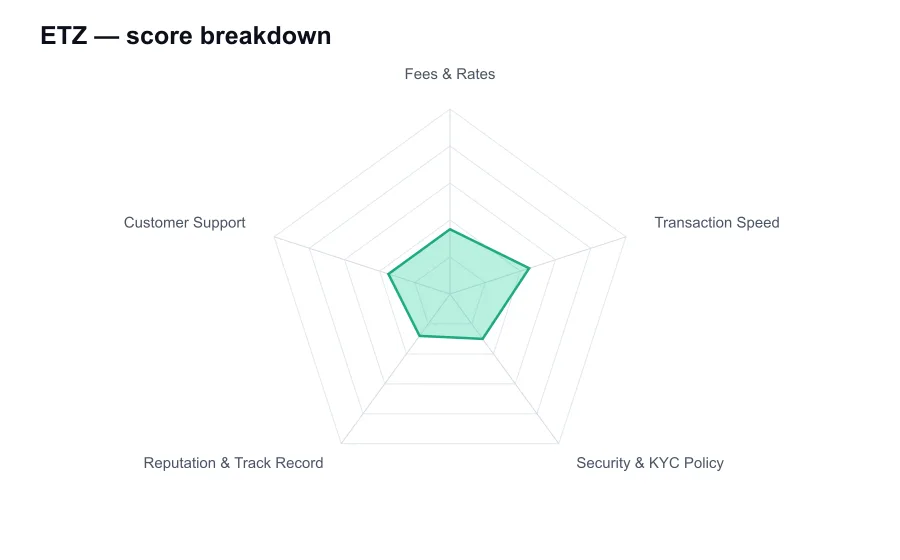
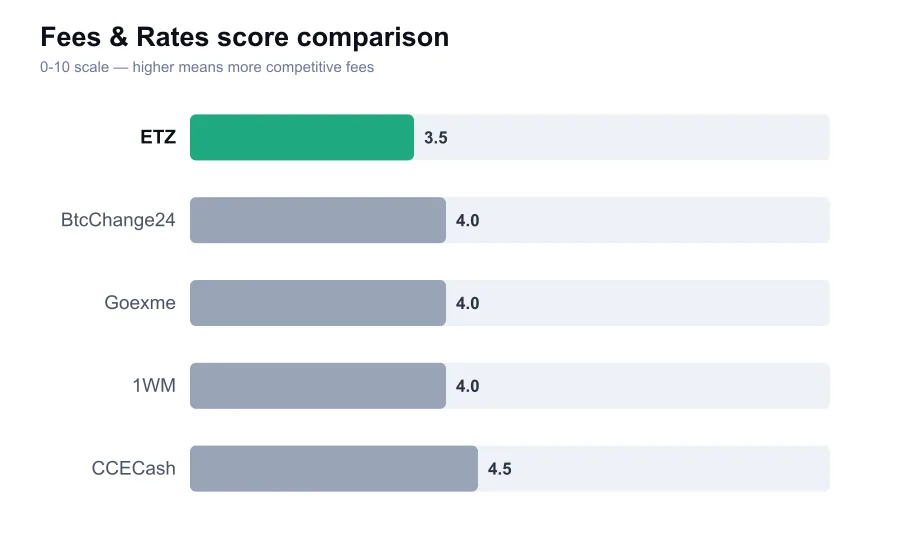
| Fees & Rates | 3.5 | Publicly verifiable fee and spread transparency appears limited |
| Transaction Speed | 4.5 | Settlement claims are hard to assess without a robust record |
| Security & KYC Policy | 3.0 | Insufficient independently verifiable security disclosure |
| Reputation & Track Record | 2.8 | Limited established public track record for a trusted rating |
| Customer Support | 3.5 | Test responsiveness before sending funds |
ETZ is a difficult provider to evaluate with the confidence normally expected from an established crypto exchange review. The name is not associated with a widely documented global venue on the level of Coinbase, Kraken, Binance, Bitstamp, or even the better-known instant exchange brands. That matters. In crypto, a sparse public footprint is not a quirky detail. It is a material risk factor, particularly when a service asks users to send irreversible assets to an address it controls.
The first problem is basic verification. A prospective customer should be able to identify the legal operator, jurisdiction, licensing claims, supported regions, fee schedule, terms of service, privacy policy, security practices, and responsive official support channels. If any of those facts are unclear, inconsistent, or only available through promotional pages, that is enough reason to pause. A new provider can be legitimate, but legitimacy has to be demonstrated rather than assumed from a working website.
For that reason, ETZ cannot fairly receive the benefit of the doubt that comes with a long operating history. A service may process a few fast swaps successfully and still be a poor choice for meaningful funds. Crypto's history is full of new exchanges that looked polished before liquidity dried up, withdrawals slowed, or operators disappeared. The relevant test is not whether a homepage loads. It is whether the provider has proved it can survive stress and resolve disputes in public.
Fees are especially hard to score where a provider does not offer a clear, stable, public pricing model. If ETZ quotes a conversion amount rather than listing a maker fee, taker fee, or fixed swap commission, the quote may include a spread, liquidity markup, network fee, and service margin. That does not automatically make it dishonest. It does mean the user should compare the final amount received against at least two alternatives before sending anything.
A transparent exchange lets a trader estimate cost before trading. It explains which fee is charged, when it is charged, whether withdrawal charges change, and whether the displayed price can move. An opaque instant-swap quote makes that harder. The cheapest-looking service can become expensive through a wide spread, especially on small-cap assets, during volatility, or for pairs with thin liquidity. Without independently verifiable fee documentation, ETZ deserves a cautious fee score rather than a generous one.
Speed claims should be treated in the same way. A platform may promise fast conversion, but a user needs to know whether speed means a deposit address appears instantly, an internal order is created quickly, or the destination asset actually reaches the wallet. The last measure is the one that counts. Blockchain confirmation times, liquidity sourcing, manual checks, and risk screening can all delay settlement even if the interface says the order is processing.
There is also a difference between noncustodial branding and practical counterparty risk. An instant exchange may not hold a long-term customer balance, but it controls the process after the customer sends the deposit. For that period, the customer has counterparty exposure. A decentralized swap settles through smart contracts, with its own serious risks. A regulated exchange holds custody but has identifiable policies. An obscure intermediary can combine custody-like execution risk with fewer visible protections.
Security statements should be specific. Strong providers explain custody arrangements, hot and cold wallet practices, multisignature controls, penetration testing, incident handling, two-factor authentication, withdrawal protections, and the legal entity accountable for operations. If ETZ does not make such practices independently verifiable, users should not fill in the blanks with optimism. A padlock in the browser only encrypts the connection. It says nothing about reserves, internal controls, or whether withdrawals will be honored.
KYC policy is another area where marketing language can mislead. A claim of no registration or no KYC may mean no upfront identity check for ordinary swaps. It does not necessarily mean funds cannot be paused for anti-money-laundering review after deposit. Any service touching liquidity providers, banking partners, or blockchain screening tools may impose conditions when a transaction is flagged. Users should never assume that no-KYC wording guarantees an unconditional, anonymous, or immediate payout.
The right question is whether ETZ clearly states what happens during a review. Does it identify the operator that receives documents? Does it say which jurisdictions are restricted? Is there a documented refund process? Does it explain whether the original asset can be returned, net of network fees, if an order cannot be completed? Those details separate a service that has planned for real operational problems from one that only markets frictionless swaps.
Reputation is where ETZ falls furthest behind more established alternatives. I cannot point to a deep, widely recognized record of independent audits, years of reliable public operations, major exchange listings, regulatory registration, or substantial coverage from credible industry publications. That absence does not prove misconduct. It does mean that a prudent reviewer cannot recommend it as a trusted venue for substantial capital. In finance, uncertainty itself has a cost.
User reviews can help, but they are weak evidence on their own. Review platforms can contain genuine feedback, affiliate-driven enthusiasm, duplicate submissions, and adversarial complaints. Look for detailed reports with transaction hashes, dates, exact issues, and evidence of how the provider replied. A pattern of unresolved withdrawal complaints, requests for unexplained extra payments, or support silence should end the evaluation immediately. Never send more funds to unlock a pending crypto withdrawal.
Support is the practical stress test for a small exchange. Before using ETZ, try its published contact method with a precise pre-sale question about fees, confirmation requirements, network support, and refund policy. A useful answer should be coherent and specific, not a generic invitation to deposit. Keep copies of the response. If the service has no accountable contact channel beyond a chat widget or a social-media account, there is not enough protection for a serious transfer.
My recommendation is deliberately conservative. If you are considering ETZ because it offers an asset pair unavailable elsewhere, use a very small test amount, verify every address and network, and do not treat the test as proof that a larger transaction is safe. For normal swaps, there are better-documented choices, including established centralized exchanges, direct DEX aggregators, and recognizable instant exchange providers. ETZ may be usable, but the available public confidence signals do not justify placing it in the same trust category as mature competitors.
| Pros | Cons |
|---|---|
| May offer a simple exchange flow | — |
| Potentially useful only for small test transactions | — |
| No broad exchange account may be required | — |
| — | Not suitable for meaningful balances |
ETZ is not a provider I would recommend for beginners, large transfers, business treasury activity, or anyone who needs clear legal and support accountability. At most, technically confident users could consider a tiny test transaction after independently verifying the current official service details. Most users should choose a better-documented exchange or aggregator. If privacy is the goal, that is not a reason to accept weak transparency.
There is not enough independently verifiable public information to rate ETZ as a trusted venue for meaningful funds. Use established alternatives where possible.
No. If you choose to test the service, use only a small amount you can afford to lose and verify the destination network and current terms first.
Confirm the legal operator, official domain, fee schedule, support contacts, terms, public history, and withdrawal reports. Compare all of this with established competitors.
| Alternative | Score |
|---|---|
| BtcChange24 Review | 3.6/10 |
| Goexme Review | 3.6/10 |
| 1WM Review | 3.7/10 |
| CCECash Review | 3.8/10 |
| 1Mile Review | 4.0/10 |
| ClickPay Review | 4.0/10 |
