| Best for | Not for |
|---|---|
| Self-custody wallet trading | — |
| Aggregates liquidity across DEX sources | — |
| Can reduce slippage on larger swaps | — |
| Broad multichain DeFi presence | — |
| No conventional account KYC | — |
Live market data via CoinGecko, for informational purposes only. Not financial advice.
Editorial independence: our scores and rankings are produced using the fixed criteria above and are not influenced by advertisers. This is an independent ranking site and is not operated by, or affiliated with, any provider we list.
Affiliate disclosure: some links on this page may earn us a commission at no extra cost to you. This does not affect our rankings.
| Criterion | Score | Note |
|---|---|---|
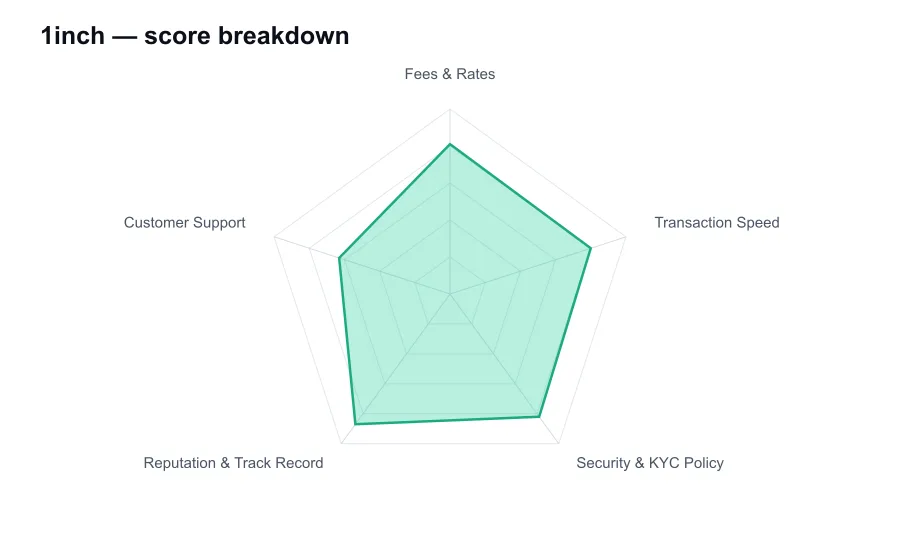
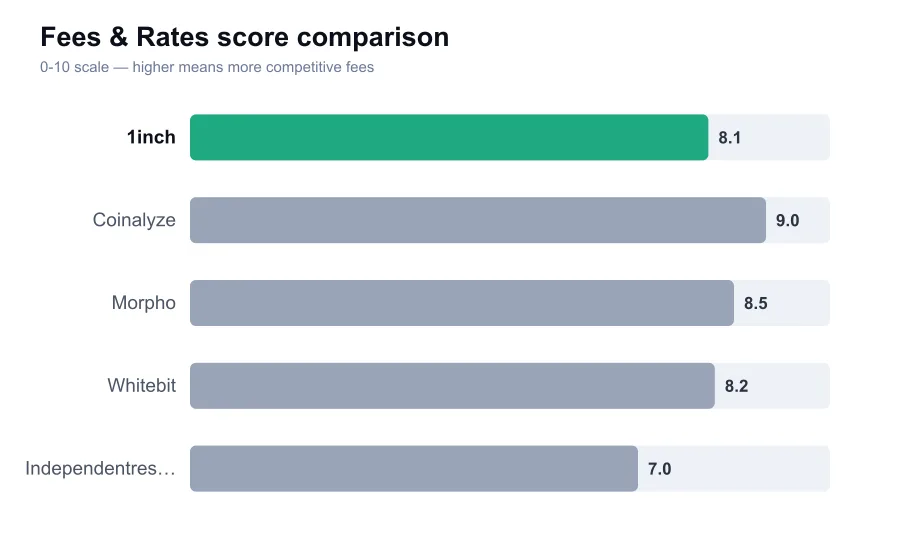
| Fees & Rates | 8.1 | Strong routing, but gas and liquidity fees still matter. |
| Transaction Speed | 8.0 | Fast on low-cost chains, chain-bound on Ethereum. |
| Security & KYC Policy | 8.2 | Self-custody and mature contracts, with DeFi risks. |
| Reputation & Track Record | 8.7 | A major DeFi brand operating since 2019. |
| Customer Support | 6.3 | Useful resources, but irreversible transactions limit help. |
1inch is not a conventional cryptocurrency exchange. It is a decentralized exchange aggregator and liquidity-routing system, built for people who want to trade from their own wallet rather than deposit funds with a company. That distinction matters more than the branding. 1inch searches supported decentralized liquidity sources and tries to split or route a swap through the path that produces the best result after price impact and gas are considered.
In the DeFi market, 1inch sits closer to MetaMask, Uniswap, Curve, and Paraswap than to Coinbase or Kraken. It is a tool for onchain users. You connect a wallet, approve a token contract if needed, set the transaction parameters, and sign through your wallet. There is no familiar customer account holding your assets, no conventional cash balance, and no help desk that can reverse a bad transaction.
That self-custody design is 1inch's biggest strength. Your tokens remain controlled by your wallet until the smart-contract transaction executes. A failure of the 1inch interface does not automatically put wallet-held assets into a bankrupt exchange estate. After the painful lessons of centralized exchange failures, that is not a theoretical benefit. It gives competent users direct control, with the equally direct responsibility that control requires.
Fees need a more careful reading than many users expect. 1inch does not generally present itself as charging a universal retail swap fee on every trade. The liquidity protocol, the pool, and the network do. The cost you actually experience includes the price impact, the fee tier of the liquidity source, the gas required by the route, and sometimes a protocol or integrator component. The estimate on screen is useful, but it is not the same thing as zero-cost trading.
For large swaps, routing can save meaningful money compared with swapping blindly through one pool. Splitting an order across several sources can reduce slippage, particularly on liquid pairs. That is 1inch at its best. For a small swap on Ethereum mainnet, though, the gas bill can dwarf any cleverness in the route. A $50 token exchange may be economically ridiculous during a busy period, even if 1inch finds a marginally better rate than a single DEX.
Users should compare the displayed output after gas, not the headline token price. The best route can change seconds later as pool balances and gas conditions move. Setting an overly loose slippage tolerance is also an invitation for a poor fill, while setting it too tight can cause failed transactions that still cost gas. There is no magic setting. Liquid stablecoin trades can often tolerate tighter limits, while volatile and thin tokens require more caution.
Speed is governed mostly by the blockchain selected and the gas settings approved in the wallet. On Ethereum mainnet, a transaction may take seconds or many minutes depending on congestion and fee choice. On faster networks such as Arbitrum, Optimism, Polygon, Base, or BNB Chain, the experience can feel much more immediate and the transaction cost is often far lower. 1inch cannot outrun the chain, but it can reduce the number of manual steps needed to find liquidity.
The practical friction comes before the swap. A first-time token approval requires a separate transaction on many EVM chains. Users who choose unlimited approvals gain convenience but increase the damage a compromised dApp connection or malicious contract could cause. I prefer limited approvals for unfamiliar tokens and periodic revocation of approvals no longer needed. It costs more in gas, but that is a rational trade for a wallet holding serious value.
Security at 1inch is fundamentally smart-contract security plus user operational security. The project has a long history in DeFi, a public technical profile, and code that has been subject to considerable scrutiny. That inspires more confidence than a brand-new anonymous swap website. Yet audit history and market longevity do not make smart contracts risk-free. Exploits, interface compromises, oracle problems, and user signature mistakes remain possible across DeFi.
The lack of standard KYC is a real attraction for privacy-conscious wallet users. Connecting a wallet is not the same as providing a passport and a residential address. Still, it would be naive to call this private in an absolute sense. Public blockchains expose transaction history, analytics firms cluster addresses, and the front end or third-party services may apply access restrictions based on geography or compliance requirements. Self-custody is not invisibility.
1inch's reputation is considerably stronger than that of most instant-swap sites. Launched in 2019, it has survived several crypto market cycles and is recognized as one of the major DeFi routing brands. Its ecosystem includes the 1INCH token, the 1inch Network, and related wallet and infrastructure products. Longevity matters here because it means the protocol has been used under real market stress, not merely demonstrated in a polished launch campaign.
That said, the token should not be confused with a deposit guarantee or a claim on customer funds. Governance tokens can be volatile, and DeFi governance is not consumer protection. The better reason to use 1inch is the quality of a specific route and the self-custody model, not enthusiasm for a token. Traders who cannot distinguish a token approval from a swap signature should spend time learning before using any DEX aggregator.
Customer support is the area where centralized platforms feel more comfortable. 1inch provides documentation, community channels, and support resources, but no agent can retrieve a transaction sent to the wrong address or unwind a completed blockchain swap. Scam accounts impersonating support are common throughout DeFi. Legitimate help will not need your seed phrase, private key, or a remote-access session. Anyone asking for any of those is trying to steal from you.
My take is positive, with a hard condition: 1inch is excellent for users who already understand wallets, gas, slippage, and token approvals. It can deliver genuinely better execution than going straight to a single pool, especially for larger onchain swaps. It is a poor first crypto trading venue and a terrible place to learn by making expensive mistakes. Use a hardware wallet for meaningful balances, verify the domain, simulate the economics, and treat every signature as irreversible.
| Pros | Cons |
|---|---|
| Self-custody wallet trading | — |
| Aggregates liquidity across DEX sources | — |
| Can reduce slippage on larger swaps | — |
| Broad multichain DeFi presence | — |
| No conventional account KYC | — |
1inch is a strong fit for experienced DeFi traders, self-custody investors, and users swapping meaningful amounts on supported EVM chains. It is especially useful for people who would otherwise compare several DEX pools manually. Beginners who need fiat deposits, simple tax records, or live account recovery should choose a reputable centralized exchange first. It is also a poor fit for anyone unwilling to manage wallet security.
Your total cost can include liquidity-source fees, price impact, gas, and route-specific charges. Check the final estimated output and network cost before signing.
Connecting a self-custody wallet does not normally involve conventional account KYC, though access and compliance restrictions can vary by service and location.
No. Once a blockchain transaction is confirmed, it is generally irreversible. Verify the token, network, recipient details, and approval request before signing.
| Alternative | Score |
|---|---|
| Coinalyze Review | 8.0/10 |
| Morpho Review | 8.0/10 |
| Whitebit Review | 8.1/10 |
| Independentreserve Review | 7.8/10 |
| Defillama Review | 7.7/10 |
| Anycoin Review | 7.7/10 |