| Best for | Not for |
|---|---|
| Noncustodial onchain lending and borrowing | — |
| Efficient, modular Morpho Blue markets | — |
| No standard protocol KYC layer | — |
| Strong technical reputation in DeFi | — |
Live market data via CoinGecko, for informational purposes only. Not financial advice.
Editorial independence: our scores and rankings are produced using the fixed criteria above and are not influenced by advertisers. This is an independent ranking site and is not operated by, or affiliated with, any provider we list.
Affiliate disclosure: some links on this page may earn us a commission at no extra cost to you. This does not affect our rankings.
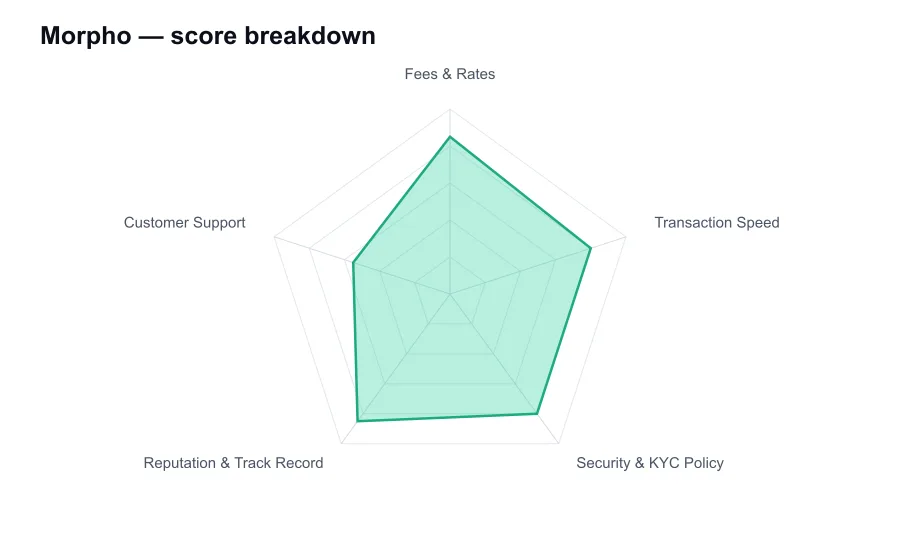
| Criterion | Score | Note |
|---|---|---|
| Fees & Rates | 8.5 | Lean protocol design, but gas and vault fees still apply |
| Transaction Speed | 8.0 | Onchain execution settles at network speed |
| Security & KYC Policy | 8.0 | Audited transparent contracts, with real market risk |
| Reputation & Track Record | 8.5 | Respected DeFi lending infrastructure and ecosystem |
| Customer Support | 5.5 | Good documentation, limited transaction level recourse |
Morpho is not a conventional crypto exchange, and judging it as one misses the point. It is a decentralized lending protocol and infrastructure layer, best known for enabling permissionless lending markets on Ethereum compatible networks. Users do not place a market order against a centralized order book. They supply collateral, borrow against it, or provide liquidity to earn yield, all through smart contracts and front ends built around the Morpho ecosystem.
That distinction matters from the first click. Morpho does not custody a user's wallet keys, process bank transfers, or promise the easy consumer protections of a centralized exchange. A connected wallet signs each action onchain. The upside is direct control and transparent settlement. The cost is that a mistaken transaction, a risky market choice, or a compromised wallet can have consequences that no support agent can simply reverse.
Morpho's development began with peer to peer matching layered over Aave and Compound, seeking to improve rates for lenders and borrowers while retaining those protocols as liquidity backstops. Its more recent Morpho Blue architecture takes a more modular approach. Markets are defined by a loan asset, collateral asset, oracle, interest rate model, and liquidation loan to value parameter. This design is powerful, but it asks users to understand what they are selecting.
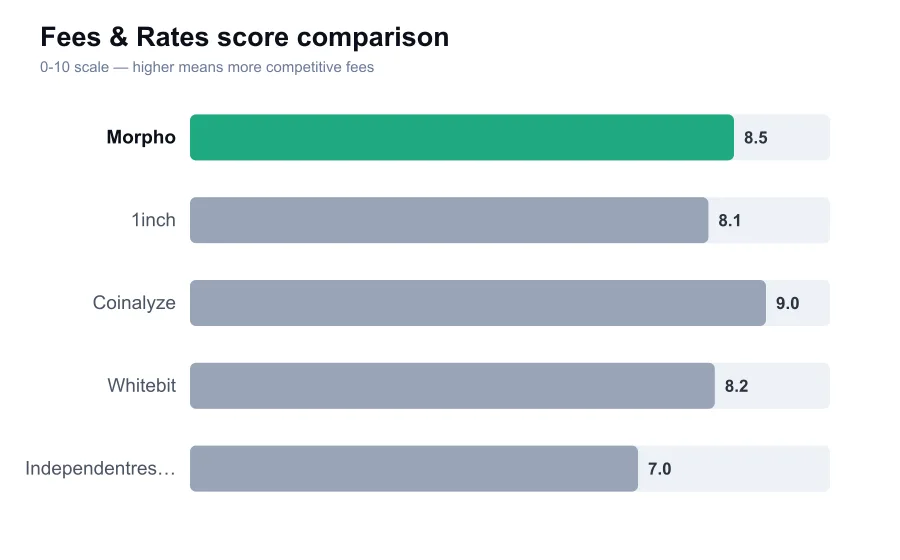
Fees are one of Morpho's strongest points, with an important qualification. The core protocol is generally designed to be permissionless and lean, and Morpho Blue itself does not impose a blanket trading style fee on every user action. Market creators or vault curators can configure fees, and users still pay blockchain gas, swap costs where applicable, and the economic cost of borrowing. Calling it free would be misleading. Calling it low overhead compared with a traditional exchange is fair.
The rate shown in a Morpho vault or market is not a fixed savings account yield. It changes with utilization, borrower demand, market parameters, and the strategy selected by a curator. A lender can earn an attractive annualized return today and a lower one tomorrow. Borrowers face the opposite side of that dynamic. The honest way to evaluate cost is to inspect the current annual percentage rate, the utilization curve, the vault fee, the underlying collateral risk, and gas before committing.
Execution is fast in the way decentralized finance is fast. Once a transaction is submitted, it settles according to the network's block times and confirmation conditions. On Ethereum mainnet, that often means seconds to minutes, although congestion and a low gas setting can slow inclusion. There is no manual approval queue for a standard transaction. This is a real advantage over platforms where withdrawals sit pending for hours or days.
Yet speed should not be confused with liquidity certainty. Borrowing requires available liquidity in the chosen market or vault, and a large position can move conditions or be impossible to fill at the expected rate. A collateral deposit may confirm quickly, but unwinding a complex position can require several transactions, a swap, or a wait for liquidity. Sophisticated users should simulate their path out before opening the position, not just celebrate the path in.
Morpho's security story is considerably stronger than that of an obscure swap site because the protocol has visible code, public documentation, recognized ecosystem participation, and a history of professional security review. The protocol has undergone audits by established security firms, and its architecture is scrutinized by a knowledgeable DeFi community. That is meaningful. It is not an insurance policy against smart contract bugs, oracle failures, curator mistakes, or threats in connected applications.
The protocol's permissionless character creates an unusual security tradeoff. Users do not need to trust a centralized company with custody or routine identity data. They do need to assess each market's risk configuration. An aggressive loan to value ratio, volatile collateral, poor oracle design, or untested asset can turn a seemingly attractive market into a liquidation trap. Morpho Blue's flexibility is a feature for experts and a minefield for people who only see a high yield number.
KYC is generally not built into the permissionless protocol layer. A self custody wallet can interact with smart contracts without creating a Morpho account in the way one would at Coinbase. Interfaces, wallet providers, fiat ramps, and local law can introduce their own controls, and sanctions restrictions can affect access to certain websites. Users should not mistake lack of form based KYC for legal anonymity or immunity from tax and compliance obligations.
Morpho has built a credible reputation in DeFi, particularly among technically informed users and institutions exploring onchain credit primitives. It is not a household name in the retail exchange world, but that is not the relevant comparison. Its reputation rests on protocol design, integrations, transparent onchain activity, and an active builder ecosystem. The main reputational risk comes from the complexity of the permissionless market layer, where a weak third party vault or asset can reflect badly on the experience even if the core contracts work as intended.
Support is not Morpho's strongest consumer category. Documentation, community channels, governance resources, and interface guidance are useful, but they are not the same as a phone line that can stop a transfer. There is no human who can reverse a wallet signature or reimburse a liquidation caused by poor collateral management. For developers and experienced DeFi users, that is an accepted model. For a person accustomed to a bank app, it can feel unforgiving.
The sensible user begins with a small amount, a reputable interface, and a market whose collateral and oracle they actually understand. Check the liquidation threshold, monitor health factor or loan to value, retain gas funds, and learn how to repay before borrowing. Lending is simpler but still carries smart contract, liquidity, and strategy risk. Yield should be treated as compensation for those risks, not as a passive promise.
Morpho is excellent infrastructure, not a beginner friendly exchange substitute. It earns high marks for transparent, noncustodial architecture, efficient execution, and serious technical credibility. It loses points for the very thing that makes it powerful, namely the user must make informed choices in a system that cannot rescue every mistake. For an experienced DeFi user, it is one of the more compelling lending protocols available. For someone who just wants to buy crypto and forget about it, it is the wrong tool.
| Pros | Cons |
|---|---|
| Noncustodial onchain lending and borrowing | — |
| Efficient, modular Morpho Blue markets | — |
| No standard protocol KYC layer | — |
| Strong technical reputation in DeFi | — |
Morpho suits experienced DeFi lenders, borrowers, treasury managers, and developers who understand collateral, oracles, and wallet security. It can also suit careful intermediate users willing to start very small and learn the mechanics. Beginners seeking fiat deposits, simple spot purchases, or recoverable account support should use a mainstream exchange instead. It is particularly unsuitable for anyone who cannot monitor a leveraged borrowing position.
Not in the usual spot trading sense. Morpho is primarily a permissionless lending and borrowing protocol. Users supply assets, borrow against collateral, or use vaults rather than trade through a centralized order book.
The permissionless protocol does not normally require account based KYC. Front ends, wallet providers, fiat services, local law, and sanctions restrictions may still affect access or compliance obligations.
Yes. If the value of your collateral falls or debt grows past the market's liquidation threshold, liquidators can close part or all of the position. Monitor loan to value and keep a safety buffer.
Costs can include borrowing interest, vault or curator fees, network gas, and any swap fees needed to manage a position. Inspect the specific market or vault because terms are not identical everywhere.
| Alternative | Score |
|---|---|
| 1inch Review | 8.0/10 |
| Coinalyze Review | 8.0/10 |
| Whitebit Review | 8.1/10 |
| Independentreserve Review | 7.8/10 |
| Defillama Review | 7.7/10 |
| Anycoin Review | 7.7/10 |