| Best for | Not for |
|---|---|
| Excellent DeFi market and protocol data | — |
| Swap routes can compare multiple liquidity sources | — |
| No typical interface fee for swaps | — |
| No custodial account or routine KYC | — |
Live market data via CoinGecko, for informational purposes only. Not financial advice.
Editorial independence: our scores and rankings are produced using the fixed criteria above and are not influenced by advertisers. This is an independent ranking site and is not operated by, or affiliated with, any provider we list.
Affiliate disclosure: some links on this page may earn us a commission at no extra cost to you. This does not affect our rankings.
| Criterion | Score | Note |
|---|---|---|
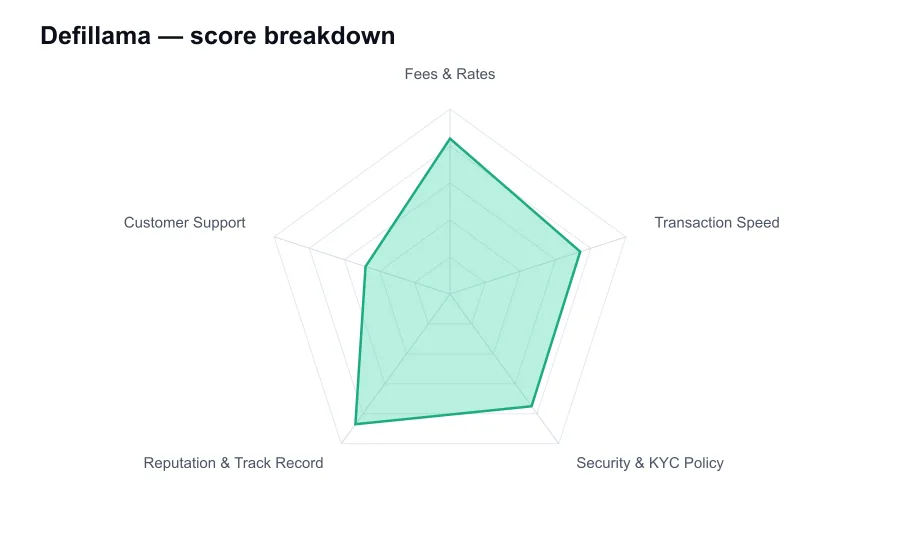
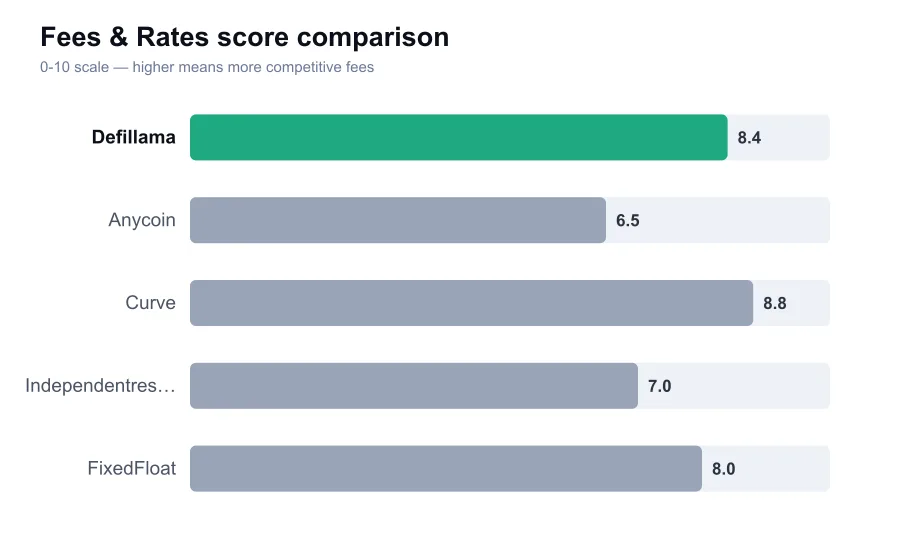
| Fees & Rates | 8.4 | No typical interface fee, but route and gas costs still apply |
| Transaction Speed | 7.4 | Settlement depends on the selected chain, DEX, and bridge |
| Security & KYC Policy | 7.5 | Noncustodial interface, with third-party route risk |
| Reputation & Track Record | 8.7 | Widely used independent DeFi data and analytics platform |
| Customer Support | 4.8 | Useful community resources, limited transaction-level help |
DefiLlama is not a conventional crypto exchange, and that distinction should be made before discussing its numbers. It began as a DeFi analytics platform, best known for tracking total value locked across chains and protocols. Its Swap feature is an aggregator interface that helps users find routes through decentralized exchanges and bridges. You are not opening a custodial DeFiLlama trading account in the way you would at Kraken or Coinbase.
That positioning is a strength. DeFi has far too many token pages, dashboards, incentive programs, and dubious volume claims, and DeFiLlama earned attention by publishing broad, relatively clean protocol data without building its business around selling users a token. The site covers chains, yields, stablecoins, bridges, DEX volume, hacks, raises, governance, and more. For researchers, it is one of the first tabs worth opening.
The swap tool takes a similar aggregator approach. Rather than acting as a single liquidity pool, it can surface routes from providers such as 1inch, CoW Swap, OpenOcean, Paraswap, Li.Fi, and other supported routing sources, depending on the asset and network. The exact sources can change. That breadth can save a trader from manually checking several interfaces, and it makes DefiLlama more useful than a passive data site.
The fee story needs careful wording. DefiLlama Swap has promoted a zero-fee approach for the interface itself, meaning it does not generally add a visible platform cut to the quoted trade. That does not mean a swap is free. The route may contain DEX liquidity-provider fees, aggregator fees, price impact, protocol fees, gas costs, and bridge costs. A user should judge the final received amount, not a marketing phrase about zero fees.
That final-amount comparison is where the tool can be genuinely good. If an aggregator finds a better route than a direct Uniswap trade, the saving may be materially larger than any nominal fee difference. But an aggregated route can also be hard to audit at a glance. Several hops, unfamiliar tokens, or crosschain components may increase execution complexity. For a simple, liquid ETH to USDC trade, a direct venue can be easier to understand and verify.
Speed is equally route-dependent. A same-chain swap on a fast network such as Arbitrum, Base, or Polygon may settle in seconds or a few minutes, subject to block conditions. An Ethereum mainnet transaction takes longer and can be expensive in busy periods. Crosschain swaps are the least predictable category because bridge confirmation, relayers, destination liquidity, and destination-chain finality all matter.
DefiLlama should not be judged as though it personally processes each transaction. It provides an interface and route discovery layer, while settlement happens through the selected underlying protocols and your wallet. That architecture limits custody risk, but it also spreads operational risk across third parties. If a route uses a bridge or solver network that stalls, the user cannot simply ask DefiLlama to release a held balance because DefiLlama never held it.
The platform's security reputation is stronger on the data side than it is possible for any swap aggregator to be on the execution side. DeFiLlama has built a reputation for transparent methodology and relatively independent analytics. Its public API and broad data coverage are widely used by journalists, analysts, builders, and serious retail users. That is a much better foundation than anonymous swap sites with no visible operators or methodology.
Yet an analytics brand does not remove the dangers of signing transactions. Every route involves contracts, allowances, wallet signatures, and potentially third-party infrastructure. A route can be economically attractive while still exposing the user to a protocol they have never independently assessed. Use a hardware wallet for meaningful balances, verify URLs, inspect approvals, and avoid treating a route estimate as a guaranteed outcome until the transaction settles.
There is no routine KYC requirement to browse DefiLlama or connect a self-custody wallet to its decentralized swap tools. That makes it attractive to privacy-minded users and to people who do not want another custodial database linking identity to holdings. It also means there is no traditional compliance department deciding whether to approve a withdrawal. The trade-off is plain: users retain control, and users retain the consequences.
One unusual point in DefiLlama's history is that its team has been visibly public about disagreements and governance issues rather than burying them behind corporate messaging. The 2023 episode involving a proposed token launch and a temporary fork was messy, but it also showed that the project had a community that cared about its independence. The original site and team continued. It was not a confidence-building moment, but neither was it the kind of silent disappearance common in crypto.
Support is modest. The documentation, social channels, GitHub presence, and community spaces are useful for reporting data errors or getting pointed toward resources. They are not a replacement for an exchange help desk. If an underlying route fails, support boundaries can be frustrating because the relevant party may be the connected DEX, bridge, wallet, RPC provider, or network rather than DefiLlama itself.
For research, the product is much easier to recommend than its swap interface. The dashboards make it simpler to identify whether a chain's apparent activity is real, whether a stablecoin is growing, or whether a protocol's TVL is concentrated in a few pools. Even then, TVL is a useful metric, not a seal of quality. Incentives can attract temporary capital, and reported data should lead to further investigation rather than replace it.
I like DefiLlama because it is unusually useful without demanding that users surrender custody or attention to a casino-style exchange interface. Its swap feature is a convenience layer, not a reason to lower normal DeFi standards. Use it to compare routes and study the market, then understand the contracts and settlement path you are choosing. It is a very good research companion and a competent aggregator, but it is not a safe shortcut around DeFi risk.
| Pros | Cons |
|---|---|
| Excellent DeFi market and protocol data | — |
| Swap routes can compare multiple liquidity sources | — |
| No typical interface fee for swaps | — |
| No custodial account or routine KYC | — |
DefiLlama is ideal for DeFi researchers, active self-custody users, and traders who want to compare routing options rather than trust a single DEX. Its data tools are useful even for people who never swap through the site. Beginners who need fiat deposits, simple order books, or live agent support should look to a regulated exchange. It is also a poor fit for anyone unwilling to verify wallet prompts and underlying protocols.
Not in the custodial sense. DefiLlama is mainly a DeFi analytics platform, and its Swap feature aggregates routes through decentralized trading and bridging providers.
The interface has generally presented itself as zero-fee, but your final price can include DEX fees, bridge fees, gas, price impact, and costs charged by underlying providers.
Browsing the site and using self-custody wallet tools does not normally require KYC. Individual third-party services or fiat ramps have their own policies.
| Alternative | Score |
|---|---|
| Anycoin Review | 7.7/10 |
| Curve Review | 7.7/10 |
| Independentreserve Review | 7.8/10 |
| FixedFloat Review | 7.6/10 |
| Trocador Review | 7.6/10 |
| Kamino Review | 7.6/10 |