| Best for | Not for |
|---|---|
| Very efficient stablecoin and correlated-asset swaps | — |
| Noncustodial trading with no routine KYC | — |
| Deep liquidity across established DeFi pools | — |
| Available on several lower-cost networks | — |
Live market data via CoinGecko, for informational purposes only. Not financial advice.
Editorial independence: our scores and rankings are produced using the fixed criteria above and are not influenced by advertisers. This is an independent ranking site and is not operated by, or affiliated with, any provider we list.
Affiliate disclosure: some links on this page may earn us a commission at no extra cost to you. This does not affect our rankings.
| Criterion | Score | Note |
|---|---|---|
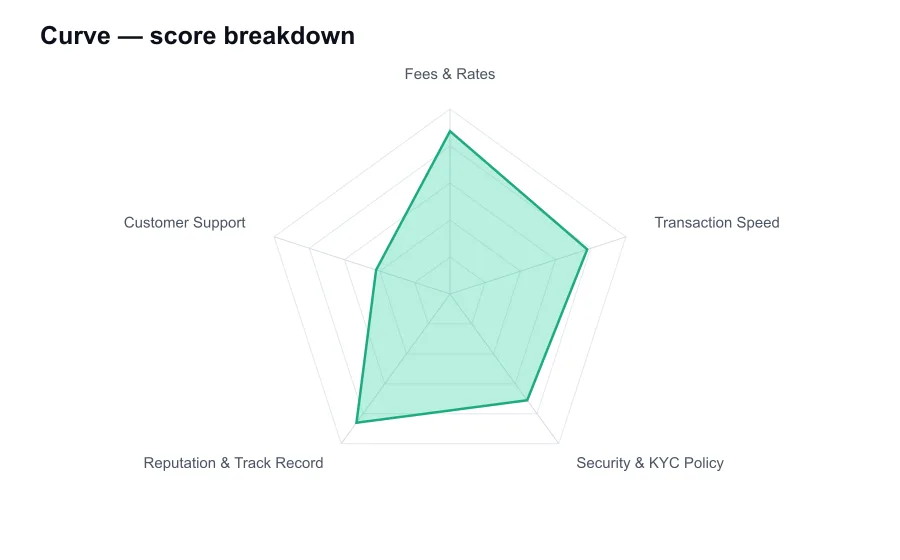
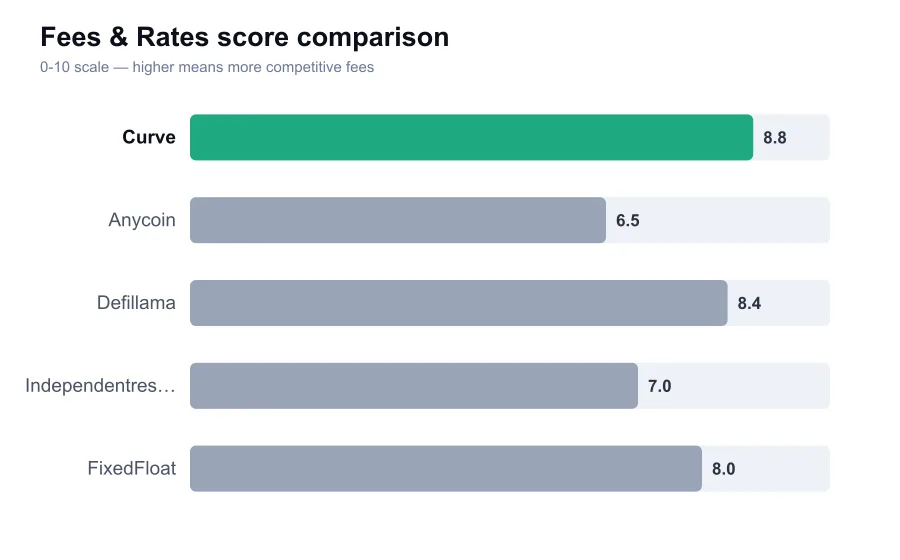
| Fees & Rates | 8.8 | Typically 0.04% pool fee, plus gas and price impact |
| Transaction Speed | 7.8 | Fast on L2 networks, slower and costlier on Ethereum |
| Security & KYC Policy | 7.1 | Noncustodial and audited, but smart-contract risk is real |
| Reputation & Track Record | 8.6 | A major DeFi protocol with a long public track record |
| Customer Support | 4.2 | Community and documentation support, no account recovery |
Curve is one of DeFi's foundational exchanges, although calling it an exchange without qualification misses the point. It is a set of smart contracts built primarily for swaps between assets that should trade close to the same price, such as USDC and USDT, ETH and liquid staking tokens, or wrapped forms of bitcoin. It is not trying to be Coinbase, Binance, or even Uniswap. Curve exists to make deep, low-slippage stablecoin and correlated-asset trading possible onchain.
That specialization still matters. A standard automated market maker can be expensive for a trader who wants to move a large amount of one stablecoin into another, because price impact rises as the pool becomes unbalanced. Curve's StableSwap design was built to keep the exchange rate tight around parity while still rewarding liquidity providers. In the right pool, it remains one of the most efficient pieces of market infrastructure in crypto.
The experience starts in a browser wallet. Connect MetaMask, Rabby, Ledger through a compatible wallet, or another Web3 provider, choose a network and token pair, approve the token, then sign the swap. There is no account registration, password recovery, or conventional onboarding. That is liberating for experienced self-custody users, but it also means a mistaken address, bad approval, or fraudulent front end is your problem rather than a support ticket someone can reverse.
Fees are one of Curve's strongest points, at least if you understand what you are paying. Most traditional Curve pools have a 0.04% trading fee, though pools can use different parameters and newer pool designs are more flexible. That quoted fee is only one part of the price. A swap also faces pool imbalance, price impact, network gas, and sometimes an external route if the interface finds a better path through another venue. Small swaps on Ethereum mainnet can be uneconomic despite Curve's low protocol fee.
For large stablecoin conversions, the comparison with centralized exchanges is favorable. A retail account on a major centralized platform may pay 0.1% to 0.6% in explicit trading fees, then face withdrawal charges and custody risk. Curve can beat that handily if the pool is deep and gas is reasonable. It does not always win. A highly liquid USDC to USDT market on Binance or Kraken can have almost no visible spread, and its execution is simpler for someone already holding funds there.
Speed depends more on the chain than Curve itself. On Ethereum, a swap waits for block inclusion and then the number of confirmations a user considers final, often a few minutes in ordinary conditions. On Arbitrum, Optimism, Base, Polygon, and other supported networks, the interaction usually feels much faster and gas is lower. The swap is not subject to a company manually reviewing it, which is a real advantage over some instant-swap websites.
Still, onchain speed has sharp edges. A low gas setting can leave a transaction pending while the market moves. A token approval may be a separate transaction. Bridge-related routes introduce their own settlement delays and risks. Curve's interface is generally clear about the transaction steps, but no interface can make the underlying chain behave like an instant card payment. Users who need guaranteed delivery at a quoted minute should not treat a DeFi swap as that product.
Security is where Curve earns respect and loses points at the same time. The protocol has been extensively used, audited, and battle-tested through several market cycles. Its contracts are public, and its architecture has survived stress that would have ended many younger DeFi projects. Governance is tied to CRV and veCRV, and the protocol's mechanisms have been examined by a very large technical community.
But battle-tested is not the same as safe. Curve's pools have suffered exploits and incidents, most notably the July 2023 attack involving a Vyper compiler vulnerability that affected several pools. The episode was a blunt reminder that audited contracts can still fail because of dependencies, implementation details, admin choices, or an unexpected interaction. Liquidity providers carry smart-contract and impermanent-loss-like pool imbalance risk, even in pools that appear to contain only stable assets.
Curve does not impose KYC for ordinary protocol use. There is no centralized operator taking custody or routinely asking a trader for ID. That privacy is useful, particularly for users who simply want to move assets between wallets without creating another exchange account. It also means users must assess local legal obligations themselves. Wallet screening, blocked front ends, and regulated fiat rails can still affect the practical availability of DeFi in particular jurisdictions.
The reputation question is nuanced. Curve is not a fly-by-night no-KYC swap page with a polished logo and no visible history. It has been a major DeFi protocol since 2020 and was central to the so-called Curve Wars, where major protocols competed for voting power and liquidity incentives. That history gives it credibility. It also produced a complicated emissions-and-governance culture that newcomers can find opaque and that has sometimes favored sophisticated liquidity operators over ordinary depositors.
Curve's support is not consumer-exchange support. Documentation, Discord, governance forums, transaction explorers, and community channels are the practical support stack. There is no reliable telephone line and no one who can recover a wallet seed phrase, cancel a signed transaction, or reimburse a bad trade. Official social accounts and documentation are useful, but impersonators are everywhere. Anyone contacting you first in direct messages is almost certainly trying to steal from you.
The interface has improved, and routing can be quite good, yet Curve remains best understood by users who know token contracts, slippage settings, and chain selection. It is easy to make an operational mistake by using a bridged asset rather than the canonical version, selecting an illiquid pool, or approving a malicious token contract reached through a fake link. The protocol's technical elegance does not remove that responsibility.
My view is that Curve remains excellent infrastructure and a poor first crypto exchange. For a DeFi-native trader converting meaningful stablecoin or liquid-staking-token size, it deserves a place in the toolkit, particularly on low-fee networks. For a newcomer buying their first crypto, an investor seeking account recovery, or anyone who cannot independently verify contracts and transactions, a regulated centralized exchange is the saner starting point. Curve's low fees are real, but self-custody is not free in the broader sense.
| Pros | Cons |
|---|---|
| Very efficient stablecoin and correlated-asset swaps | — |
| Noncustodial trading with no routine KYC | — |
| Deep liquidity across established DeFi pools | — |
| Available on several lower-cost networks | — |
Curve fits self-custody users who already understand wallets and want efficient stablecoin, ETH derivative, or wrapped-asset swaps. It is particularly useful for larger onchain conversions where low slippage matters. Newcomers, fiat buyers, and users who need phone support or transaction reversals should use a regulated centralized exchange instead. Liquidity providers should understand pool composition and smart-contract exposure before depositing.
Many Curve pools use a 0.04% swap fee, but pool settings vary. You also pay network gas and may face price impact if a pool is imbalanced.
The protocol does not normally require account registration or identity verification. Access can still be affected by local rules, wallet providers, or front-end restrictions.
No. Blockchain transactions are generally irreversible after confirmation. Curve does not custody funds or operate a conventional account recovery desk.
| Alternative | Score |
|---|---|
| Defillama Review | 7.7/10 |
| Anycoin Review | 7.7/10 |
| Independentreserve Review | 7.8/10 |
| FixedFloat Review | 7.6/10 |
| Trocador Review | 7.6/10 |
| Kamino Review | 7.6/10 |