| Best for | Not for |
|---|---|
| Fast, low-cost Solana transactions | — |
| Useful lending and borrowing markets | — |
| Polished Multiply leverage workflow | — |
| Self-custody wallet access | — |
| Prominent Solana DeFi presence | — |
Live market data via CoinGecko, for informational purposes only. Not financial advice.
Editorial independence: our scores and rankings are produced using the fixed criteria above and are not influenced by advertisers. This is an independent ranking site and is not operated by, or affiliated with, any provider we list.
Affiliate disclosure: some links on this page may earn us a commission at no extra cost to you. This does not affect our rankings.
| Criterion | Score | Note |
|---|---|---|
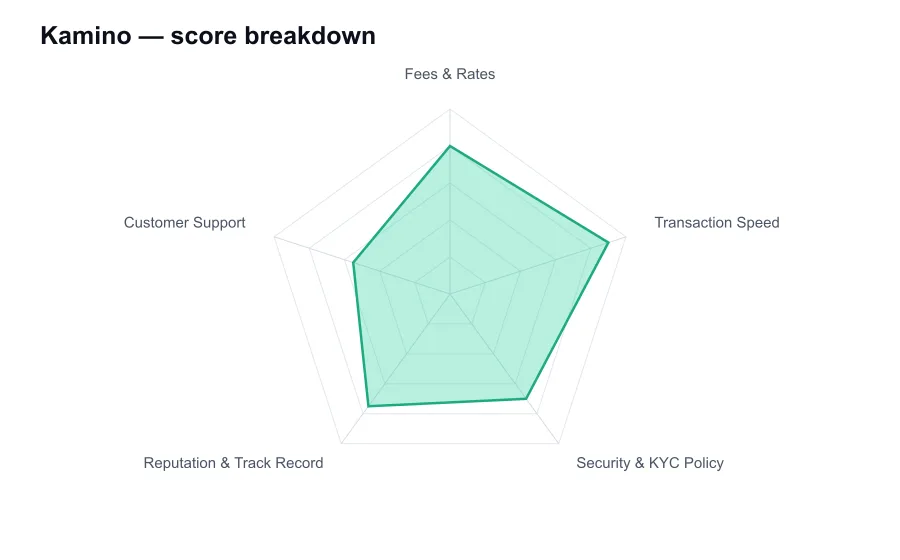
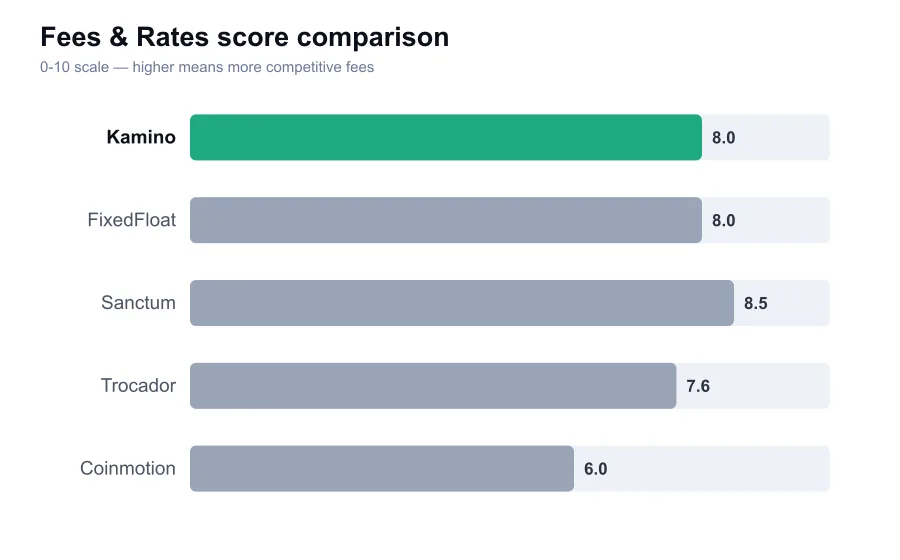
| Fees & Rates | 8.0 | Low Solana transaction costs, but borrowing rates vary |
| Transaction Speed | 9.0 | Solana confirmations are usually measured in seconds |
| Security & KYC Policy | 7.0 | Audited DeFi design, but smart-contract risk remains |
| Reputation & Track Record | 7.5 | Prominent Solana lending protocol with growing adoption |
| Customer Support | 5.5 | Helpful docs and community, no transaction reversals |
Kamino is not a conventional centralized exchange, and judging it as one would miss the point. It is a Solana DeFi protocol centered on lending, borrowing, liquidity management and leveraged strategies. The product is for users who already understand wallet signing, token approvals, collateral ratios and liquidation risk. It can be remarkably efficient, but it does not offer the safety net, human account recovery or simple fiat gateway that people expect from an exchange.
Its core lending product lets users supply assets to earn variable yield or borrow against posted collateral. Kamino's Multiply function packages borrowing and redepositing into a leveraged position, making it far easier to build exposure than manually looping across transactions. That convenience is real. It is also dangerous because a clean interface can make leverage feel like a normal savings product when it is anything but.
The fee story is fundamentally different from a spot exchange. There is no basic maker and taker commission for simply interacting with the lending market. Suppliers earn part of borrower interest, borrowers pay variable interest, and the protocol applies reserve factors and strategy-specific economics. You also pay Solana network fees, usually tiny by Ethereum standards. The meaningful cost is rarely the transaction fee. It is the borrowing rate, price impact, leverage drag and possible liquidation.
Rates move with utilization. A lending position that looks attractive when a pool has abundant liquidity can become expensive as borrowing demand increases. Anyone using Multiply needs to watch both the loan-to-value ratio and the evolving annualized borrow rate. Chasing a headline APY without those checks is how users turn a small yield strategy into a losing trade. Stablecoin yields also carry the risk of stablecoin depegs and borrower demand disappearing.
Kamino can be fast because Solana is fast. A normal wallet interaction may confirm in seconds, and the protocol feels far more responsive than many Ethereum mainnet lending applications. That is a legitimate advantage for collateral management, where minutes can matter during volatile markets. Still, Solana has experienced periods of congestion and outages in its history. A fast chain is helpful until it is the precise moment you need to add collateral and cannot get a transaction through.
The protocol's transaction flow has another practical limitation: your wallet is the account. There is no password reset if you lose a seed phrase, and no support agent can reverse a signed transaction. Phantom, Solflare and hardware-wallet users should slow down before confirming every signature. Fake front ends and malicious token approvals remain a serious threat. Bookmark the official site and do not arrive through sponsored search links or unsolicited messages.
Kamino is generally accessible through a self-custody wallet without the traditional KYC process of a centralized exchange. That makes it attractive to onchain users, but it should not be misunderstood as a promise of legal immunity or total privacy. Interface availability can vary by jurisdiction, analytics can observe public wallet activity, and the assets themselves may come with issuer or compliance constraints. No-KYC is a user-access model, not a risk-free feature.
Security has to be considered at several levels. First is smart-contract risk. Kamino has invested in audits and has become one of Solana's more prominent DeFi protocols, which is a meaningful positive. Audits reduce obvious implementation mistakes, but they do not eliminate bugs, oracle failures, governance failures or novel economic exploits. A protocol can work flawlessly for years and still face a risk event during a market dislocation.
Second is oracle and liquidation risk. Lending markets rely on price feeds to decide whether collateral is adequate. In a fast selloff, collateral can fall faster than users expect, liquidity can thin out and liquidations can happen before a manual top-up is confirmed. Leveraged long positions are especially exposed. If you have never been liquidated, do not learn the mechanics with a large Multiply position. Start with a tiny amount or avoid leverage entirely.
Third is asset risk. On Solana, token names and symbols are not enough. Users need to verify mints, understand whether a token is wrapped or native, and assess stablecoin issuer risk. Supplying a volatile token can earn a tempting yield, but the lending return is small comfort if the asset loses half its value. Supplying a stablecoin introduces different concerns, including depeg risk and changes in pool utilization.
Kamino's reputation is meaningfully stronger than that of an anonymous new DeFi app. It emerged as a major Solana lending and liquidity venue, and the KMNO token launch in 2024 increased its visibility. The protocol has also benefited from Solana's renewed activity, which brought real liquidity and usage rather than a purely theoretical product. Yet DeFi reputation must never be scored like a regulated bank's. There is no deposit insurance, and governance token visibility is not the same as customer protection.
The user experience is one of Kamino's strongest points. It does a better job than many DeFi interfaces at showing borrowing capacity, collateral metrics and position composition. That does not make the outcomes simple. A user should understand the liquidation threshold, health factor and maximum loss before pressing a button. If those terms are unfamiliar, buying spot crypto and holding it in a wallet is the more sensible starting point.
Support is community-oriented, not account-manager oriented. Documentation, Discord, social channels and community discussions can be useful for understanding a transaction or a product change. They cannot retrieve a wrongly sent token, restore a compromised wallet or undo a liquidation that occurred according to the contract rules. Users should be suspicious of direct messages offering help. Legitimate project staff do not need your seed phrase, private key or remote access to your device.
Compared with Aave, Kamino offers a more Solana-native and often faster experience. Compared with centralized margin borrowing, it offers more transparent onchain positions and self-custody, but less human intervention and fewer consumer protections. The right comparison depends on the user. For an experienced Solana participant, Kamino can be a useful capital-efficiency tool. For someone who simply wants to purchase Bitcoin or earn a predictable return, it is unnecessarily complex.
My view is favorable, with a hard limit. Kamino is among the more credible places to access lending on Solana, and its product design is genuinely polished. But polished leverage is still leverage, and quick confirmations do not cure smart-contract, oracle or liquidation risk. Supply modest amounts, keep collateral buffers generous, avoid chasing extreme yields, and never treat a DeFi deposit as cash in a savings account.
| Pros | Cons |
|---|---|
| Fast, low-cost Solana transactions | — |
| Useful lending and borrowing markets | — |
| Polished Multiply leverage workflow | — |
| Self-custody wallet access | — |
| Prominent Solana DeFi presence | — |
Kamino suits experienced Solana users who understand collateralized borrowing, wallet security and onchain risk. It can also fit disciplined users supplying modest assets without leverage. It is a poor first crypto product for beginners, anyone seeking fiat deposits, or investors who need predictable insured returns. Users unwilling to monitor collateral should avoid Multiply completely.
Kamino is generally accessed with a self-custody Solana wallet rather than a traditional exchange account. Availability and obligations can still vary by jurisdiction.
Solana network fees are usually low. The larger costs are variable borrowing interest, reserve economics, swap effects within strategies and potential liquidation losses.
Yes. If a borrowed position breaches its liquidation threshold, collateral can be liquidated. This risk is much higher with Multiply or any leveraged strategy.
No. Onchain transactions are generally irreversible. Support and community channels may explain what happened, but they cannot recover a seed phrase or undo valid contract actions.
| Alternative | Score |
|---|---|
| FixedFloat Review | 7.6/10 |
| Trocador Review | 7.6/10 |
| Sanctum Review | 7.6/10 |
| Coinmotion Review | 7.5/10 |
| Exolix Review | 7.5/10 |
| StealthEX Review | 7.5/10 |