| Best for | Not for |
|---|---|
| Fast SOL and LST conversions | — |
| No retail KYC requirement | — |
| Useful liquidity across many Solana LSTs | — |
| Very low Solana network costs | — |
Live market data via CoinGecko, for informational purposes only. Not financial advice.
Editorial independence: our scores and rankings are produced using the fixed criteria above and are not influenced by advertisers. This is an independent ranking site and is not operated by, or affiliated with, any provider we list.
Affiliate disclosure: some links on this page may earn us a commission at no extra cost to you. This does not affect our rankings.
| Criterion | Score | Note |
|---|---|---|
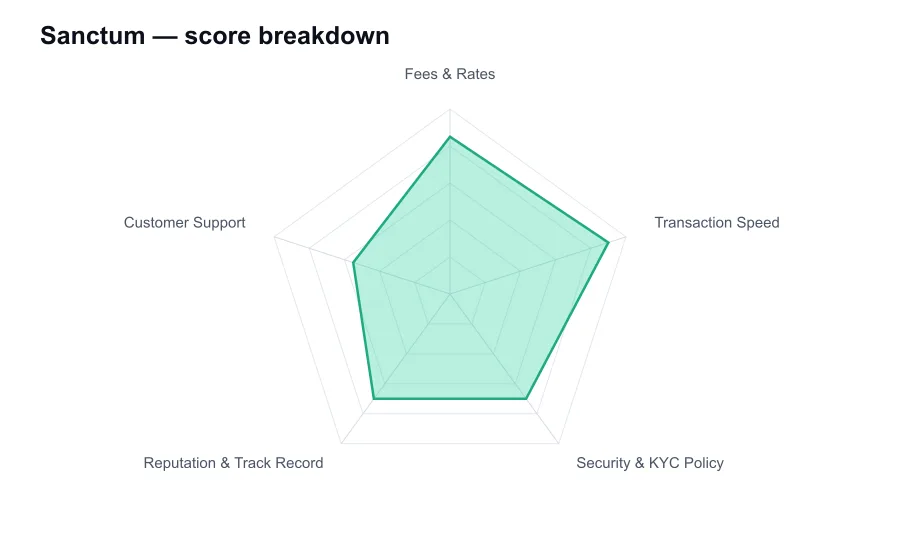
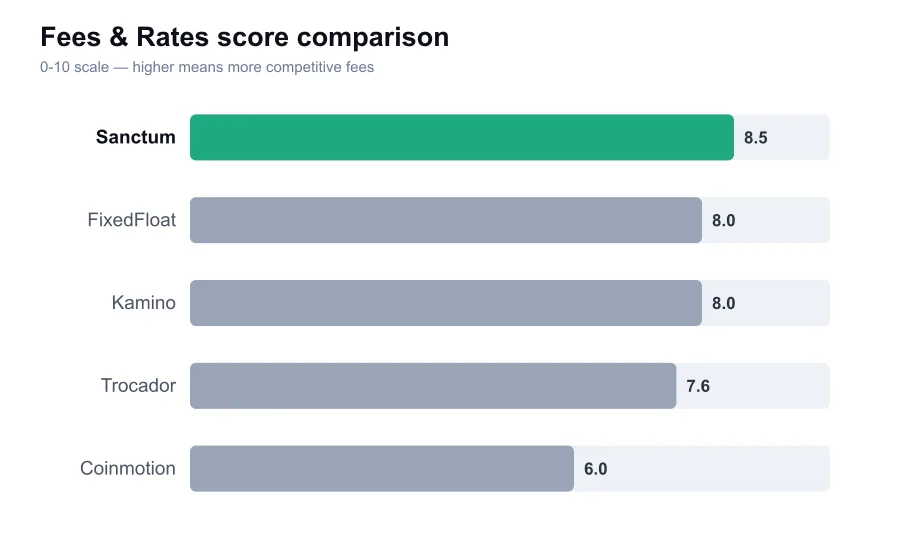
| Fees & Rates | 8.5 | Low explicit costs, but pool pricing can create effective spread. |
| Transaction Speed | 9.0 | Most swaps settle within seconds on Solana. |
| Security & KYC Policy | 7.0 | Non-custodial, but smart contract and LST risks remain. |
| Reputation & Track Record | 7.0 | Respected Solana project with a relatively short history. |
| Customer Support | 5.5 | Documentation and community channels, not hands-on account support. |
Sanctum is not a conventional crypto exchange in the Binance or Kraken sense. It is a Solana-native liquidity and liquid staking protocol built around one practical problem, making SOL staking positions easier to use, trade, and exit. Its Infinity pool and associated products let users move between SOL and supported liquid staking tokens, often called LSTs, without waiting through the normal unstaking process. That makes Sanctum an important piece of Solana infrastructure, but it also means users should judge it as a DeFi protocol, not as a familiar customer-service-led exchange.
The basic appeal is straightforward. Traditional SOL staking locks a user into an activation and deactivation cycle tied to Solana epochs. An LST represents staked SOL while preserving liquidity, but the Solana market became fragmented as validators and projects issued their own versions. Sanctum tries to connect that fragmented market. It allows swaps among many LSTs and SOL through its shared liquidity design, and its Reserve and Infinity products make immediate exits more practical than waiting for a stake account to cool down.
That utility is real, particularly for users who want to support a preferred validator without being trapped in one thinly traded token. A holder of an LST such as JitoSOL, mSOL, bSOL, or a smaller validator-issued token may be able to convert it into SOL or another LST through Sanctum with less friction than using a series of separate Solana DEX routes. It is one of those products that looks niche until you have had to unwind a staking position during a volatile market.
Fees are better understood as a moving combination of protocol pricing, liquidity conditions, and Solana network costs than as one clean advertised trading commission. Sanctum's Infinity model has promoted low or zero explicit swap fees for supported assets, but that does not mean every conversion is economically free. The exchange rate can include liquidity imbalance, pool pricing, validator rewards, and spread. Users need to inspect the quoted output before signing rather than fixating on a headline fee.
For plain SOL to a major LST conversion, pricing can be very competitive. On a healthy Solana network, the transaction cost itself is usually tiny, often only a fraction of a cent. That compares well with centralized exchanges that charge a visible trading fee and then a withdrawal charge. Yet a less popular LST can carry a meaningful discount or premium because the underlying market is thin. Sanctum reduces fragmentation, it does not abolish the market risk attached to obscure validator tokens.
The speed is excellent in the context that matters. A normal swap settles at Solana speed, commonly within seconds once the transaction has been sent and confirmed. There is no account approval queue, bank transfer delay, or manual withdrawal review for a standard on-chain action. This is one reason active Solana users like the protocol. If the network is congested, wallet simulations fail, or a transaction lands with insufficient priority fees, the experience can become less graceful, but that is largely Solana plumbing rather than Sanctum's own matching engine.
Immediate liquidity should not be confused with guaranteed redemption at par. A user can usually swap out of an LST immediately if the pool has a usable route, whereas native unstaking has an epoch-based delay. However, an LST's market price may sit below its eventual redemption value. That difference is the price of instant liquidity. Anyone calling Sanctum a risk-free fast unstake button is selling the story too neatly.
Sanctum is non-custodial in the ordinary DeFi sense. Users connect a wallet such as Phantom or Solflare and approve on-chain transactions. The protocol does not ask retail users for identity documents, proof of address, or a conventional exchange account. That is attractive for privacy-conscious Solana users, but no-KYC access is not the same thing as safety. There is no password-reset department that can reverse a malicious wallet signature or rescue funds sent to the wrong address.
The security question is also more layered than it is at a simple spot exchange. Users face smart contract risk, oracle or pricing-design risk, wallet security risk, and the underlying risks of each LST they choose. Sanctum's system is designed to make many staking tokens interoperable, which adds utility but increases conceptual complexity. A user who understands SOL but does not understand LST redemption mechanics, validator exposure, or pool liquidity can make a poor decision very quickly.
Sanctum has built meaningful credibility inside the Solana ecosystem, especially through its Infinity liquidity concept, partner LSTs, and the attention around its 2024 CLOUD token launch. It has not existed long enough to claim the multicycle operating record of an established exchange. That matters. The protocol has survived active use and has become a recognized name among Solana DeFi participants, but it remains a young project in a sector where impressive launches sometimes age badly.
The product's strongest reputation is among users already comfortable with on-chain Solana. It is less convincing for a newcomer who wants a regulated venue, a tax statement, and someone to call if a deposit goes missing. Comparing Sanctum with Coinbase is simply the wrong comparison. Comparing it with Jupiter, Marinade, Jito, or a direct stake account is more useful. Sanctum wins where cross-LST liquidity and instant repositioning matter, not where fiat access or institutional controls matter.
Support is community-led rather than concierge-led. Documentation, wallet prompts, official social channels, and Discord are the places users will usually find help. That is normal for DeFi, but it is still a weak point for a service handling assets that can be worth thousands of dollars. Response quality can be good for technical questions, yet there is no promise that a human will solve an urgent problem at 3 a.m., and support cannot undo a transaction that has already settled.
The interface is cleaner than the protocol's underlying mechanics. A wallet-connected user can see a route, compare quoted output, and execute without wrestling with a full order book. Still, the clean screen may tempt people to skip the important work. Check the asset mint, verify the wallet prompt, consider slippage, and understand whether you are swapping or engaging with a redemption-related feature. Solana is fast enough that a careless confirmation becomes an immediate mistake.
For frequent Solana users, Sanctum is one of the more useful specialized tools available. Its fee efficiency and speed are genuinely strong, especially for larger LST portfolios that would otherwise require awkward routing. I would not use it as my first step into crypto, and I would not treat a pool quote as a promise of fair value during market stress. Used with a self-custody wallet, modest transaction testing, and a clear grasp of liquid staking, Sanctum earns its place. It is infrastructure for informed users, not a universal exchange.
| Pros | Cons |
|---|---|
| Fast SOL and LST conversions | — |
| No retail KYC requirement | — |
| Useful liquidity across many Solana LSTs | — |
| Very low Solana network costs | — |
Sanctum fits experienced Solana users, liquid staking participants, and validator supporters who want flexible LST liquidity. It is particularly useful for people rotating between SOL and several LSTs without waiting through unstaking epochs. Beginners buying their first crypto, users needing fiat rails, and anyone wanting regulated custodial protection should use a mainstream exchange instead.
Standard wallet-based use does not require a conventional account or retail identity verification. You connect a Solana wallet and approve transactions yourself.
The network cost is usually very low and some routes advertise low or zero explicit fees, but the quoted rate can still reflect liquidity conditions and pool pricing.
It can provide immediate liquidity through swaps or related liquidity mechanisms, but that is not identical to native unstaking at guaranteed par value.
| Alternative | Score |
|---|---|
| FixedFloat Review | 7.6/10 |
| Trocador Review | 7.6/10 |
| Kamino Review | 7.6/10 |
| Coinmotion Review | 7.5/10 |
| Exolix Review | 7.5/10 |
| StealthEX Review | 7.5/10 |