| Best for | Not for |
|---|---|
| Clear FloatRate and FixedRate choices | — |
| Published fee model is more transparent than many rivals | — |
| Very fast automated processing on suitable networks | — |
| No routine account registration | — |
Live market data via CoinGecko, for informational purposes only. Not financial advice.
Editorial independence: our scores and rankings are produced using the fixed criteria above and are not influenced by advertisers. This is an independent ranking site and is not operated by, or affiliated with, any provider we list.
Affiliate disclosure: some links on this page may earn us a commission at no extra cost to you. This does not affect our rankings.
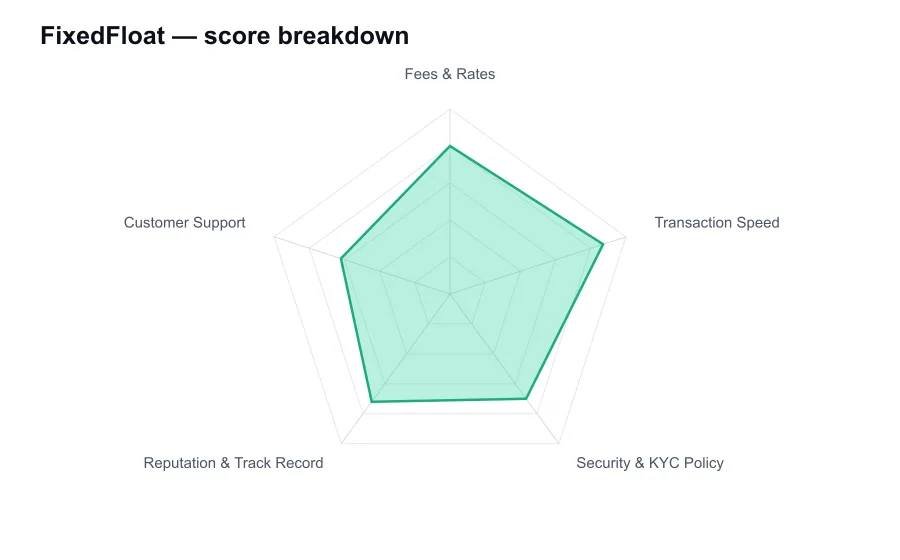
| Criterion | Score | Note |
|---|---|---|
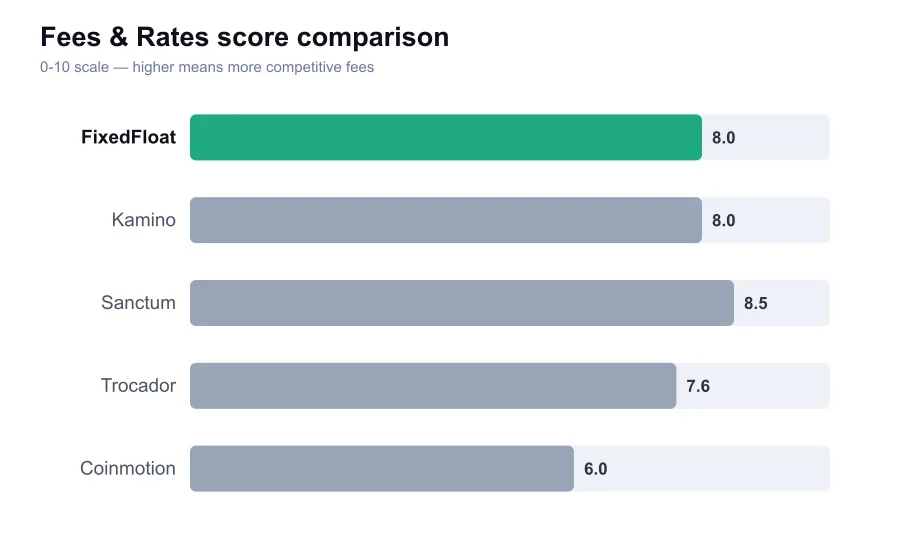
| Fees & Rates | 8.0 | Published 0.5% FloatRate and 1% FixedRate model |
| Transaction Speed | 8.7 | Highly automated swaps on liquid, fast networks |
| Security & KYC Policy | 7.0 | No routine account custody, AML reviews remain possible |
| Reputation & Track Record | 7.2 | Well-known crypto-native service with mixed edge-case feedback |
| Customer Support | 6.2 | Efficient for routine orders, less reassuring for exceptions |
FixedFloat is one of the better-known automated instant exchange services, and it has always had a slightly more technical personality than the polished consumer-first brands. It is built for speed, API-style efficiency, and direct crypto-to-crypto conversion. Users who already understand confirmations, wallet addresses, and network fees will find it refreshingly stripped down. People expecting a hand-held retail banking experience probably will not.
The name explains the central choice. FixedFloat offers both FloatRate and FixedRate exchanges. FloatRate follows the market while the order is processed, so the final amount can move from the initial estimate. FixedRate locks a stated amount subject to the order's time limit and conditions. That choice is not cosmetic. It lets a user decide whether to accept market exposure in exchange for a potentially better rate, or pay for certainty during volatile conditions.
Its published fee structure has traditionally been unusually clear for this corner of the market. FloatRate exchanges have commonly been advertised with a 0.5 percent service fee, while FixedRate exchanges have commonly carried a 1 percent fee, with network costs added as relevant. The exact output still depends on liquidity and blockchain fees, so users should inspect the final quote. Even so, stating a recognizable pricing model is better than hiding the entire cost inside an unexplained spread.
That does not automatically make FixedFloat cheap. A 1 percent fixed-rate charge can be substantial for a large trade, and on some routes a centralized exchange can beat it by a wide margin. The advantage is that you know what kind of premium you are accepting for immediate, account-free execution. On FloatRate orders, the 0.5 percent model can be attractive for users who are already comfortable with price movement and want a quick conversion without depositing into a trading platform.
The service has long appealed to users of fast, low-fee networks and to people making smaller operational swaps. Its minimums are generally practical, and the automated flow avoids unnecessary friction. Still, it is not an ideal venue for buying crypto with fiat, managing a portfolio, or executing sophisticated trades. There are no charting tools, limit orders, lending products, or meaningful custody features. That is intentional, but it narrows the audience.
Speed is FixedFloat's best argument. Straightforward orders can move rapidly after the incoming transaction reaches the required confirmation threshold. On networks like Litecoin, Tron, Polygon, or certain other fast chains, the experience can feel almost immediate. The platform is designed to automate rather than manually handle normal exchanges. For users who want to convert an asset and get back to self-custody quickly, that efficiency is valuable.
Bitcoin and Ethereum still obey their own network realities. A cheap Bitcoin transaction fee can leave your deposit sitting in the mempool, and Ethereum congestion can make the entire swap expensive or slow. FixedFloat cannot fix either issue. The useful thing is that it does not pretend otherwise. A user should select a realistic fee in the sending wallet, check the required confirmations, and avoid judging transaction speed only by the timer on an exchange page.
FixedFloat's automation is a benefit until something unusual happens. Incorrect network selection, deposits below the minimum, token contract mistakes, and unusual transaction patterns are not cases that a simple exchange widget handles elegantly. The company has historically provided support channels and an FAQ, but the experience is not built around extensive personal assistance. If you need someone to walk you through every step, a larger consumer exchange may be a safer fit.
The service generally operates without account registration or routine KYC for normal exchanges, which remains one reason it is popular with privacy-conscious users. Yet no-KYC should be read as a standard onboarding model, not an unconditional promise. FixedFloat can apply AML procedures and request information where it considers that necessary. Funds can also be delayed if a transaction is subject to a compliance review. That is an uncomfortable reality in this sector, but users should understand it before sending.
From a security perspective, the lack of a persistent custodial balance is helpful. There is no exchange account full of assets waiting to be compromised through a reused password or phishing attack. Your exposure is largely limited to the amount currently being exchanged. But you are still sending assets to a service-controlled address for a period of time. Verify the domain carefully, bookmark it, and ignore social-media accounts offering support or recovery help.
FixedFloat has been around long enough to have a recognizable reputation among crypto-native users. It has earned credit for speed, simple operation, and relatively transparent rate options. Its reputation is also more polarizing than that of a heavily regulated platform, partly because automated exchanges generate sharp complaints whenever an order is delayed or reviewed. That does not make every complaint proof of wrongdoing, but it does reinforce the rule not to send money you need instantly.
One serious limitation is the lack of the institutional disclosure people may expect from a mainstream financial company. There is no public-company reporting, bank-like insurance framework, or exchange-grade regulatory structure. FixedFloat should be judged as a specialist swap service, not as a replacement for a regulated broker. The fact that it works well for a quick conversion does not mean it is the right location to route a six-figure trade.
Support gets a middling score from me because it is adequate for the product's normal use but less reassuring during exceptional cases. The site provides order tracking and help resources, which solve many routine questions. For an order that needs manual review, response speed and outcome can matter more than the presence of a chat button. Document the transaction hash, amount, timestamp, and screenshots immediately if you need help.
FixedFloat is particularly good for a technically capable user who values a fast, straightforward swap and understands the difference between fixed and floating execution. The fee model is clearer than many competitors, and the service can be extremely efficient on supported, liquid routes. It is a poor match for someone who wants human guidance, fiat access, or a regulatory safety net. That distinction is more important than any headline claim about anonymity.
My judgment is positive, with firm limits. FixedFloat does what it is designed to do better than many bloated instant exchange sites, especially where speed and transparent rate type matter. The 0.5 percent and 1 percent pricing structure makes the tradeoff understandable, not necessarily cheap. Its weak point is support confidence when an automated process becomes a manual problem. Use it for deliberate crypto-native swaps, not as a substitute for a full-service exchange.
| Pros | Cons |
|---|---|
| Clear FloatRate and FixedRate choices | — |
| Published fee model is more transparent than many rivals | — |
| Very fast automated processing on suitable networks | — |
| No routine account registration | — |
FixedFloat suits crypto-native users who understand wallets, confirmations, and the difference between floating and fixed execution. It is especially useful for quick swaps on liquid networks and smaller operational conversions. Beginners who want phone support, fiat deposits, or extensive compliance clarity should choose a major regulated exchange. Large holders should avoid treating any automated instant exchanger as a treasury venue.
FloatRate settles using the market rate while the exchange is processed, so the received amount can change. FixedRate aims to lock the quoted output if the order is funded correctly within its specified conditions.
FixedFloat has commonly advertised a 0.5 percent fee for FloatRate and 1 percent for FixedRate exchanges. Network fees and route conditions still affect the final displayed amount.
Routine use has generally not required account registration or standard KYC. Its policies allow compliance checks and information requests for transactions flagged by its risk controls.
| Alternative | Score |
|---|---|
| Trocador Review | 7.6/10 |
| Kamino Review | 7.6/10 |
| Sanctum Review | 7.6/10 |
| Coinmotion Review | 7.5/10 |
| Exolix Review | 7.5/10 |
| StealthEX Review | 7.5/10 |