| Best for | Not for |
|---|---|
| Compares multiple instant-swap providers | — |
| No routine account registration | — |
| Supports fixed and floating rate routes | — |
| Trocador Safe adds limited transaction recourse | — |
| Good fit for self-custody users | — |
Live market data via CoinGecko, for informational purposes only. Not financial advice.
Editorial independence: our scores and rankings are produced using the fixed criteria above and are not influenced by advertisers. This is an independent ranking site and is not operated by, or affiliated with, any provider we list.
Affiliate disclosure: some links on this page may earn us a commission at no extra cost to you. This does not affect our rankings.
| Criterion | Score | Note |
|---|---|---|
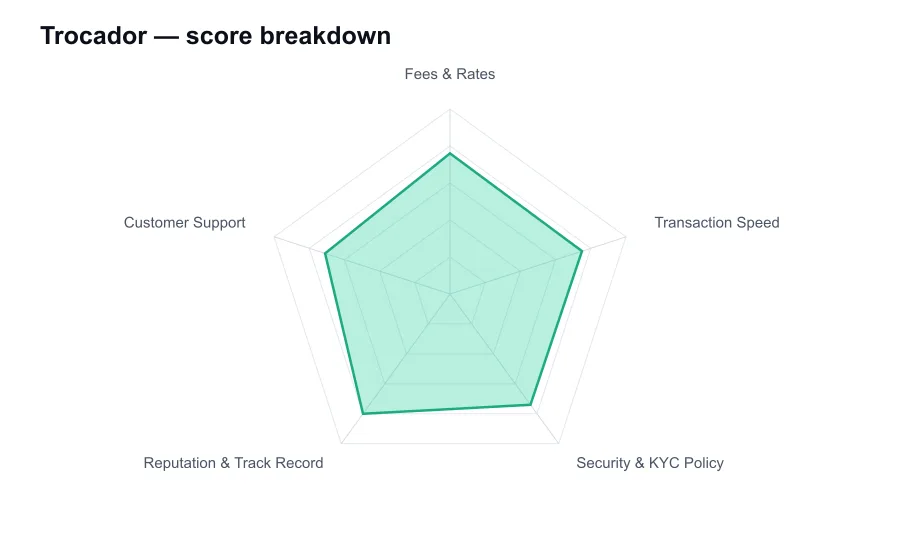
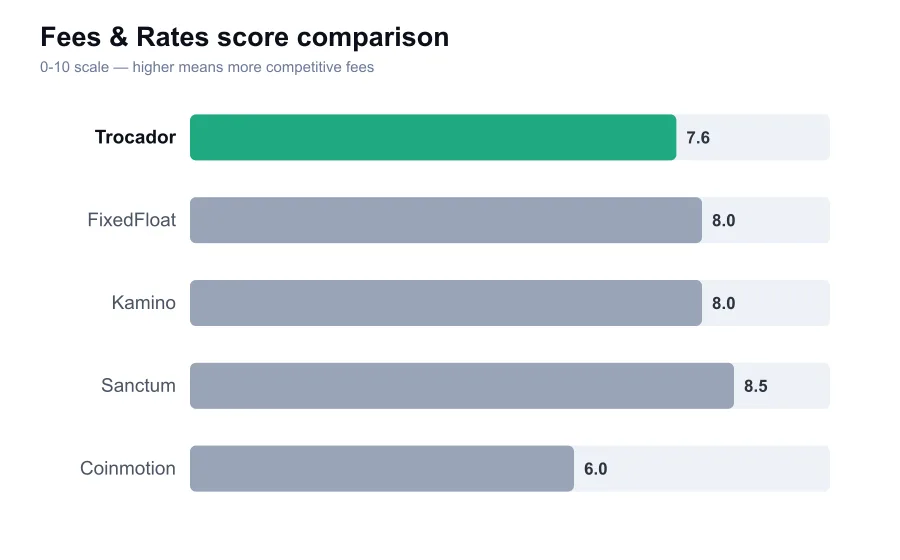
| Fees & Rates | 7.6 | 0.5% service fee, with partner spreads and network fees added |
| Transaction Speed | 7.5 | Fast for many swaps, but timing depends on partner and chain |
| Security & KYC Policy | 7.4 | No standing custody, plus transaction protection on eligible swaps |
| Reputation & Track Record | 8.0 | Well-known instant-swap aggregator with years in the niche |
| Customer Support | 7.1 | Helpful transaction-based support, but partner limits apply |
Trocador is a crypto swap aggregator built for users who want to exchange coins without opening a traditional exchange account. It does not try to be a trading terminal, a fiat on-ramp, or a custody platform. Its role is narrower and useful: compare offers from partner exchange services, route a swap, and deliver the output to the wallet address selected by the user. Think of it as a privacy-oriented marketplace for instant exchanges.
That positioning makes Trocador particularly relevant to people who already hold crypto in self-custody. You choose the asset to send, the asset to receive, the amount, and the destination address. The service then presents partner options. There is no familiar account dashboard with a permanent balance waiting to be traded, which is a positive for users who do not want to leave funds sitting on another centralized platform.
Trocador's strongest selling point is comparison. Instant swap providers often quote noticeably different outcomes for the same pair, especially for lower-liquidity assets, fixed-rate transactions, and coins with expensive networks. Checking several providers manually is tedious. Trocador puts those options in one place. This can produce better pricing than going directly to the first service you recognize, although users still need to read the quote rather than assume the first listing is best.
The platform states a standard service fee of 0.5 percent, with a lower rate available through certain referral arrangements. That charge sits alongside the partner's own spread and any network fees. The practical price is therefore not 0.5 percent. It is the difference between the amount you send and the amount that arrives, after the aggregator fee, provider rate, mining fee, and possible price movement are included.
For major pairs, Trocador can be competitive because the comparison engine creates pressure between partners. For small swaps, network fees can make the result poor, particularly with Bitcoin or Ethereum during busy periods. For obscure coins, a seemingly attractive quote may conceal a thin market or a partner with weaker execution. I would use the final received amount as the decision metric, not the percentage fee displayed near the top of the page.
Trocador offers both floating-rate and fixed-rate choices through available partners. Floating rates may give better expected pricing but leave the result exposed to movement between quote and execution. Fixed rates generally cost more, but they are sensible when sending a large amount or working with a volatile asset. The important detail is to send the exact required amount within the stated time window. Underpaying or sending late can turn a simple swap into a support case.
Speed is usually good for a noncustodial instant-swap aggregator, but it is not uniformly instant. A Litecoin or stablecoin transaction on a fast network can be handled quickly. Bitcoin requires confirmations, Monero has its own timing characteristics, and an exchange partner may pause a transaction for liquidity or risk review. The website can estimate timing, yet real settlement depends on the source chain, destination chain, partner, and current network conditions.
Trocador is appealing to privacy-conscious users because it generally does not require a customer account or routine KYC for ordinary swaps. That benefit needs careful wording. Trocador aggregates third-party providers, and a selected partner can flag a transaction and request verification under its own risk procedures. The service cannot promise that every swap will stay KYC-free. Anyone who needs certainty should select partners carefully and understand the terms before sending funds.
The no-account model also changes the security profile. Trocador does not hold a standing customer balance, which sharply reduces the risk of an account takeover or exchange insolvency affecting idle funds. But the swap itself still involves sending coins to a partner-controlled deposit address. You must verify the receiving address, token network, and exchange ID. There is no chargeback if you send USDT on the wrong network or paste an attacker's address.
A notable feature is Trocador Safe, its transaction protection program for eligible swaps. The idea is valuable because instant exchanges sometimes fail to settle smoothly, and an aggregator should have a way to advocate for the customer. Still, users need to read the current eligibility rules, limits, and claims process rather than assume every transaction is insured. It is a useful layer of recourse, not the same thing as regulated deposit protection.
Trocador has a stronger reputation than an anonymous swap widget because it has operated as a recognizable brand in the privacy and instant-exchange space for years. It is regularly mentioned alongside services such as ChangeNOW, FixedFloat, SimpleSwap, and Exolix. That does not mean every partner is equally good. The aggregator model deliberately exposes users to different providers, so route selection matters. Trocador's reputation is better judged as a routing service than as a direct exchanger.
Support is better than many no-account services because transaction pages and exchange IDs give users something concrete to reference. The team can often help trace a delayed order or communicate with a partner. But support cannot override blockchain finality, force a third party to ignore compliance rules, or retrieve a payment sent from the wrong chain. Response quality is usually most important during exceptions, and that is where a transparent record of the transaction matters.
I would use Trocador for medium-sized wallet-to-wallet swaps where I want choice, privacy, and a better chance of finding a competitive quote. It is less suitable for buying crypto with fiat, placing limit orders, or moving very large sums where a regulated desk and a formal account relationship may be preferable. For a first transaction with an unfamiliar partner, start small, especially if the route uses a low-liquidity coin.
Trocador is one of the more useful tools in the instant-swap category because it offers genuine route comparison rather than pretending every swap has one universal price. Its 0.5 percent service fee is not the cheapest-looking figure in crypto, but it can be justified if the marketplace finds a better partner rate or avoids a poor route. The weak spots are familiar to this whole sector: variable execution, partner-dependent KYC risk, and limited recourse compared with a full regulated exchange. Used carefully, it is a solid privacy-conscious swap tool.
| Pros | Cons |
|---|---|
| Compares multiple instant-swap providers | — |
| No routine account registration | — |
| Supports fixed and floating rate routes | — |
| Trocador Safe adds limited transaction recourse | — |
| Good fit for self-custody users | — |
Trocador suits self-custody users who want to compare instant crypto swaps without maintaining another exchange account. It is especially useful for privacy-minded holders who understand network selection, transaction IDs, and fixed versus floating rates. Fiat buyers, active chart traders, and institutions needing regulated custody should look elsewhere. Large first-time swaps should be split into a small test and a main transaction.
Trocador states a standard 0.5 percent service fee. The final cost can also include the selected partner's spread and blockchain network fees, so compare the received amount.
Trocador does not generally require a routine account or KYC for ordinary swaps. A selected exchange partner can still request verification if its risk or compliance systems flag a transaction.
Trocador Safe is a protection program for eligible transactions, not bank deposit insurance. Check its current limits, exclusions, and claim requirements before relying on it.
Many swaps settle within minutes to an hour, but timing depends on blockchain confirmations, the chosen provider, liquidity, and whether the transaction is subject to review.
| Alternative | Score |
|---|---|
| FixedFloat Review | 7.6/10 |
| Kamino Review | 7.6/10 |
| Sanctum Review | 7.6/10 |
| Coinmotion Review | 7.5/10 |
| Exolix Review | 7.5/10 |
| StealthEX Review | 7.5/10 |