| Best for | Not for |
|---|---|
| Established Dutch broker founded in 2013 | — |
| Clear retail-focused purchase and sale flow | — |
| European compliance and identifiable business presence | — |
| Helpful for first-time buyers using euros | — |
Live market data via CoinGecko, for informational purposes only. Not financial advice.
Editorial independence: our scores and rankings are produced using the fixed criteria above and are not influenced by advertisers. This is an independent ranking site and is not operated by, or affiliated with, any provider we list.
Affiliate disclosure: some links on this page may earn us a commission at no extra cost to you. This does not affect our rankings.
| Criterion | Score | Note |
|---|---|---|
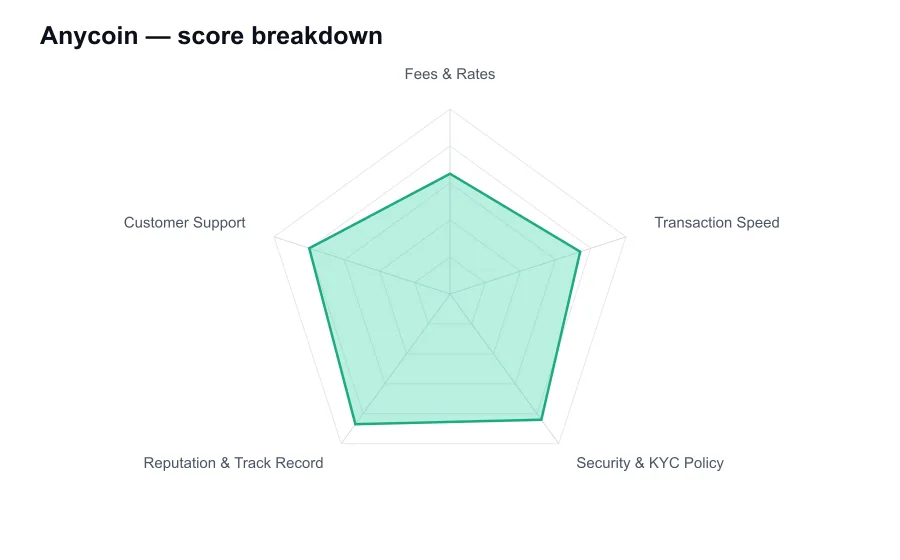
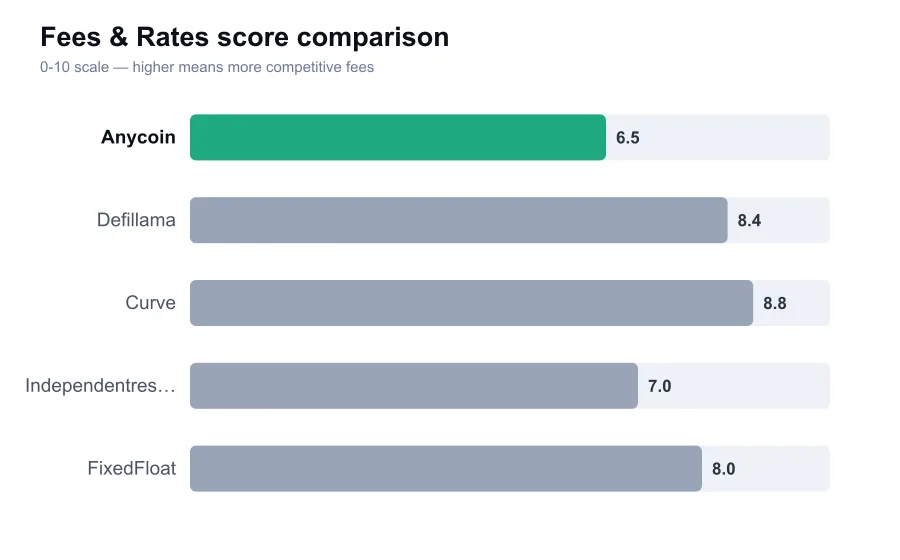
| Fees & Rates | 6.5 | Clear quote-based pricing, though cheaper trading venues exist. |
| Transaction Speed | 7.4 | Reliable processing, with payment rails and blockchain timing limits. |
| Security & KYC Policy | 8.4 | Established European broker with mandatory identity verification. |
| Reputation & Track Record | 8.7 | Founded in 2013 with a substantial European operating history. |
| Customer Support | 8.0 | Strong retail guidance and more mature support than swap sites. |
Anycoin Direct, commonly shortened to Anycoin, is a Dutch cryptocurrency broker founded in 2013. It sits in a very different part of the market from anonymous instant swap sites. This is a regulated, Europe-focused platform designed to make buying, selling, and exchanging crypto accessible while accepting the trade-off of identity verification. Its strongest point is not that it offers the lowest possible price. Its strongest point is that it has been around for a long time, operates visibly, and gives European customers a more accountable route into crypto.
The broker model is central to understanding it. Anycoin does not ask most retail users to navigate a traditional order book. Instead, it presents a quoted price for the asset and payment method selected, then guides the customer through the purchase or sale. That is friendlier for first-time buyers than a professional exchange screen. It also means you should not expect the razor-thin spreads available to experienced users on Kraken Pro, Bitvavo, or Coinbase Advanced.
Fees at Anycoin are best understood as quote-based pricing. The total cost can include a broker spread, payment-method cost, and network withdrawal cost where relevant. The platform generally makes the final amount visible before confirmation, which is more useful than displaying a tiny trading fee while hiding an unfavorable rate. Still, transparent checkout is not the same as cheap execution. For a recurring investor buying a major asset with euros, the convenience premium can add up over time.
Payment method matters enormously. SEPA transfers tend to be the economical route for European users, while cards and other instant methods typically cost more because payment processing itself costs more and has higher fraud risk. A buyer who wants the best possible euro price should compare Anycoin's final quote with Bitvavo, Kraken, and a local regulated competitor at the same moment. A buyer who values a simple flow, local payment familiarity, and a direct withdrawal to a personal wallet may decide Anycoin's premium is fair.
Anycoin is not the place for day trading. The absence of an active trader's order book is a feature for its intended audience, but it is a real limitation for everybody else. You cannot expect advanced charting, conditional orders, or the ability to work a large order gradually through deep liquidity. If you trade weekly, use a platform built for trading. Anycoin is more appealing for a periodic purchase, a sale back to euros, or a straightforward exchange handled with clear customer-facing steps.
Speed is generally good once the account and payment are in order. Crypto withdrawals depend on the network, so Bitcoin can take longer than faster chains and Ethereum timing can be affected by congestion. SEPA transfer processing is tied to banking rails and can be slower than a card, particularly outside normal banking windows. That said, Anycoin's workflow is usually more predictable than a loosely documented instant exchanger because the platform has established verification and payment procedures rather than improvising around each order.
The important caveat is onboarding. Anycoin follows European compliance requirements, so users should expect identity verification rather than hoping to avoid it. This is not a no-KYC provider. You may need personal details, identification, and verification steps before accessing meaningful limits or payment methods. Some crypto users see that as a flaw. I see it as an honest statement of the service being offered. A regulated broker cannot responsibly sell itself as a loophole around financial rules.
That compliance posture also makes Anycoin more suitable for people who need a clean paper trail. A salaried investor using a bank account in their own name, buying mainstream assets, and withdrawing to a wallet they control is likely to find the process sensible. Someone trying to transact with obscure sources, avoid verification, or move high-risk blockchain funds should look elsewhere, though not with the expectation that reputable providers will simply ignore risk. In the current European environment, transparent compliance is a practical advantage, not merely a burden.
Security is stronger here than at most small swap sites because the company has operated under Dutch and European regulatory scrutiny, including registration history with De Nederlandsche Bank under the former Dutch crypto registration regime. Regulatory frameworks have evolved, and customers should check the current legal disclosures directly, but the broader point stands. Anycoin has a named, established business presence. That gives users a clearer place to turn if something goes wrong than an anonymous web exchanger does.
No regulated broker is risk-free. Customers still need strong passwords, unique email credentials, two-factor authentication where offered, and careful wallet hygiene. The safest long-term practice is to buy crypto and withdraw it to a wallet whose keys you control, rather than treating any broker as permanent storage. Anycoin's structure reduces some counterparty uncertainty, but it does not protect you from phishing, sending to the wrong address, fake support accounts, or a compromised personal device.
Reputation is Anycoin's standout category. A company founded in 2013 has weathered bull markets, bear markets, regulatory changes, and the collapse of several apparently larger competitors. Longevity alone is not a guarantee of perfection, but it is meaningful evidence in crypto. The company is especially familiar in the Netherlands and surrounding European market. It does not have the global scale of Coinbase or Binance, yet for its target region it has a far more substantial record than a recently launched swap portal.
Customer support is also one of the reasons to consider Anycoin. It has historically put effort into guides, educational material, and direct support for retail users who may not understand wallet operations or verification requirements. That doesn't mean every ticket will be instant or that a compliance decision will always satisfy the customer. It does mean there is a more mature support structure than the email-only model common among small exchangers. Be prepared with your order number, payment reference, and transaction details if you need help.
The platform has a few practical limitations that deserve emphasis. Its geographic focus is European, so users outside supported regions may find fewer options or no access. Asset selection may not match a giant global exchange's constantly expanding list, and a broker quote can be less attractive than market execution for large orders. Those are not accidental shortcomings. They are the cost of a more conservative, compliance-first retail business. Whether they matter depends on what you want from crypto.
I would recommend Anycoin to European newcomers and long-term investors who want a reputable, regulated-feeling on-ramp and are willing to complete KYC. It is particularly sensible for someone who values support and clear checkout more than shaving every basis point from a purchase. It is a poor match for privacy maximalists, high-frequency traders, or users chasing newly launched tokens. My final view is positive: Anycoin is not the flashiest broker, and it is not the cheapest, but it has something many crypto services lack, namely a credible history and a business model that does not depend on ambiguity.
| Pros | Cons |
|---|---|
| Established Dutch broker founded in 2013 | — |
| Clear retail-focused purchase and sale flow | — |
| European compliance and identifiable business presence | — |
| Helpful for first-time buyers using euros | — |
Anycoin suits European beginners, long-term investors, and buyers who want a regulated, clearly documented route from euros to self-custody. It is particularly appropriate for users who value support and a straightforward checkout over trading tools. Active traders should look to Bitvavo, Kraken Pro, or another liquid exchange. Privacy-first users and people unwilling to complete KYC should look elsewhere.
Yes. Anycoin is a compliance-focused European broker, so users should expect KYC and payment verification before using the full service.
Usually not for active trading. Anycoin uses broker-style quoted pricing, while liquid spot exchanges can offer lower spreads and trading fees.
Yes, the service is designed to let customers provide their own destination wallet address. Always verify the asset and network before confirming.
| Alternative | Score |
|---|---|
| Defillama Review | 7.7/10 |
| Curve Review | 7.7/10 |
| Independentreserve Review | 7.8/10 |
| FixedFloat Review | 7.6/10 |
| Trocador Review | 7.6/10 |
| Kamino Review | 7.6/10 |