| Best for | Not for |
|---|---|
| Simple wallet-to-wallet swap flow | — |
| No conventional trading account required | — |
| Can be useful for small test conversions | — |
| — | Brand identity can be confusing |
Live market data via CoinGecko, for informational purposes only. Not financial advice.
Editorial independence: our scores and rankings are produced using the fixed criteria above and are not influenced by advertisers. This is an independent ranking site and is not operated by, or affiliated with, any provider we list.
Affiliate disclosure: some links on this page may earn us a commission at no extra cost to you. This does not affect our rankings.
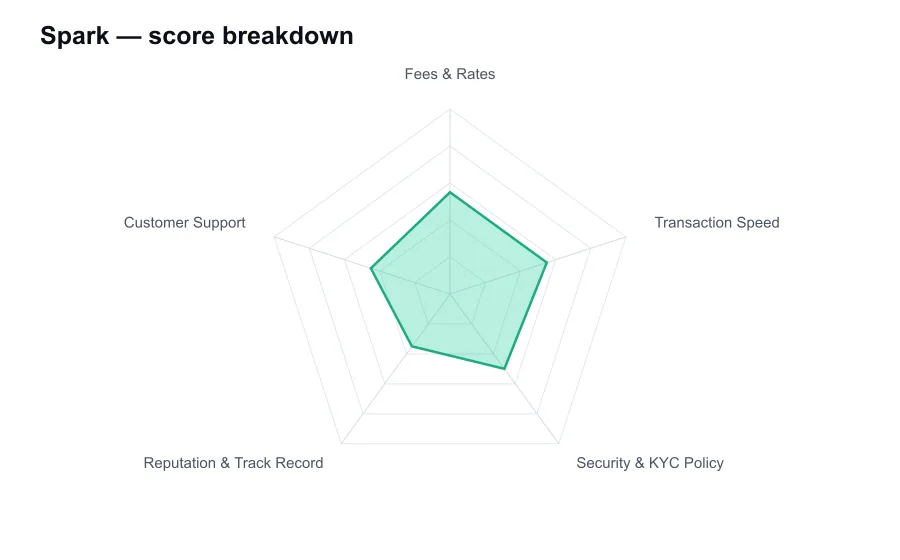
| Criterion | Score | Note |
|---|---|---|
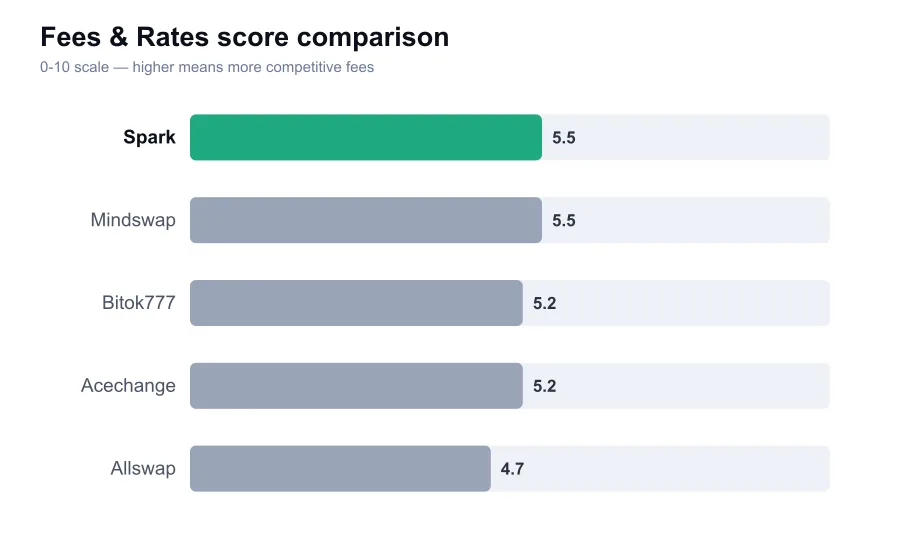
| Fees & Rates | 5.5 | Quotes are simple, but effective spreads are not very transparent |
| Transaction Speed | 5.5 | Settlement depends heavily on network and liquidity partner |
| Security & KYC Policy | 5.0 | Non-custodial model, but limited public compliance detail |
| Reputation & Track Record | 3.5 | Thin independently verifiable operating record |
| Customer Support | 4.5 | Support capability is not yet well proven publicly |
Spark is a difficult service to assess with the confidence I would apply to a long established exchange, largely because the name is used by multiple crypto and financial products and its public operating history is thin. In the instant swap market, Spark presents itself as a lightweight route for exchanging crypto without opening a conventional trading account. That simplicity is appealing, but it also leaves a prospective customer doing more homework than they should have to do.
The basic proposition is familiar. You select the asset you are sending, choose the asset you want back, enter a destination wallet, and fund the quoted order. There is no order book, advanced charting screen, custody account, or fiat banking layer. Spark is aimed at someone who already holds crypto and wants a quick conversion, not a trader trying to place limit orders or a newcomer buying their first bitcoin with a card.
That limited scope is not necessarily a flaw. A good instant exchange can save a lot of friction for a simple conversion such as ETH to USDT or BTC to LTC. The trouble is that Spark does not have the depth of public documentation, long operating record, or widely scrutinised pricing history that gives better known non-custodial swap brands some credibility. A clean checkout is not a substitute for transparency.
Fees are the first place where that matters. Spark quotes an output amount before a customer sends funds, but a quoted amount is not the same thing as a plainly itemised fee. The spread can include liquidity-provider costs, network fees, and the service's own margin. That is common across instant swap services, yet stronger operators explain the distinction clearly and provide enough transaction detail for a customer to judge the effective rate.
For small swaps, a modest spread may be a fair price for convenience. For larger orders, even a one or two percent difference in execution can matter much more than the visible network fee. I would compare Spark's final receive amount against StealthEX, ChangeNOW, SimpleSwap, and a liquid centralised exchange before committing a meaningful sum. If Spark is not clearly competitive at the moment of the quote, there is little reason to pay extra for a brand with less of a track record.
Fixed-rate options deserve particular attention. A floating quote can change between order creation and the point at which the provider receives enough confirmations. That is normal in volatile markets, but it can produce an unpleasant surprise during a busy network period. If Spark offers a guaranteed-rate route for a pair, read the conditions carefully, including the permitted deposit window and the consequences of sending too little or too much.
Speed depends mostly on the coin, blockchain congestion, and the liquidity partner behind the order. A swap involving fast networks can settle in minutes. Bitcoin transactions, token transfers that need several confirmations, and cross-chain routes involving a less liquid asset can take considerably longer. Spark should not be judged by an optimistic timer alone. The meaningful question is whether it gives a transaction ID, an honest status trail, and useful information when the order is delayed.
I would be cautious about using it for time-sensitive transfers. Instant exchanges are not truly instant once deposits, confirmations, liquidity checks, and outbound withdrawals are involved. A centralised venue with assets already deposited can execute a trade immediately, while a non-custodial swap provider cannot. Spark may suit a routine wallet-to-wallet conversion, but it is a poor tool for moving collateral, catching a market entry, or meeting a strict payment deadline.
Its security model also needs to be understood without marketing gloss. A non-custodial exchange does not normally hold a continuing account balance, which reduces the risk of an exchange collapse affecting idle customer funds. It does not remove counterparty risk during a live order. You still send funds to an address controlled by the swap process and wait for the service and its partners to deliver the purchased asset.
No-KYC positioning is often attractive to privacy-minded users, but it should never be read as a guarantee that identity checks cannot happen. Most instant exchange providers reserve the right to request source-of-funds or identity information when an automated compliance system flags an order. Spark customers should assume the same possibility unless the terms explicitly state otherwise. Sending a large amount before understanding the compliance policy is a poor gamble.
The absence of a major public reputation is Spark's largest weakness. It is not enough that a website works or that an order tracker exists. A service handling irreversible transfers should have visible company information, durable independent feedback, clear terms, and a support history that can be examined. Spark has less of that evidence than established names such as StealthEX or ChangeNOW, and that should affect the amount a customer is willing to risk.
Support is another area where small providers either earn loyalty or lose it fast. The important test is not whether a chat bubble appears on the site. It is whether an agent can identify an order, explain a blockchain delay, and resolve an underpayment or missing memo issue without canned replies. Until Spark demonstrates that consistently in public, I would treat its support as unproven rather than assuming it will be there under pressure.
There are practical ways to reduce the risk. Start with a small test transaction, verify the receiving wallet address character by character, keep screenshots of the original quote, and do not send tokens on the wrong network. Avoid a large first order, especially with assets that require destination tags, memos, or contract-address verification. Those precautions apply everywhere, but they are especially sensible with a less documented provider.
Spark may be useful if its live quote beats better known alternatives and the amount is small enough that a delay would not hurt. It has the appeal of a simple, low-friction swap tool, but it has not earned the trust premium that lets a service charge more or ask customers to take bigger operational risks. I would use it selectively, after a test, not as a primary exchange. There are too many more established routes for serious volume.
| Pros | Cons |
|---|---|
| Simple wallet-to-wallet swap flow | — |
| No conventional trading account required | — |
| Can be useful for small test conversions | — |
| — | Brand identity can be confusing |
Spark fits experienced crypto holders making a small, non-urgent swap after comparing live quotes elsewhere. It may suit privacy-conscious users who do not want a full exchange account. Large-volume users, first-time buyers, and anyone moving funds against a deadline should choose a more established exchange or swap provider with clearer support and compliance documentation.
A conventional account may not be required, but instant swap providers can still request verification for orders flagged by compliance systems. Check the current terms before sending funds.
It depends on the asset, deposit confirmations, network congestion, and liquidity. Fast-chain swaps may take minutes, while Bitcoin and less liquid routes can take much longer.
I would not make a large first order. Test the route with a small amount, compare the effective quote with established competitors, and keep records of the transaction.
| Alternative | Score |
|---|---|
| Mindswap Review | 5.0/10 |
| Bitok777 Review | 4.8/10 |
| Acechange Review | 5.1/10 |
| Allswap Review | 4.6/10 |
| Baltex Review | 5.3/10 |
| Changee Review | 4.5/10 |