| Best for | Not for |
|---|---|
| No full trading account for basic swaps | — |
| Wallet-to-wallet, noncustodial transaction flow | — |
| Simple interface for straightforward conversions | — |
Live market data via CoinGecko, for informational purposes only. Not financial advice.
Editorial independence: our scores and rankings are produced using the fixed criteria above and are not influenced by advertisers. This is an independent ranking site and is not operated by, or affiliated with, any provider we list.
Affiliate disclosure: some links on this page may earn us a commission at no extra cost to you. This does not affect our rankings.
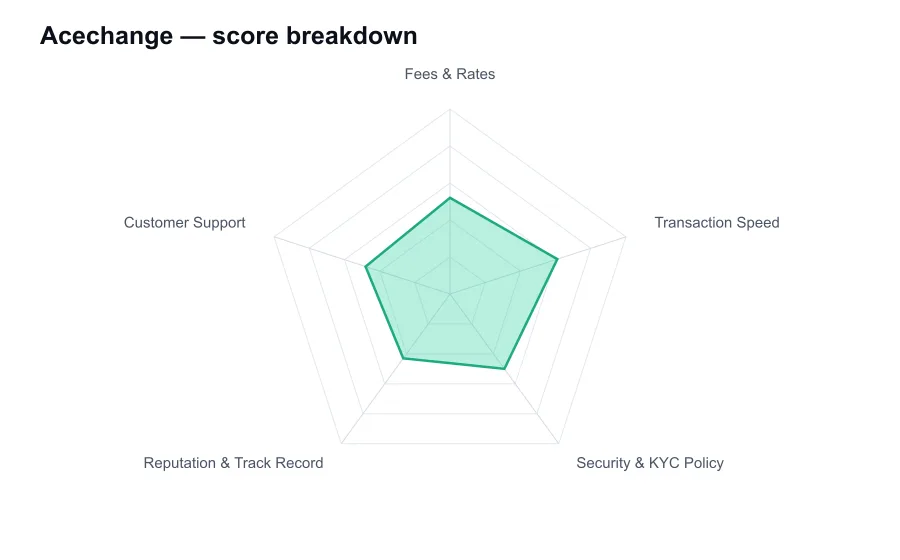
| Criterion | Score | Note |
|---|---|---|
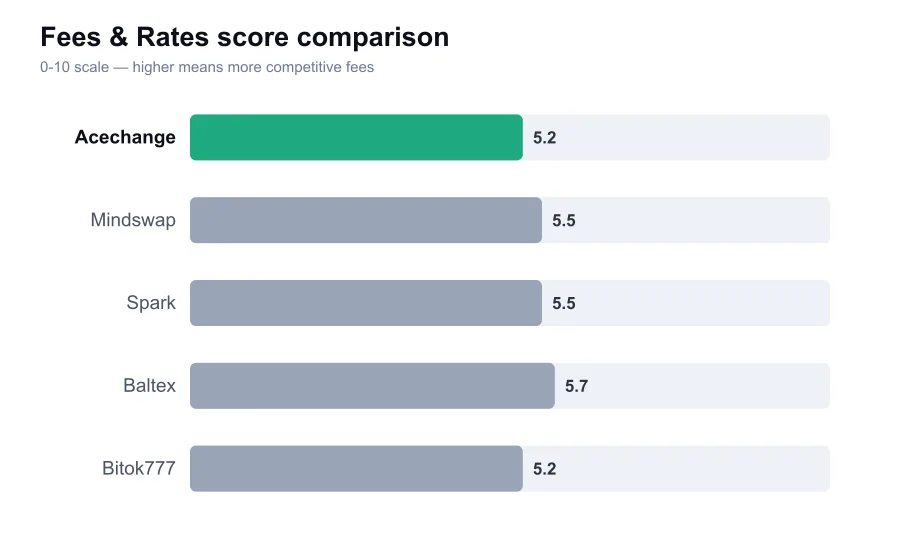
| Fees & Rates | 5.2 | Rates include spread, with no clear fixed public fee schedule. |
| Transaction Speed | 6.1 | Usually confirmation-dependent, not suited to urgent execution. |
| Security & KYC Policy | 5.0 | Noncustodial flow, but limited public security transparency. |
| Reputation & Track Record | 4.3 | Small public footprint and limited documented track record. |
| Customer Support | 4.8 | Online support is available, but escalation visibility is limited. |
Acechange is a small instant crypto exchange service aimed at people who want to swap coins without opening a full trading account. It occupies the anonymous, noncustodial end of the market, closer in spirit to ChangeNOW, SimpleSwap, and older swap aggregators than to Kraken or Coinbase. That positioning has appeal, particularly for a one-off Bitcoin, Litecoin, or USDT conversion. It also creates a hard problem for prospective users, because the company has a much lighter public footprint than the better-known operators in this category.
The service's basic promise is straightforward. You select a pair, provide a destination address, send the deposit, and Acechange forwards the converted asset after it has sourced liquidity. There is no order book to study, no portfolio dashboard worth speaking of, and no reason to leave a balance on the site. For a user who already understands wallet addresses and network fees, that simplicity is refreshing. For a beginner, it can be too bare-bones. A wrong network choice or an incorrect destination address is still your problem.
Acechange does not present fees with the kind of clean, permanent schedule I expect from a mature exchange. Its cost is generally folded into the quoted rate, together with the liquidity provider spread and blockchain mining fee. That is common among instant swap services, but it means the headline amount matters far more than a claimed fee percentage. Compare the final receive amount against ChangeNOW, StealthEX, and a liquid exchange before sending. On common pairs, the difference can be modest. On thin altcoin pairs, it can be much larger.
That opaque pricing is Acechange's biggest commercial weakness. A user cannot reliably say that it charges 0.25 percent, 0.5 percent, or any other fixed figure because the effective cost shifts with the pair, market conditions, and transaction size. Fixed-rate quotes, where available, are generally easier to trust than floating quotes, though they can include a wider buffer. Floating rates may land better in a quiet market, but a fast move in Bitcoin or Ethereum can turn a seemingly cheap swap into an expensive one.
The practical way to use Acechange is to test it with a small transaction and record three figures: the amount sent, the quoted amount, and the amount actually received. Don't judge it by the price displayed before network confirmation alone. The fair comparison is the final amount arriving in your wallet. This is especially important with USDT because a cheap-looking token rate can be erased by selecting an expensive network, or by an unhelpful spread on the provider's side.
Speed depends less on Acechange's interface than on the assets involved. A swap from Litecoin or a low-fee network can complete quickly once the required confirmations arrive. Bitcoin deposits naturally take longer, particularly during congestion, and Ethereum mainnet transactions can be slowed by gas conditions. A normal instant exchange transaction often finishes within minutes to an hour, but that is not a delivery guarantee. Liquidity sourcing, deposit confirmation, and compliance review can all interrupt the optimistic estimate shown on screen.
I would not use Acechange for a time-critical payment, an arbitrage trade, or a conversion needed before a volatile market deadline. There is no trading engine and no meaningful ability to cancel once the deposit has been sent. If the receiving asset rises sharply while your transaction is waiting for confirmations, a floating-rate order may disappoint. A centralized exchange with funded balances is the right tool for traders who need execution certainty. Acechange is better understood as a wallet-to-wallet conversion utility.
Its noncustodial format is a real positive, but it shouldn't be confused with complete safety or anonymity. The platform may not ask every customer to create an account, yet transaction screening and risk controls can still trigger an identity request. That is now standard practice across much of the instant-swap market. Anyone promising that no transaction can ever face review is not being realistic. If Acechange flags a transfer, funds may be held while it requests evidence of source of funds or identity documentation.
This creates an awkward mismatch between marketing expectations and actual user experience. People often choose smaller instant exchangers specifically to avoid KYC, then react badly when a transaction is paused. The sensible assumption is that KYC may be required in exceptional cases, not that the service is guaranteed private. Don't send coins linked to mixers, scams, ransomware, sanctioned services, or questionable counterparties. Even an innocent user can face a long and frustrating review if blockchain analytics identifies elevated risk.
Acechange gives limited public material about corporate ownership, licensing arrangements, cold-storage practices, insurance, or independently audited reserves. That does not automatically make the service unsafe, because it is not designed to hold client balances for long. Still, it does mean the trust burden sits with the user. A company with a transparent team, clear legal entity, detailed terms, and years of independently documented operating history deserves more confidence than a lightly documented swap page.
Reputation is where Acechange trails the established names most clearly. It has nowhere near the public track record of Bitstamp, Kraken, or even long-running instant services such as Changelly. Reviews of small exchangers can be difficult to interpret because a handful of successful swaps proves little, while a few complaints may involve invalid addresses, compliance checks, or genuine service failures. I found no compelling reason to treat Acechange as a major market institution. It should be approached as a niche provider that needs transaction-by-transaction caution.
Support appears to be primarily online and ticket-based, with response quality likely to matter most when a transaction is pending. That is exactly the moment small instant exchanges are tested. A simple completed swap rarely needs assistance. The real question is whether someone gives a clear explanation, a transaction identifier, and a realistic timetable when a deposit is delayed or a compliance review begins. Acechange does not have the publicly visible support infrastructure that larger regulated platforms can fund.
Before using it, save screenshots of the quote, order ID, destination address, deposit address, transaction hash, and any exchange correspondence. That sounds tedious until something goes wrong. Never rely on a copied address without checking its first and last characters, and do not send a token over a network the order page did not explicitly specify. I would also avoid sending a life-changing amount in one order. Breaking a large conversion into carefully tested tranches is more prudent, even if it costs a little extra.
Acechange can do a useful job for an experienced self-custody user making a modest, uncomplicated swap. Its lack of account friction is attractive, and the noncustodial flow avoids the risk of leaving coins on an exchange. But the weak point is confidence, not convenience. Pricing is hard to audit in advance, public corporate transparency is thin, and there is limited evidence of a long, battle-tested service record. My view is blunt: use it only after comparing the live quote and only with money you can afford to have temporarily delayed. For larger amounts, regulated and more transparent alternatives are the better call.
| Pros | Cons |
|---|---|
| No full trading account for basic swaps | — |
| Wallet-to-wallet, noncustodial transaction flow | — |
| Simple interface for straightforward conversions | — |
Acechange fits experienced self-custody users making a small, simple conversion after checking its live quote against competitors. It may suit someone who values account-light access more than a polished trading platform. Beginners, high-volume traders, and anyone converting a large amount should use a more transparent, established exchange instead. Avoid it for deadline-sensitive trades.
A full account may not be required for a standard swap, but risk controls can trigger identity or source-of-funds checks. Do not assume every transaction is KYC-free.
The effective cost is generally built into the exchange rate and may also reflect network fees. Compare the final receive amount, not just a displayed fee.
Timing depends on deposit confirmations, network congestion, liquidity, and any review. Many swaps can finish within minutes to an hour, but delays are possible.
| Alternative | Score |
|---|---|
| Mindswap Review | 5.0/10 |
| Spark Review | 4.9/10 |
| Baltex Review | 5.3/10 |
| Bitok777 Review | 4.8/10 |
| YaObmen Review | 5.4/10 |
| WmMoney Review | 5.4/10 |