| Best for | Not for |
|---|---|
| Straightforward conversion flow | — |
| May cover niche payment routes | — |
| Useful for small test swaps | — |
| No trading interface required | — |
Live market data via CoinGecko, for informational purposes only. Not financial advice.
Editorial independence: our scores and rankings are produced using the fixed criteria above and are not influenced by advertisers. This is an independent ranking site and is not operated by, or affiliated with, any provider we list.
Affiliate disclosure: some links on this page may earn us a commission at no extra cost to you. This does not affect our rankings.
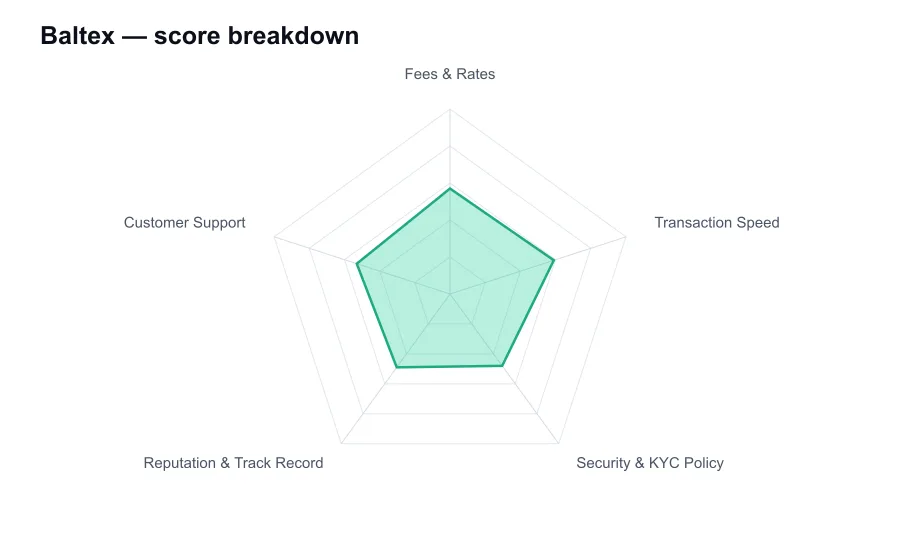
| Criterion | Score | Note |
|---|---|---|
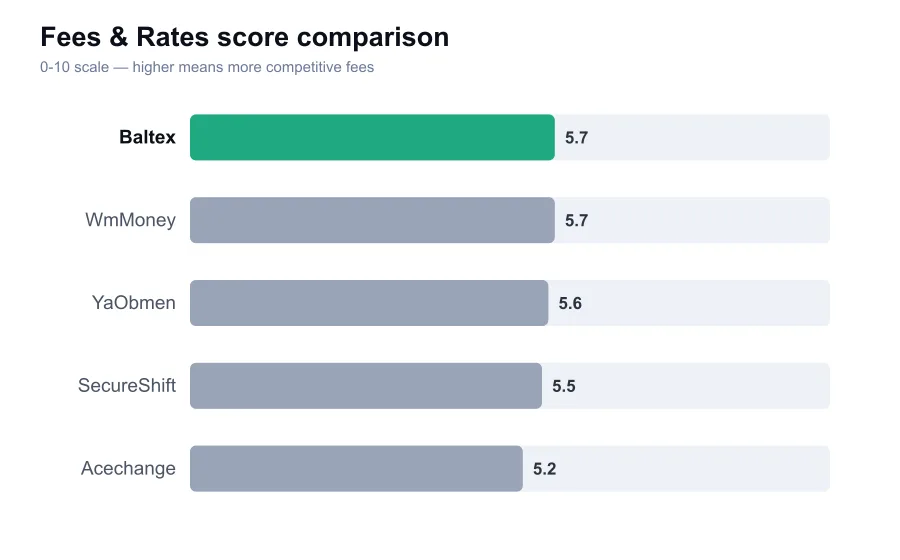
| Fees & Rates | 5.7 | Quote spread requires careful external comparison. |
| Transaction Speed | 5.9 | Simple swaps may be quick, reviews can slow orders. |
| Security & KYC Policy | 4.8 | Public evidence on custody controls is limited. |
| Reputation & Track Record | 4.9 | A modest public footprint limits confidence. |
| Customer Support | 5.3 | Test support before committing meaningful funds. |
Baltex is a smaller exchange service aimed at direct cryptocurrency conversions rather than a broad, regulated trading ecosystem. It occupies the same practical niche as many regional online exchangers, offering a quick route between coins, stablecoins, and selected payment methods. That niche can be useful, particularly where large exchanges do not serve a local rail well. It is also a segment where glossy promises should be treated with more skepticism than a familiar brand name.
The first thing to understand is that Baltex is not built to replace a major spot exchange. You are not getting deep public order books, advanced order types, transparent maker and taker tiers, or a mature custody product. You are requesting a conversion at a provider-set rate. For a person who simply needs to turn one asset into another, that can be less intimidating. For anyone trying to obtain best execution, it is a less favorable starting point.
Fees are the hardest category to grade generously because the real cost is usually folded into the rate. A conventional venue such as Kraken Pro can show a fee separately from market price. Baltex-style services usually cannot offer that same clarity. The customer must calculate the difference between the external market value and the amount quoted at checkout. Network fees can be meaningful too, especially for Bitcoin and Ethereum transfers during busy periods.
I would not accept a quote without checking it against a liquid reference market and at least one alternative exchanger. This matters far more than saving a minute on the interface. A seemingly small spread can turn into a costly transaction once the amount rises. The better Baltex quote may vary by route, reserve level, and time of day, so blanket claims that it is cheap or expensive are not very useful. Check the actual payout each time.
Minimums and maximums deserve the same attention. Small exchangers commonly have route-specific limits based on reserve, banking capacity, or compliance risk. An advertised pair may be available in theory but not have enough liquidity for a larger request at that moment. If the amount is substantial, ask support whether the transaction can be completed at the shown rate, whether partial payout is possible, and what proof may be requested before you send anything.
Speed can be perfectly adequate on an uncomplicated crypto-to-crypto transfer. Once an incoming deposit has confirmed, a standard payout should not require the machinery of a large trading platform. Yet this is where the word "instant" causes trouble. Blockchain confirmation time, wallet maintenance, staff availability, transaction screening, and payment-provider settlement all affect the clock. A quick order can become a several-hour matter if one of those pieces needs human intervention.
Baltex is therefore best used with a realistic time buffer. Do not fund a travel bill, property payment, liquidation deadline, or other hard deadline through an unfamiliar exchanger. Stablecoins on a supported low-fee chain can be much more predictable than a BTC transfer, but chain selection must match exactly. Sending USDT over the wrong network is one of the most common and most avoidable failures in this market.
Security documentation is not where Baltex competes with established exchanges. I have not seen the level of public evidence that would let a customer evaluate independent security audits, reserves, insurer backing, segregated custody, or a formal incident-reporting history. That absence is material. It does not prove bad practice, but it means users should not assume the protections that a better known exchange may offer.
There is a second security issue that users sometimes overlook. A conversion service generally has no reason to hold your balance longer than an order requires. That is actually a good operating rule for the customer. Deposit only to the specific address and amount requested, complete the order, then withdraw the result to a self-custody wallet or an account at a trusted venue. Keeping a balance with a small exchanger adds risk without creating much benefit.
KYC should be viewed as conditional, not absent. Some flows may begin without a full account profile, but risk controls can still trigger a document request. A card payment, a bank transfer from a third party, a large amount, sanctioned-address exposure, or a transaction that does not match the order can all cause a review. Anyone unwilling or unable to provide identification should not assume a transaction will remain frictionless.
Baltex's reputation is modest and difficult to assess with the confidence available for older, regulated names. Search results, monitoring-site comments, and individual reviews can help identify recurring operational complaints, but they are not a substitute for regulator records or audited disclosures. I would pay attention to patterns, particularly unresolved delays and recurring rate changes, rather than being swayed by a handful of glowing or angry posts.
This modest reputation does not mean there is no reason to use it. Regional providers can be more practical than global platforms for a particular cash-out or payment method. A customer may care more about receiving local currency through a supported route than about trading at the lowest possible fee. Baltex has a case if it offers that route, shows adequate reserve, and returns a better final payout than its alternatives. It has little case as a default crypto home.
Support quality is difficult to verify until a problem appears, which is exactly why pre-sale checking matters. Look for a clear order identifier, a support channel that is actually monitored, published operating hours, and terms explaining refunds or recalculation. Send a basic question before a meaningful order. If the reply is vague, slow, or cannot explain a common problem such as an incorrect network, that is useful information before your funds are involved.
For a small first transaction, Baltex can be a workable utility. Keep screenshots, use your own wallet, and confirm every character of the address and memo. I would avoid sending a large amount in one shot until a smaller order has closed successfully. That is not paranoia. It is sound practice for any provider whose public record and operational disclosures are limited.
My opinion is that Baltex belongs in the comparison list, not at the center of a user's crypto activity. Its direct workflow may solve a specific exchange need, but its pricing is less transparent than a proper spot venue and its public trust signals are comparatively thin. Use it only if the route and final payout are compelling. If reliability, formal compliance evidence, and strong customer escalation matter more, choose a larger exchange.
| Pros | Cons |
|---|---|
| Straightforward conversion flow | — |
| May cover niche payment routes | — |
| Useful for small test swaps | — |
| No trading interface required | — |
Baltex may suit a crypto user who needs a particular supported conversion route and is comfortable verifying rates independently. It is more appropriate for a modest one-off transaction than recurring high-value activity. Traders, companies, and users seeking clear regulation, published controls, and a broad support operation should look to established exchanges.
Not necessarily. Baltex-style services often include their margin in the conversion rate. Compare the final received amount with a spot exchange and another exchanger.
No. A direct exchanger is best treated as a transaction service. Move completed proceeds to a wallet you control or a trusted account.
Yes. Even where an order starts simply, AML, payment risk, amount, or transaction details can result in a request for documents.
| Alternative | Score |
|---|---|
| YaObmen Review | 5.4/10 |
| WmMoney Review | 5.4/10 |
| SecureShift Review | 5.5/10 |
| Acechange Review | 5.1/10 |
| Mindswap Review | 5.0/10 |
| Spark Review | 4.9/10 |
