| Best for | Not for |
|---|---|
| Useful for niche electronic money conversions | — |
| Direct order based workflow | — |
| May reduce multi platform transfer steps | — |
| Suitable for small test exchanges | — |
Live market data via CoinGecko, for informational purposes only. Not financial advice.
Editorial independence: our scores and rankings are produced using the fixed criteria above and are not influenced by advertisers. This is an independent ranking site and is not operated by, or affiliated with, any provider we list.
Affiliate disclosure: some links on this page may earn us a commission at no extra cost to you. This does not affect our rankings.
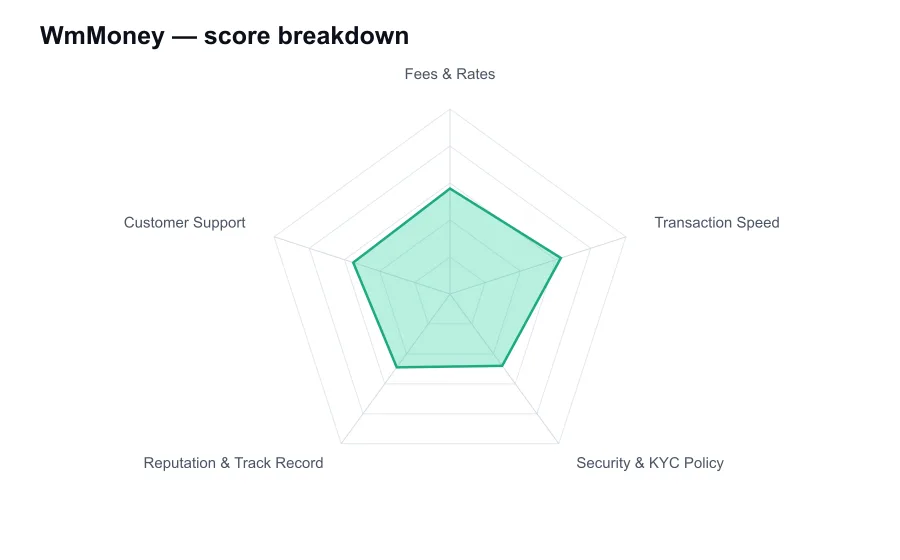
| Criterion | Score | Note |
|---|---|---|
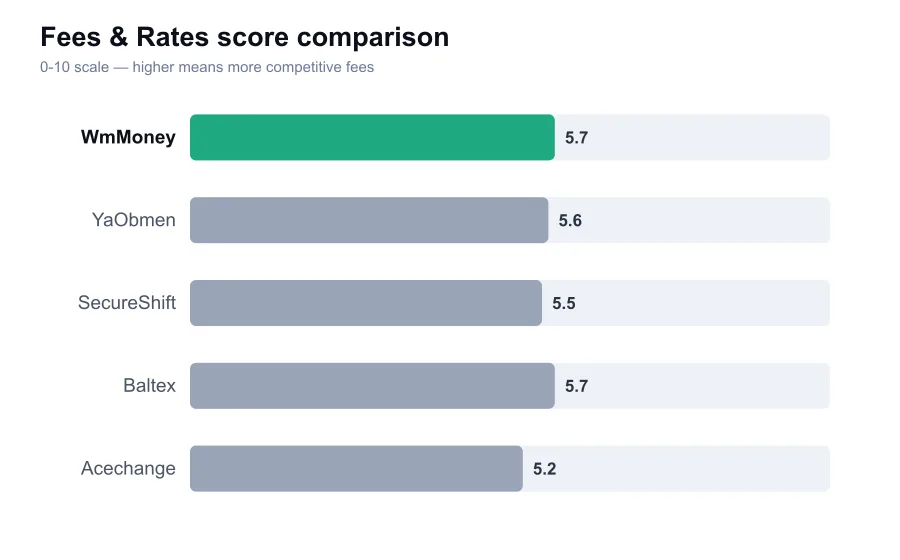
| Fees & Rates | 5.7 | Rate based pricing can be convenient but needs careful comparison |
| Transaction Speed | 6.3 | Routine digital orders may be quick, exceptions can take longer |
| Security & KYC Policy | 4.8 | Treat as a short term transaction counterparty, not a wallet |
| Reputation & Track Record | 4.9 | Smaller public footprint than established centralized exchanges |
| Customer Support | 5.5 | Support quality is crucial and should be tested with small orders |
WmMoney is a smaller online exchange service in the broad cashout and digital currency conversion market. Its name and positioning naturally appeal to users moving between WebMoney style electronic balances, cryptocurrency, and local payment options. That niche can be useful, especially where banking access is inconsistent or users need a direct conversion path. It is not, however, a substitute for a full featured crypto exchange.
The central question with WmMoney is not whether the website can create an order. Most exchange services can do that. The question is whether the rate, reserve, processing time, and support quality are good enough for the specific payment route you need. Smaller exchangers can be excellent on one local direction and poor on another. Treat each pair as its own product rather than assuming a familiar brand name makes every conversion equally attractive.
Fees are commonly embedded in the offered rate. That is normal in this segment, but it makes comparison essential. A quoted exchange might include a service margin, a payment system fee, blockchain costs, and risk pricing related to reversible payment methods. The final amount received is the only number that matters. Compare it with at least two alternatives and include any cost of sending funds to WmMoney in the calculation.
For crypto pairs with deep external liquidity, a major exchange will usually deliver better raw pricing. WmMoney's possible advantage is avoiding multiple steps. Someone who needs to exchange a particular electronic money balance into a stablecoin may prefer a single direct order even if it costs more. That trade can make sense for a modest amount. It is far less convincing for routine high volume activity, where small rate differences accumulate rapidly.
Order speed depends on what is being exchanged. Digital wallet payments may be recognized quickly, and a crypto payout can follow after internal confirmation. On chain deposits still depend on the network, so bitcoin transactions may take much longer than a transfer on a low fee stablecoin network. Bank linked transfers and cards can introduce delays, reversals, or fraud checks. A service cannot honestly make those dependencies disappear.
There is an additional complication with lesser known exchangers: reserve availability. A displayed exchange direction does not always mean unlimited immediate capacity. Larger orders may need to wait for replenishment or be handled manually. Before placing a substantial transaction, verify the stated reserve, check whether the rate is fixed, and ask support about processing expectations if the order is unusual. This is not paranoia. It is ordinary due diligence in a market where small operators have limited working capital.
WmMoney's security profile should be assessed conservatively. Any service that receives your funds and sends a different asset back is a temporary custodian. If it does not provide the public compliance footprint, audited disclosures, and longstanding institutional record of a major exchange, users should adjust the amount they risk accordingly. I would use a service like this for a specific conversion, not for storing balances, recurring payroll, or business treasury transfers.
No KYC language can also be misunderstood. A simple order process may not require creating a detailed account in advance, yet financial crime controls can still apply. A transfer linked to a suspicious address, an unusual amount, or a payment provider dispute may trigger requests for identification or transaction evidence. Sending funds before understanding that possibility is a poor decision. Privacy minded users should assume that no centralized exchange route is guaranteed to remain verification free.
The best personal security habits are boring but effective. Use the genuine domain, verify the receiving address and network, keep the order ID, and record the transaction hash. Don't follow instructions from an account claiming to be support on social media. Do not split an order, send a different amount, or use a different sender name unless the official instructions explicitly permit it. Those shortcuts are a common cause of manual holds.
Public reputation for WmMoney is harder to assess than for an internationally recognized exchange. Smaller services may have reviews on monitoring directories and local forums, but feedback can be fragmented and difficult to verify. A handful of positive comments should not be treated as proof of deep reliability. I would look for a sustained record of completed orders, clear terms, responsive official communication, and an absence of repeated complaints about unexplained rate changes or frozen payouts.
That limited public footprint is the main reason I cannot rate WmMoney as highly as an established regulated exchange. It may serve customers honestly and efficiently, but a reviewer should distinguish direct evidence from assumption. Users have less independent information to lean on if something goes wrong. With a major platform, there are usually published policies, substantial public scrutiny, and clearer escalation channels. With a small exchanger, the relationship is more personal and more fragile.
Support therefore matters disproportionately. A good operator can resolve a wrong memo, delayed payment, or unrecognized deposit if the customer has supplied good evidence. A weak one leaves users waiting with little explanation. WmMoney customers should make their first support interaction before a major transaction if possible, perhaps by asking a concise question about the route they intend to use. The quality and specificity of the reply can reveal a great deal.
I would also avoid relying on advertised around the clock availability unless it is tested. An automated order form is not the same as an operator available to resolve exceptions at midnight or over a holiday. For routine transactions that distinction may not matter. For money needed urgently, it matters a lot. Keep a second exchange route available if timing has consequences.
WmMoney can have a legitimate role for users who need a particular electronic money or regional payment conversion that large exchanges don't handle elegantly. The right approach is modest, methodical, and unsentimental. Get a live quote, start with a small test, and judge the provider by the actual payout and communication. Do not let convenience turn into blind trust.
My view is that WmMoney is a niche option rather than a primary recommendation. It may be useful for a successful small exchange in a route where it has real local expertise. Its weak point is the smaller public track record and thinner transparency compared with major platforms. Use it as a transaction tool, not a place to keep money, and choose another provider if you need institutional safeguards, predictable high limits, or formal support escalation.
| Pros | Cons |
|---|---|
| Useful for niche electronic money conversions | — |
| Direct order based workflow | — |
| May reduce multi platform transfer steps | — |
| Suitable for small test exchanges | — |
WmMoney may fit users who specifically need a payment route that larger crypto exchanges do not serve well. It is best used for a small, planned conversion after checking the live rate and support responsiveness. It is not a good match for active traders, high value transfers, or users who need formal regulatory protections. Businesses should choose a provider with clearer compliance documentation and account management.
The cost is typically reflected in the offered exchange rate, along with payment and network costs. Compare the final payout against other services before funding an order.
Not necessarily. Large orders can depend on available reserves, payment review, and manual handling. Ask through official support before sending a substantial amount.
No. Use a small exchanger for the specific conversion and transfer funds to a wallet or established platform you control afterward.
| Alternative | Score |
|---|---|
| YaObmen Review | 5.4/10 |
| SecureShift Review | 5.5/10 |
| Baltex Review | 5.3/10 |
| Acechange Review | 5.1/10 |
| Explace Review | 5.8/10 |
| WxMoney Review | 5.8/10 |