| Best for | Not for |
|---|---|
| Simple no-account swap workflow | — |
| Personal-wallet destination model | — |
| Potentially useful live quotes on small swaps | — |
| Less intimidating than a trading terminal | — |
Live market data via CoinGecko, for informational purposes only. Not financial advice.
Editorial independence: our scores and rankings are produced using the fixed criteria above and are not influenced by advertisers. This is an independent ranking site and is not operated by, or affiliated with, any provider we list.
Affiliate disclosure: some links on this page may earn us a commission at no extra cost to you. This does not affect our rankings.
| Criterion | Score | Note |
|---|---|---|
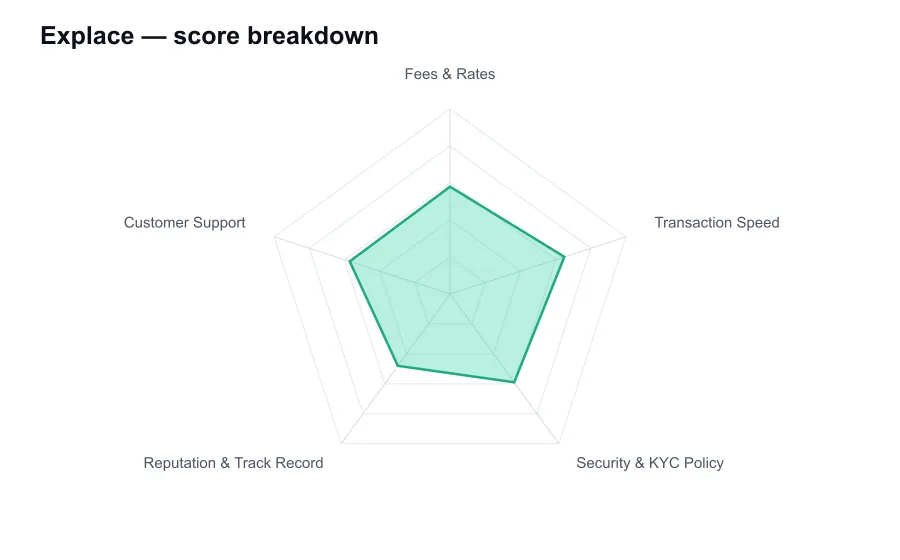
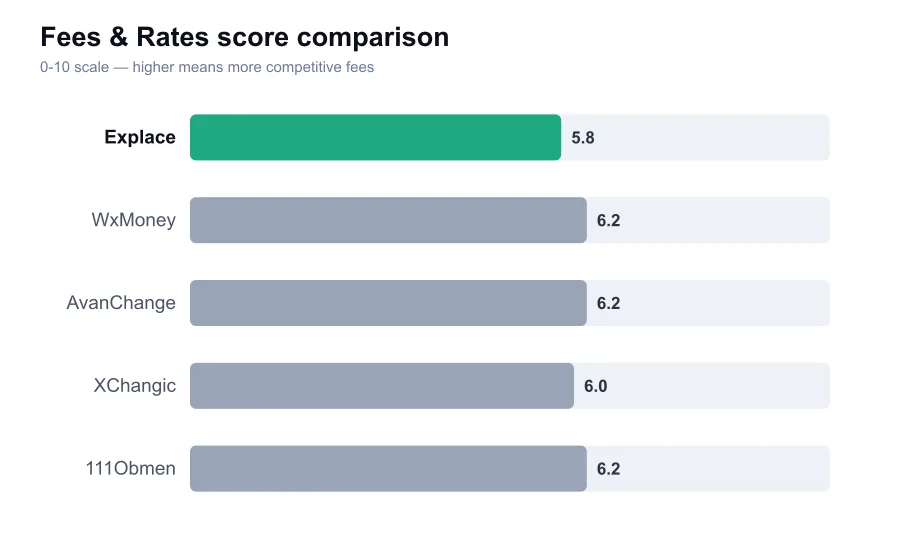
| Fees & Rates | 5.8 | Quote-based pricing needs comparison with established rivals |
| Transaction Speed | 6.5 | Routine swaps can be quick, edge-case history is limited |
| Security & KYC Policy | 5.9 | No-account model, but compliance and operations need caution |
| Reputation & Track Record | 4.8 | Smaller public track record than leading exchange services |
| Customer Support | 5.7 | Support availability matters, escalation depth is unclear |
Explace is a smaller instant crypto exchange brand aimed at the same audience that uses no-account swap services. Its proposition is straightforward: select a pair, send crypto, and receive another asset in a personal wallet without navigating a full trading terminal. That can be appealing, particularly to users who find conventional exchanges bloated. The problem is that Explace enters a market where simplicity is easy to copy and trust is much harder to earn.
The site is designed around the quick-conversion model rather than custody, margin trading, staking, or fiat banking. You are not opening a portfolio account in the usual sense. The exchange is a transaction service, with your deposit sent to an address for processing and the proceeds delivered to an address you control. This makes the interface approachable, but it also means the quality of its execution and support matters far more than glossy design.
Explace offers a range of familiar cryptocurrency pairs, and its quote-driven process will feel immediately recognizable to anyone who has used an instant exchanger. The key practical question is not whether it lists an asset, but whether it can source that asset competitively at the moment you trade. Smaller services often display a wide catalog through third-party liquidity connections. Listing availability is not the same thing as deep, reliable liquidity.
Fees are the area where I would be most demanding. Explace does not have the kind of transparent, universally published maker and taker fee schedule that traders get from a major exchange. The price difference between the market rate and the offered output is effectively the service's all-in charge, alongside network costs. That is acceptable for a simple swap tool, but it prevents users from knowing the cost before comparing the live quote against alternatives.
For a modest conversion of major coins, the quote may be reasonable. For less liquid tokens or fast-moving markets, the spread can be a poor deal without looking obviously expensive at first glance. A user who only sees the destination amount has no easy way to separate market movement, liquidity cost, and service margin. That lack of fee transparency is not unique to Explace, but it is harder to excuse from a less established provider because there is less independent evidence of consistently good execution.
My practical advice is to use Explace only after running a live comparison. Check the same amount and pair at Exolix, ChangeNOW, StealthEX, and a centralized exchange if you have an account. Make sure every service is quoting the same network and stablecoin version. A few minutes of comparison can save more than the apparent convenience of choosing the first available widget.
Transaction speed should be judged realistically. Explace can process a straightforward liquid swap quickly once the deposit is confirmed, and a light transaction on Tron or Polygon may reach the recipient wallet in a short time. Bitcoin, Ethereum, and congested chains introduce delays that no intermediary can eliminate. A provider can only process what it has received, and it may wait for confirmations before hedging or releasing funds.
The greater concern is exception handling. A small exchange can look fast while every order is ordinary. The real test is a deposit with an incorrect memo, an amount below the minimum, an unsupported token contract, a delayed confirmation, or a liquidity outage. This is where Explace has less publicly visible operational history than leading names. I would not use it for a large time-sensitive transaction until it has earned that confidence through smaller tests.
The no-account approach is a privacy advantage, but users should not confuse it with absolute anonymity. Services operating in this category can screen blockchain activity and may require identity verification if an order triggers compliance controls. Explace's policy position and operational procedures should be read before sending, especially for larger amounts. If identity verification becomes necessary after funds are already in transit, the user has very little leverage besides cooperating with support.
There is also a security distinction that inexperienced users miss. No long-term custodial account means there is less risk of an account balance being exposed in a future exchange breach. Yet the service is still entrusted with funds while the swap is in progress. You must verify the destination address, protect your email and device, and avoid fake support accounts. An instant swap is not a wallet-to-wallet atomic exchange, even if the interface makes it feel that simple.
Explace does not have the same depth of public track record as older instant exchanges or heavily regulated centralized venues. That does not prove misconduct, and newer companies need a chance to establish themselves. It does mean reputation should be scored conservatively. Marketing claims, review widgets, and affiliate listings are weak substitutes for years of independently observable uptime, transparent corporate information, and a long record of resolving difficult cases.
Support is particularly important for Explace because a lean service leaves little room for error. A clear transaction ID, responsive live chat, and accessible email route are basic requirements. For routine questions, users may get what they need quickly. I would not assume that the support operation has the staffing or escalation depth of a major platform, though. Keep detailed records before contacting it, and never rely on direct messages from accounts claiming to be support staff.
The service can still make sense for a small, non-urgent swap where its quote beats better-known rivals. That is the honest use case. Start with an amount you can afford to have delayed, send from a wallet where you control the keys, and verify each network selection twice. Do not use a small provider as your first choice for moving treasury funds, converting a large amount during a volatile market, or meeting a deadline.
Explace has the appeal of a clean, low-friction swap tool, but it has not accumulated enough public weight to be treated as a default recommendation. The product category is unforgiving. One delayed order may be manageable, while poor communication during that delay can destroy trust quickly. Until the company builds a deeper, more independently documented history, a cautious user should treat its convenience as secondary to quote comparison and position sizing.
My final view is guarded rather than hostile. Explace may work perfectly well for simple transactions, and its no-account format is genuinely convenient. But its fee opacity, limited public track record, and uncertain resilience under edge cases make it a weaker choice than the best-known instant exchangers. Use it selectively, not casually. The price must be clearly better to justify accepting the additional reputation risk.
| Pros | Cons |
|---|---|
| Simple no-account swap workflow | — |
| Personal-wallet destination model | — |
| Potentially useful live quotes on small swaps | — |
| Less intimidating than a trading terminal | — |
Explace is best approached by experienced wallet users testing a small, non-urgent conversion after comparing live quotes. It may suit someone who values a simple interface and finds a materially better price than larger competitors. Beginners moving meaningful savings should choose a provider with a longer record and stronger support visibility. Businesses, large holders, and deadline-sensitive users should use established exchanges or regulated venues instead.
Explace is presented as an instant exchange service rather than a conventional account-based trading platform. Review its current terms before use because verification can still be requested in specific compliance situations.
Compare the exact amount, token, and network against multiple instant exchangers at the same time. Also compare the received amount with a liquid exchange price after accounting for withdrawal and network fees.
A large first transaction is not advisable with a provider that has a limited public track record. Test the route with a small amount first, and use a more established venue for important transfers.
| Alternative | Score |
|---|---|
| WxMoney Review | 5.8/10 |
| AvanChange Review | 5.8/10 |
| XChangic Review | 5.9/10 |
| 111Obmen Review | 5.9/10 |
| Quickex Review | 5.9/10 |
| Swapter Review | 5.9/10 |