| Best for | Not for |
|---|---|
| Fixed-rate and floating-rate swap options | — |
| No routine account registration | — |
| Operating history dating to 2018 | — |
| Convenient for occasional wallet-to-wallet conversions | — |
Live market data via CoinGecko, for informational purposes only. Not financial advice.
Editorial independence: our scores and rankings are produced using the fixed criteria above and are not influenced by advertisers. This is an independent ranking site and is not operated by, or affiliated with, any provider we list.
Affiliate disclosure: some links on this page may earn us a commission at no extra cost to you. This does not affect our rankings.
| Criterion | Score | Note |
|---|---|---|
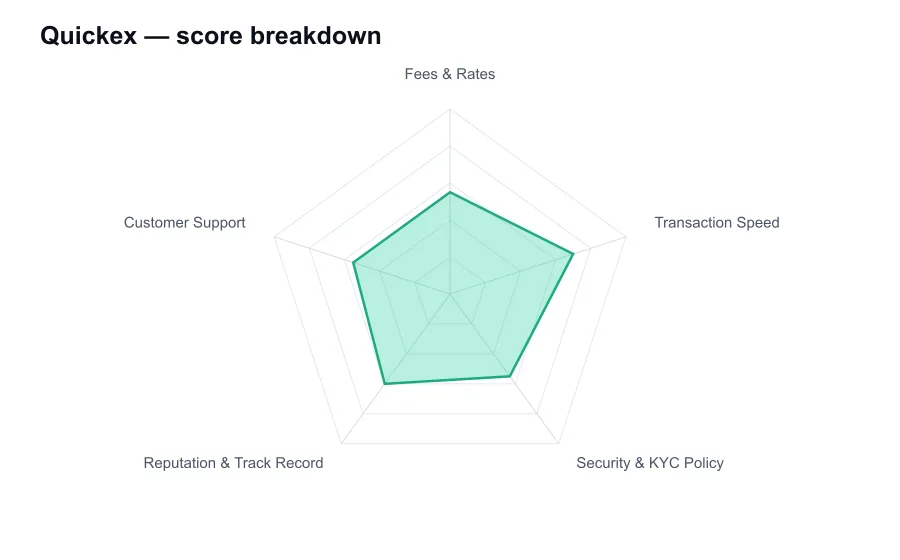
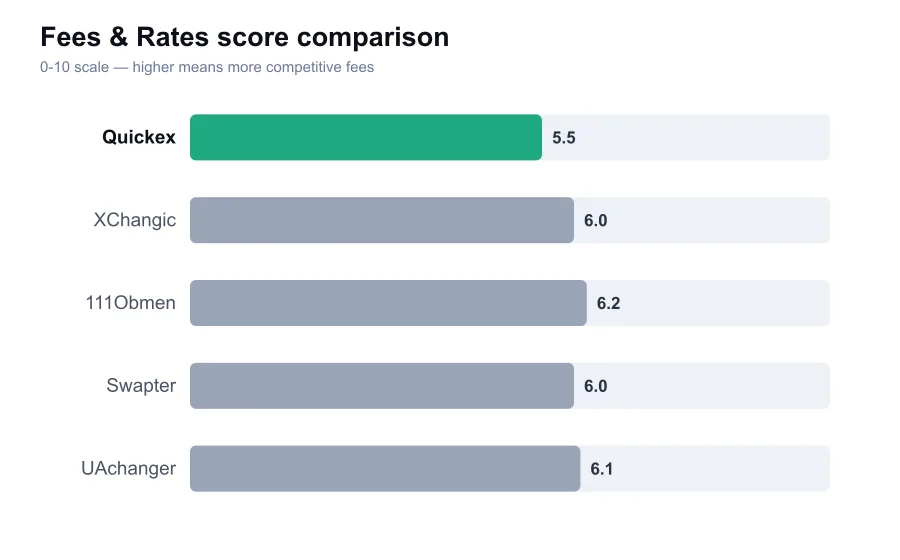
| Fees & Rates | 5.5 | Costs are embedded in quotes, so comparison is essential. |
| Transaction Speed | 7.0 | Common swaps often settle in minutes, chain permitting. |
| Security & KYC Policy | 5.5 | No routine signup, but AML reviews can still occur. |
| Reputation & Track Record | 6.0 | Operating since 2018, with mixed public feedback. |
| Customer Support | 5.5 | Useful for routine issues, variable on complex cases. |
Quickex is an instant crypto exchange service, not a full-featured trading venue. Its job is to turn one coin into another with as little account setup and chart-watching as possible. That narrow focus has value. Plenty of users do not need derivatives, staking dashboards, or a dozen order types. They want to send an asset, receive another, and move on. Quickex is built around that use case.
The service has been operating since 2018, which gives it a more meaningful history than the flood of anonymous swap pages that appear and disappear in a single market cycle. It still belongs in the second tier of market recognition rather than the league of Coinbase, Kraken, or Binance. That distinction matters because long-lived, high-volume exchanges have deeper support operations, clearer legal structures, and more public pressure to resolve complaints.
Quickex offers fixed-rate and floating-rate exchanges. This is not a cosmetic choice. A floating rate can produce a better quote if the market behaves, but the final amount can change while the transaction is being confirmed. A fixed rate gives the customer more certainty during volatile periods, usually for a somewhat less attractive quote or a defined time window. Users making a time-sensitive stablecoin or portfolio conversion should understand that difference before clicking send.
The fee question is less satisfying. Quickex does not function like a conventional order-book exchange with a neat maker and taker table. Its compensation is folded into the quoted rate and can include liquidity-provider costs and network conditions. That is normal for instant exchange services, but it means the only figure that really matters is the final amount received. The site is convenient, not necessarily cheap.
For a small conversion, the premium may be a fair price for speed and simplicity. For a large one, it can become expensive quickly. I would compare Quickex's quote with ChangeNOW, SimpleSwap, a liquid centralized exchange, and a decentralized route where appropriate. Do this immediately before sending because crypto prices move. If Quickex is only marginally worse and the fixed quote suits your purpose, the convenience can be defensible. If the gap is large, do not rationalize it.
The actual exchange process is usually straightforward. Select the send and receive assets, provide a destination address, transfer the requested amount, then wait for network confirmations and the provider's swap process. In normal conditions, common swaps often complete within minutes to roughly half an hour. That is not a contractual guarantee. Bitcoin confirmations, Ethereum congestion, wallet maintenance, and risk checks can stretch the timeline.
Quickex performs better on operational speed than on price transparency. Its flow reduces the friction of creating a trading account and withdrawing again, which is why users accept the spread. It can be especially handy for moving between assets that are inconvenient to trade directly on a user's primary exchange. Still, do not call it instant in the literal sense. Any on-chain service is dependent on blockchains and counterparties outside its control.
Quickex generally does not require registration or routine KYC to begin an exchange. That is a real benefit for users who want fewer accounts and less data exposure. It is not a promise of anonymity. Its terms allow transactions to be reviewed under anti-money-laundering procedures, and the service can request identification or source-of-funds information where risk systems flag activity. Sending money first and reading this later is how users get unpleasant surprises.
This conditional KYC model is common across instant exchangers and deserves a lower security score than a fully regulated exchange with a predictable onboarding process. A person may prefer privacy, but they should also understand the trade. There is less certainty about what happens if an automated review catches a transaction. Never use an instant exchange for funds tied to a deadline, a business invoice, or an urgent payment where a compliance pause would cause damage.
On technical security, Quickex has a practical advantage over a custodial exchange because it is designed for swap-by-swap use instead of keeping a long-term trading balance in an account. That limits exposure if you do not leave funds sitting with the service. It does not eliminate counterparty risk. The inbound transfer is still irreversible, and users must trust Quickex and its partners to execute the promised outbound transaction.
Its reputation is respectable for an instant exchanger, but it is not spotless or bank-like. Public review platforms contain many routine success stories along with the standard complaints about delayed swaps, rate differences, and verification requests. That pattern is believable for the business model. What matters is whether a delay is communicated clearly and resolved. Quickex has enough history to be considered a real operator, but not enough institutional weight to make blind trust sensible.
Customer support is available through its site and email channels, and the help materials explain basic exchange steps reasonably well. In ordinary cases, support should not be necessary. The real measure is a missing or delayed swap. Reports suggest response quality can vary, especially where blockchain confirmation, a mismatched amount, or compliance review is involved. Keep records of the transaction hash, order ID, timestamp, and destination address before opening a ticket.
Quickex is a useful tool for someone who understands wallets and wants an occasional conversion without opening another exchange account. It is particularly suitable for modest swaps where the fixed-rate option offers peace of mind. It is a poor fit for active traders, users converting five-figure sums without quote shopping, and anyone who demands guaranteed settlement times or phone-based escalation.
I would use Quickex as a convenience layer, not a primary crypto home. Its long operating history and simple no-registration workflow are genuine strengths, and fixed-rate swaps can be valuable in a fast market. The weak point is predictable: you pay for convenience through embedded pricing and accept the possibility of a compliance review despite no routine KYC. Keep transactions modest, compare quotes, and use a conventional exchange for serious trading volume.
| Pros | Cons |
|---|---|
| Fixed-rate and floating-rate swap options | — |
| No routine account registration | — |
| Operating history dating to 2018 | — |
| Convenient for occasional wallet-to-wallet conversions | — |
Quickex fits wallet users who need an occasional, modest crypto conversion and understand fixed versus floating rates. The fixed-rate route can suit someone converting during a volatile market. Traders, businesses making deadline-sensitive payments, and users moving large sums should use a transparent order-book exchange or regulated broker instead.
Quickex generally allows exchanges without routine registration, but it can request identity or source-of-funds documents under its AML procedures if a transaction is flagged.
A fixed rate aims to lock the quoted outcome for a limited period. A floating rate follows market conditions during processing, so the received amount can change.
Many common swaps finish in minutes to around half an hour, but blockchain confirmations, congestion, maintenance, mismatched transfers, and reviews can make them take longer.
| Alternative | Score |
|---|---|
| XChangic Review | 5.9/10 |
| 111Obmen Review | 5.9/10 |
| Swapter Review | 5.9/10 |
| UAchanger Review | 6.0/10 |
| Explace Review | 5.8/10 |
| WxMoney Review | 5.8/10 |
