| Best for | Not for |
|---|---|
| Simple order-based swap flow | — |
| No long-term custodial balance needed | — |
| Potentially quick crypto-to-crypto settlement | — |
| Useful for checking one-off conversion quotes | — |
Live market data via CoinGecko, for informational purposes only. Not financial advice.
Editorial independence: our scores and rankings are produced using the fixed criteria above and are not influenced by advertisers. This is an independent ranking site and is not operated by, or affiliated with, any provider we list.
Affiliate disclosure: some links on this page may earn us a commission at no extra cost to you. This does not affect our rankings.
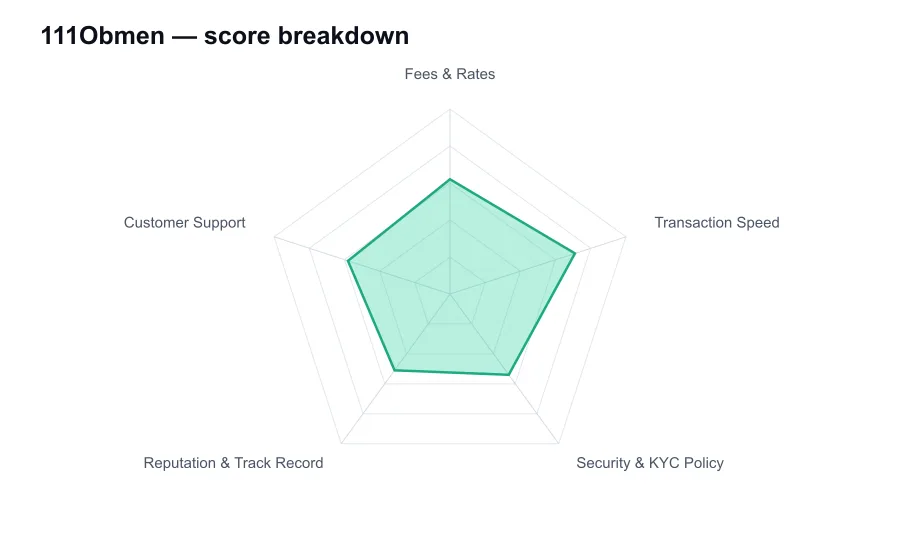
| Criterion | Score | Note |
|---|---|---|
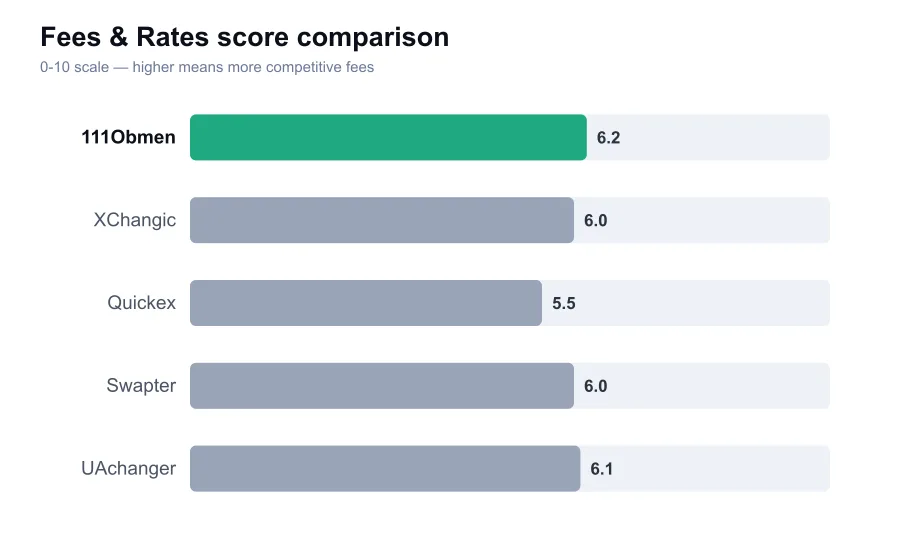
| Fees & Rates | 6.2 | Rates can be competitive, but the spread varies by pair. |
| Transaction Speed | 7.1 | Routine crypto swaps can clear quickly after confirmations. |
| Security & KYC Policy | 5.4 | No standing custody, but limited public assurance. |
| Reputation & Track Record | 5.1 | Smaller public footprint than major exchange brands. |
| Customer Support | 5.8 | Order-level help matters most for this service. |
111Obmen is a small, instant-style cryptocurrency exchanger aimed at users who want to swap assets without opening a trading account or learning an exchange interface. It sits in the same broad market as BestChange-listed exchangers, rather than competing directly with Binance or Kraken. The attraction is obvious: select a pair, enter a destination wallet, pay, and wait for delivery. That simplicity is useful, but it also means users must judge the service with more care than they would a heavily regulated global platform.
The first thing to understand is that 111Obmen is a conversion desk, not an order-book exchange. You do not place limit orders or benefit from deep market liquidity in the way you might on OKX, Coinbase, or Bybit. The quoted rate is the product. If the rate is good at the moment you create an order, the service can be convenient. If it is not, there is little reason to pay a convenience premium merely because the form is easy to use.
Its rates should always be compared with at least two alternatives before payment. A service like this normally builds its compensation into the exchange rate, and that spread can move materially from one asset pair to another. A BTC to USDT conversion may look competitive while a bank card, cash, or thinly traded altcoin route can be much less attractive. There is no single fee figure that tells the whole story, which is precisely why a final quote matters more than a headline claim.
I like that instant exchangers make the payable and receivable amounts easy to see before an order is funded. That is better than being surprised by a trading fee after a market order fills. But users should check whether the quote is fixed or floating. A floating-rate order can settle at a different amount if the market moves while the incoming transaction confirms. For volatile coins, that difference can turn an apparently cheap swap into an expensive one.
Network fees also deserve attention. Bitcoin and Ethereum transfers are not cheap simply because an exchanger advertises a low service margin. A good quote should state the final amount sent to the receiving address, but users still need to ensure they choose the correct network. Sending USDT on a different chain from the one selected in the order is one of the most common and costly mistakes in this part of the market.
Speed is usually the strongest argument for using 111Obmen. A routine crypto-to-crypto request can be processed after the deposit receives the required blockchain confirmations, then sent out promptly if the reserve is available and automated checks do not intervene. Stablecoin swaps on quick, low-cost networks may feel nearly immediate. Bitcoin, however, remains Bitcoin. Confirmation time and mempool congestion can make even an efficient exchanger feel slow.
The service's stated processing pace should not be confused with guaranteed end-to-end settlement. The customer controls the initial payment timing, miners validate it, and the recipient chain must also confirm the outgoing transaction. That is a lot of moving parts. Anyone needing certainty for a time-sensitive payment should use a fixed-rate option if offered, fund with an adequately competitive network fee, and avoid initiating a swap during obvious network congestion.
Security is more complicated than the reassuring language found on most exchanger websites. 111Obmen does not require the user to deposit funds into a standing custodial account, which reduces exposure to the sort of exchange balance risk that destroyed users of failed platforms. You send funds for a specific order and receive another asset. That is a genuine advantage over leaving a speculative portfolio on a centralized venue for months.
It does not eliminate counterparty risk. The operator still receives the deposit and must honor the quoted transaction. Before using any smaller exchanger, I would verify the exact domain, read current independent monitoring-site feedback, test the service with a modest amount, and save the order ID, payment proof, and transaction hashes. Phishing clones are a persistent problem around exchange brands, especially among users who arrive through search ads or unofficial Telegram links.
The privacy picture is not as absolute as no-registration marketing can imply. A user may be able to create an order without an account, but blockchain analytics, transaction screening, and compliance procedures can still result in questions or a request for identity documents. This is common across instant exchangers. People handling coins from gambling sites, mixers, sanctioned regions, or high-risk counterparties should assume enhanced scrutiny is possible and should not treat any no-account workflow as a promise of anonymity.
111Obmen has a much smaller public footprint than established exchanges such as Kraken, Bitstamp, or Coinbase. That does not automatically make it unsafe, but it does limit the strength of the track record a reviewer can rely on. Large platforms have years of public incidents, regulator interactions, institutional clients, and extensive user reporting. Small exchangers are harder to assess because their reputation may rest primarily on monitoring-site listings and individual reviews.
That narrower footprint affects dispute confidence. If something goes wrong on a major regulated exchange, users may at least have formal complaint paths, published legal entities, and a substantial public support history to examine. With a small exchanger, the practical route is usually support chat, email, and whatever public reputation the operator values. This is why I would not use 111Obmen as the place to move life-changing sums, regardless of how attractive one quote looks.
Support appears most relevant at the order level: confirmation delays, an incorrectly entered destination address, an unavailable reserve, or a payment that arrived late. For simple orders, responsive chat can be enough. The harder test is whether an agent can explain a compliance hold or resolve a chain mismatch clearly and promptly. Users should contact support before sending funds if the payment route is unusual, because blockchain transfers are rarely reversible once completed.
My view is straightforward. 111Obmen can be a practical tool for a small or medium, carefully checked conversion where the live rate is genuinely competitive and the user understands the selected network. It is not a substitute for a large exchange, a self-custody wallet, or a regulated fiat gateway. Treat it as a transactional service, test it first, and do not confuse a smooth first swap with proof that every large or complex transaction will go the same way.
| Pros | Cons |
|---|---|
| Simple order-based swap flow | — |
| No long-term custodial balance needed | — |
| Potentially quick crypto-to-crypto settlement | — |
| Useful for checking one-off conversion quotes | — |
111Obmen fits experienced self-custody users making a modest, one-off swap after comparing the final quote with alternatives. It can suit someone who does not want to create a trading account for a single conversion. Large-volume traders, users needing formal regulatory protections, and anyone moving urgent funds should look at established exchanges or regulated brokers instead.
Its order-based model may allow swaps without a conventional trading account, but compliance checks can still lead to verification requests for particular transactions.
Timing depends on the asset, blockchain confirmations, network congestion, reserve availability, and whether the order is handled automatically or reviewed.
Check the order screen before payment. Instant exchangers may offer fixed or floating quotes, and a floating quote can change during blockchain confirmation.
| Alternative | Score |
|---|---|
| XChangic Review | 5.9/10 |
| Quickex Review | 5.9/10 |
| Swapter Review | 5.9/10 |
| UAchanger Review | 6.0/10 |
| Explace Review | 5.8/10 |
| WxMoney Review | 5.8/10 |
