| Best for | Not for |
|---|---|
| Direct conversion flow is easy to understand | — |
| Useful alternative to multi-step exchange withdrawals | — |
| Can be competitive on selected liquid routes | — |
| Flexible verification for ordinary orders | — |
Live market data via CoinGecko, for informational purposes only. Not financial advice.
Editorial independence: our scores and rankings are produced using the fixed criteria above and are not influenced by advertisers. This is an independent ranking site and is not operated by, or affiliated with, any provider we list.
Affiliate disclosure: some links on this page may earn us a commission at no extra cost to you. This does not affect our rankings.
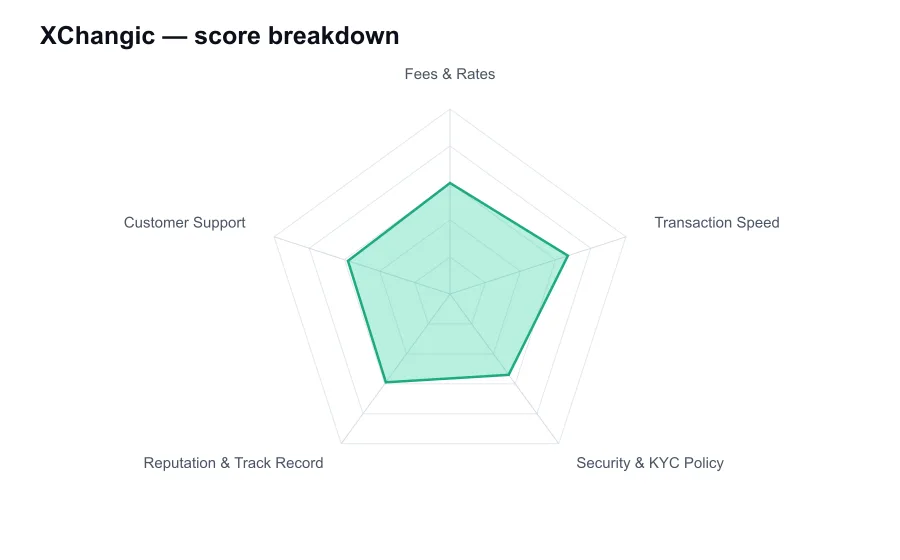
| Criterion | Score | Note |
|---|---|---|
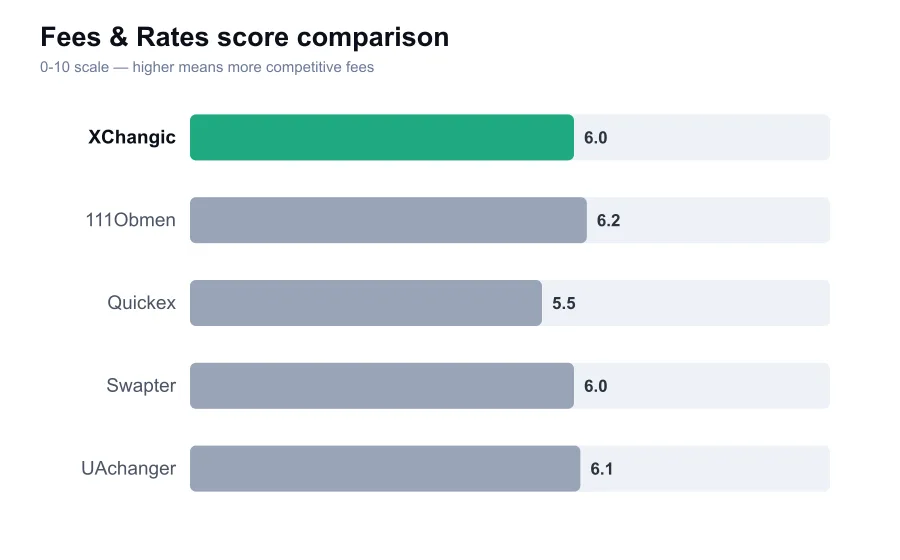
| Fees & Rates | 6.0 | Competitive on some routes, but the margin is quote-based. |
| Transaction Speed | 6.7 | Routine crypto orders can be prompt after confirmations. |
| Security & KYC Policy | 5.4 | Use as a transaction desk, not a long-term custodian. |
| Reputation & Track Record | 5.9 | Needs current review checks before larger transactions. |
| Customer Support | 5.8 | Documentation is vital if an order needs manual handling. |
XChangic sits in the familiar online-exchanger category, offering direct conversions rather than a conventional trading terminal. The proposition is speed and convenience: choose what you are sending, select what you want to receive, enter the details, and complete a single order. It is aimed at people who already know the asset and payment method they need, not at investors looking for charts, recurring purchases, custody tools, or a broad suite of financial products.
That focused model can be useful. A direct exchanger removes several annoying steps from the usual centralized-exchange process, especially for customers converting a cryptocurrency into a local payment method. There is no need to place a market order, wait for a fiat balance, then request a separate withdrawal. XChangic's value is strongest when that simplification saves time without extracting an excessive spread.
The central issue is the price shown on the order screen. Like many independent exchangers, XChangic tends to express its charge through the exchange rate and final payout rather than through a clean platform-wide tariff. This isn't inherently deceptive, but it makes lazy comparisons expensive. A customer should open at least two competing quotes for the same amount, network, and payout destination before deciding.
Its rates can be reasonable on popular routes with readily available liquidity. They are less compelling where card processing, local banking rails, or smaller crypto assets introduce friction. That pattern is not unique to XChangic, but it matters because users often compare its quoted amount with the spot price on CoinMarketCap and conclude the difference is a service fee. It is not that simple. The difference can include the market spread, network cost, payment risk, and the exchanger's own markup.
XChangic is therefore not a natural choice for active traders. A person making repeated USDT, BTC, ETH, or SOL conversions can usually improve execution on a large spot exchange and pay a known trading fee. Its better audience is the user with a specific cash-out or payment route that a major exchange cannot complete directly. For that customer, the relevant question is not whether the rate beats a spot chart. It is whether it beats the total cost of doing the job elsewhere.
The ordering flow is simple enough for a moderately experienced customer, but direct exchangers are unforgiving of careless data entry. Wallet-network mismatches are especially dangerous. Sending USDT on the wrong chain, omitting a destination tag where one is required, or entering a card number incorrectly can turn an ordinary exchange into a support case. XChangic should be used with the same attention you would give to a bank wire, not the casual attitude people sometimes bring to wallet transfers.
Speed is respectable on clean crypto transactions. Network confirmation remains the first variable, and no exchanger can erase that. Once payment is recognized, an automated or well-staffed desk can process a routine order rapidly. In practice, the slow cases are usually those involving bank transfers, payment-provider checks, unusually large sums, or an order whose amount does not exactly match the invoice.
I would be cautious about relying on any stated processing window as a hard promise. The word "instant" in this market often means the exchanger begins processing promptly, not that funds are guaranteed to arrive in minutes. A blockchain can congest, a bank can pause a transfer, or a fraud system can flag a payment. That is why a time-sensitive purchase should not depend on a last-minute exchange through a small intermediary.
Security is adequate only if you treat XChangic as a transactional counterparty, not as a custodian. The safest pattern is to send the exact amount from your own wallet, confirm the destination carefully, receive the payout, and retain no balance with the service. There is no reason to leave funds on an exchange order after the trade is done. The user has limited visibility into back-end custody, operational controls, or reserve management.
Its KYC posture appears flexible rather than fully anonymous. A normal, low-risk order may proceed without extensive documents, while unusual activity can result in a request for identification, source-of-funds information, or payment proof. Some customers dislike that uncertainty, but it is better understood as the reality of operating near banking systems. If you cannot provide a defensible transaction trail, choose a route where the compliance policy is explicit before you send money.
XChangic has the sort of reputation profile that needs active checking rather than blind trust. Independent exchangers can develop a solid following among repeat users while remaining relatively obscure outside monitoring directories and regional crypto communities. That is not a fatal flaw. It does mean that historical review patterns, recent operational complaints, and the age of public feedback deserve more weight than polished marketing language.
A few good reviews do not prove that an exchanger will handle a difficult order well. What matters is whether complaints show a repeat pattern, especially unresolved payment mismatches, surprise rate revisions, or prolonged identity verification. XChangic does not provide the same level of public assurance offered by major multinational platforms, so I would cap exposure accordingly. Treat every first transaction as a practical test of the service, not a declaration of loyalty.
Support is important here because exceptions are where direct exchangers reveal their quality. For a normal completed order, you may never speak to anyone. If an order is delayed, though, you need a human who can identify the payment, explain the hold, and state what evidence is required. XChangic's support should be approached with complete details ready: order number, transaction hash, screenshots, payment receipt, and the wallet or card information used.
The service is most compelling for customers who know exactly which route they need and have already compared final payouts. It is not the cheapest way to trade major assets, and it does not offer the safety net of a regulated exchange with published controls and a large compliance operation. Still, there is room for a competent direct exchanger, particularly in markets where fiat off-ramps are fragmented and conventional platforms are awkward.
My judgment is that XChangic is a practical but conditional choice. It can make sense for a modest, clearly defined exchange where the quote is competitive and the user understands the network and payment method. It is a poor fit for high-volume trading, corporate payments, or funds that cannot tolerate a compliance delay. The best way to use it is not emotionally, but mechanically: compare, test, document, and keep the amount proportionate to the available trust.
| Pros | Cons |
|---|---|
| Direct conversion flow is easy to understand | — |
| Useful alternative to multi-step exchange withdrawals | — |
| Can be competitive on selected liquid routes | — |
| Flexible verification for ordinary orders | — |
XChangic fits crypto users who need a specific direct payout route and are willing to compare the final quote before each order. It is better for occasional conversions than for portfolio management or active speculation. High-volume traders should use a liquid spot exchange, while businesses and privacy-sensitive users should choose providers with clearer compliance terms and documented account support.
Enter the same send amount, network, and payout method at several exchangers. Compare the final amount you receive after every cost, not a headline market price.
It may request documents or payment proof where an order triggers risk controls. Keep transaction records and use payment details that belong to you.
A first large transfer is not advisable with any lightly documented direct exchanger. Test the exact route with a smaller amount and verify limits and reserve first.
| Alternative | Score |
|---|---|
| 111Obmen Review | 5.9/10 |
| Quickex Review | 5.9/10 |
| Swapter Review | 5.9/10 |
| UAchanger Review | 6.0/10 |
| Explace Review | 5.8/10 |
| WxMoney Review | 5.8/10 |
