| Best for | Not for |
|---|---|
| Simple crypto-to-crypto checkout | — |
| No conventional account balance | — |
| Potentially competitive on liquid pairs | — |
| Suitable for small wallet conversions | — |
Live market data via CoinGecko, for informational purposes only. Not financial advice.
Editorial independence: our scores and rankings are produced using the fixed criteria above and are not influenced by advertisers. This is an independent ranking site and is not operated by, or affiliated with, any provider we list.
Affiliate disclosure: some links on this page may earn us a commission at no extra cost to you. This does not affect our rankings.
| Criterion | Score | Note |
|---|---|---|
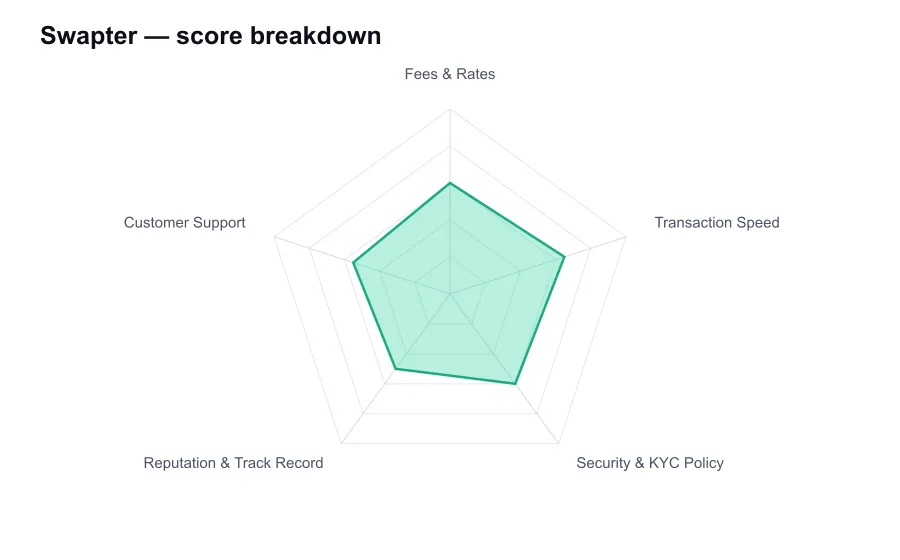
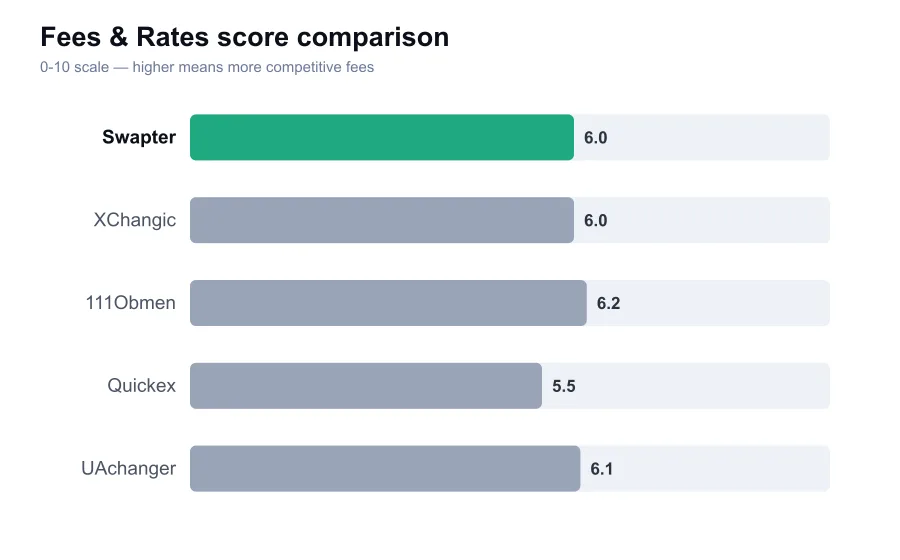
| Fees & Rates | 6.0 | Live quotes can be fair, but pricing is spread-based |
| Transaction Speed | 6.5 | Normal instant-swap timing, subject to confirmations |
| Security & KYC Policy | 6.0 | No persistent custody, but limited operational disclosure |
| Reputation & Track Record | 5.0 | Smaller public footprint than established competitors |
| Customer Support | 5.5 | Useful safety net, but less proven in complex cases |
Swapter is a smaller instant crypto exchange that tries to keep the swap process uncomplicated. It sits in the same market as StealthEX, ChangeNOW, SimpleSwap, and dozens of other non-custodial conversion sites. The pitch is straightforward: choose two assets, provide a receiving address, send crypto, and receive a different asset without maintaining an exchange balance or learning a trading terminal.
There is a real audience for that service. Many crypto users do not want to hand over identity documents just to rebalance a wallet, and many have no interest in order books. Swapter can meet that need for a simple conversion. The problem is that the instant-exchange market rewards reputation heavily, and Swapter does not yet have the depth of independently visible history enjoyed by the category's better known names.
The interface is easy to understand. It presents an expected output amount and guides the user toward a deposit address. That matters because a bad swap interface can lead directly to permanent mistakes. Still, ease of use should not be confused with execution quality. The hard part happens behind the screen, where the provider must source liquidity, manage blockchain confirmation risk, and deliver the outgoing transaction accurately.
Pricing is quoted rather than published as a single flat fee. That is not unusual. Most swap aggregators earn through a blend of rate spread and partner routing, while network fees are folded into the final result. It does mean that customers cannot judge value from a marketing claim alone. The only figure that matters is how much of the target asset reaches the wallet after every cost is accounted for.
Swapter's quotes can be reasonable on ordinary, liquid pairs, but I would not take that for granted. Compare the final output against at least two alternatives before pressing send. A small difference in the displayed rate can become a meaningful loss on a four-figure conversion. This is especially true for stablecoin swaps, where users may assume a one-to-one economic relationship and overlook a spread hidden in the route.
Be wary of overly optimistic minimums. A site may technically accept a very small deposit, yet blockchain fees can make a tiny order uneconomic or cause the received amount to disappoint. It is better to use Swapter for a sensibly sized conversion than to test it with dust. For a first transaction, though, a small but viable test amount remains the most sensible way to confirm that the address, chain, and service work as expected.
Transaction speed is ordinary for this type of provider. Fast networks and liquid assets can be processed fairly quickly once the deposit has enough confirmations. Bitcoin orders, congested Ethereum transactions, and tokens routed through less active liquidity pools can take longer. A user should distinguish a delay caused by the blockchain from a delay caused by the provider. Good status information is essential because it lets customers see where the wait is happening.
Swapter's public-facing process is simple, but its operational transparency is limited. I would prefer clearer detail on the companies or liquidity sources involved, a more extensive public incident history, and fuller explanations of rate formation. Smaller providers often argue that users only care about the final result. That is shortsighted. Transparency is part of the product when customers must send irreversible assets before receiving anything back.
Its non-custodial positioning is useful in a narrow sense. Swapter does not appear to operate a traditional customer wallet where users leave funds sitting for months. That reduces exposure to the sort of exchange custody failure seen repeatedly in crypto. Yet funds are in the service's workflow during a swap, so there is still counterparty risk. The label should encourage sensible caution, not blind confidence.
KYC is another point that deserves plain language. Swapter can be used without routine account creation, but transaction monitoring and compliance reviews can still exist. Any service that uses external liquidity or payment partners may need to pause an unusual transaction and request information. Privacy-minded users should not assume that a no-registration swap is automatically beyond compliance controls. Read the current terms, especially before sending an unusually large amount.
Reputation is where Swapter lands below StealthEX. It is not necessarily a bad service because it is smaller, but there is less long-running independent evidence to support confidence. A prospective user should look for recent, detailed reviews that discuss completed orders and support handling, not just star ratings or generic praise. Review platforms can be gamed, and a young service with a polished site can still have thin operational capacity.
Customer support appears to be an important safety net rather than a major competitive advantage. For a normal completed order, that distinction barely matters. For a transaction sent with the wrong memo, a partial payment, or a long blockchain delay, it matters a great deal. Before using Swapter with meaningful funds, I would confirm the available contact routes and save the order identifier immediately after creating the swap.
The service is best approached as a convenience tool, not a financial home. It may make sense for a one-off wallet conversion where its quote is attractive and a delay would be inconvenient but not disastrous. It is not where I would execute a large treasury conversion, move money for a deadline, or repeatedly trade. A liquid centralised exchange with transparent fees remains the better machine for those jobs.
Swapter has enough utility to deserve consideration, particularly for users who want a simple crypto-to-crypto route without account onboarding. But it does not yet offer the reputation cushion that lets me recommend it ahead of larger specialists. Use it only after comparing the live output, double-check the network, and begin with an amount you can afford to have delayed. That is cautious advice, but this category has taught users why caution matters.
| Pros | Cons |
|---|---|
| Simple crypto-to-crypto checkout | — |
| No conventional account balance | — |
| Potentially competitive on liquid pairs | — |
| Suitable for small wallet conversions | — |
Swapter is best for experienced wallet users making a modest, non-urgent conversion after comparing quotes. It can work for users who want to avoid maintaining a centralised exchange account. High-volume traders, institutions, beginners, and anyone who needs a proven dispute-resolution record should use a larger exchange or an instant swap provider with a longer public history.
It is designed as an instant swap service rather than a long-term custodial exchange. Funds still pass through the swap workflow, so counterparty risk exists while an order is active.
The cost is commonly reflected in the quoted exchange rate and network costs rather than a universal flat percentage. Compare the final amount you will receive.
No routine account signup does not rule out compliance checks. A transaction may be reviewed if it triggers monitoring or a liquidity partner requires additional information.
| Alternative | Score |
|---|---|
| XChangic Review | 5.9/10 |
| 111Obmen Review | 5.9/10 |
| Quickex Review | 5.9/10 |
| UAchanger Review | 6.0/10 |
| Explace Review | 5.8/10 |
| WxMoney Review | 5.8/10 |
