| Best for | Not for |
|---|---|
| Direct exchange workflow | — |
| Useful for specific payment corridors | — |
| No need for a trading terminal | — |
| Can suit small one-off swaps | — |
Live market data via CoinGecko, for informational purposes only. Not financial advice.
Editorial independence: our scores and rankings are produced using the fixed criteria above and are not influenced by advertisers. This is an independent ranking site and is not operated by, or affiliated with, any provider we list.
Affiliate disclosure: some links on this page may earn us a commission at no extra cost to you. This does not affect our rankings.
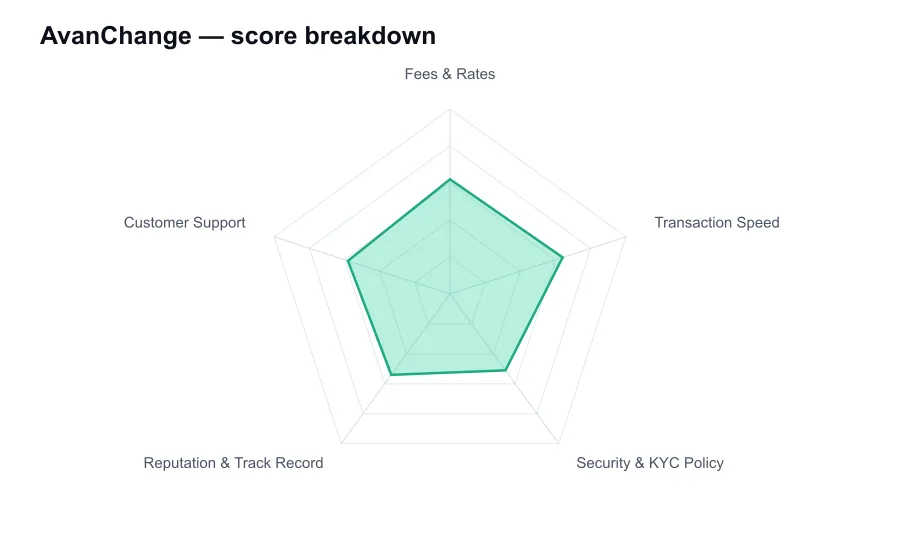
| Criterion | Score | Note |
|---|---|---|
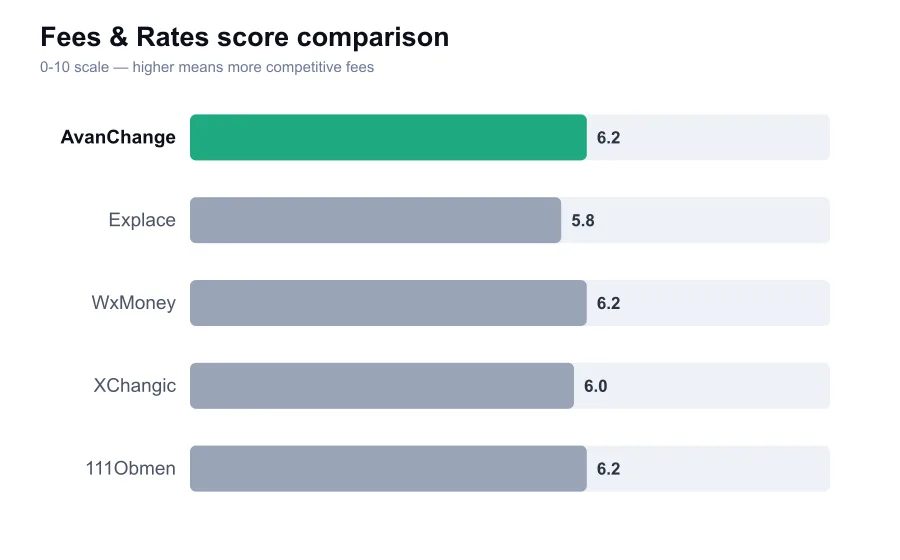
| Fees & Rates | 6.2 | Rates are quote-based, so spreads need comparison. |
| Transaction Speed | 6.4 | Crypto swaps can be prompt, payment routes vary. |
| Security & KYC Policy | 5.1 | Limited public custody and compliance disclosure. |
| Reputation & Track Record | 5.4 | Niche exchanger profile, not a major venue. |
| Customer Support | 5.8 | Check response channels before funding a large order. |
AvanChange is a small instant-exchange and payment-direction provider rather than a full trading venue. It sits in the part of the market where people arrive with a specific job, such as swapping USDT for a bank payment, exchanging one coin for another, or using a local payment rail. That makes it closer in spirit to a BestChange-style exchanger than to Binance, Kraken, or Coinbase. The appeal is simplicity, but the trade-off is much thinner public disclosure than established global platforms provide.
The site experience is built around choosing a send and receive direction, entering an amount, and following payment instructions. That can be refreshingly direct for someone who already knows what they need. There is no order book to decipher and no elaborate terminal. Still, a simple form is not the same thing as a simple transaction. Users need to read the reserve, minimum, maximum, network, and rate details before paying, because an exchange request can become awkward once funds are sent.
AvanChange's pricing is mostly expressed through its quoted conversion rate rather than a clean, universal trading-fee table. This is standard for manual and instant exchangers, but it makes apples-to-apples comparison harder. The number that matters is the final amount received, including the spread, network cost, and any payment-method premium. A quote that looks attractive at first can lose to an exchange with a visible 0.1% spot fee if the provider's embedded spread is wide.
For small, urgent swaps, the rate can still be reasonable. Convenience has a price, and many customers are not trying to run a trading strategy. The problem begins with larger transfers. A one or two percent difference on a meaningful USDT, BTC, or ETH exchange is expensive, especially where a bank-transfer route adds its own risk of delay. I would always compare the quoted payout against at least two reputable aggregators or competitors before locking an order.
Fixed-rate orders deserve special attention here. A fixed quote can protect a customer from a sudden market move while they are making a payment, but it also usually comes with a short payment window. If the incoming transfer arrives late, has the wrong memo, or is sent on the wrong chain, the order may need manual handling and could be recalculated. That is not unique to AvanChange. It is the practical reality of this corner of crypto, and users should not treat a quote screen like a guaranteed bank checkout.
Speed depends more on the route than on the marketing language. Crypto-to-crypto orders can move quickly once the deposit has enough confirmations and the operator or automation releases the outgoing transfer. Stablecoin transfers on fast networks are usually much easier than BTC deposits during congestion. Bank payments, cash-style methods, and payment processors can take longer because they introduce business-hour limits, compliance review, and occasionally a human confirmation step.
AvanChange does not have the transparency of a major exchange's status page, audited matching engine, or deep API documentation. That doesn't automatically mean an order will be slow. It does mean a customer has less independent evidence about normal completion times and fewer technical tools if something stalls. For an ordinary swap, I would budget for minutes to a few hours, not assume the fastest possible outcome shown in an interface. Weekends and large amounts deserve even more patience.
The security question is where small exchangers have to earn trust transaction by transaction. AvanChange is not a regulated, publicly listed custodian with the security reporting of Coinbase or Bitstamp. There is limited public material for independently assessing cold-storage practice, reserves, penetration testing, insurance, or corporate controls. That places the burden on the user to limit exposure. Send only what is required for the current order, and move received crypto into a wallet you control.
KYC is another area where expectations need to be realistic. A provider may allow many orders without a lengthy account opening process, yet still request identity documents, source-of-funds evidence, or a wallet explanation under AML rules or when an order triggers risk checks. No-KYC marketing should never be read as a promise that every transfer is anonymous or immune from review. If privacy is essential, ask support about the exact route before funding the transaction, and keep a record of the answer.
I also wouldn't use a small exchanger for a first-time transfer of money I cannot afford to have delayed. Address errors, tagged assets, name mismatches on payment methods, and compliance flags are painful everywhere, but large exchanges usually have more formal escalation channels. With AvanChange, the sensible approach is to test a modest amount. Verify the network, the destination details, and the actual received amount. Then decide whether its convenience is worth using again.
Its reputation is niche rather than institutionally established. A listing on an exchanger-monitoring service or positive scattered feedback can be useful evidence, but it is not equivalent to years of regulatory scrutiny, independently published financials, and a large public record of incident response. Small services can perform well for years, yet a thin reputation gives a customer less confidence in how an exceptional dispute will be resolved.
That said, niche reputation can matter in practical ways. An exchanger that has built a repeat user base on particular payment routes often understands local banking habits better than an international platform does. A global exchange may offer a lower trading fee but no workable withdrawal method for the customer. AvanChange has value where it supports a specific corridor cleanly, with a competitive final quote and enough available reserve. Outside that use case, its advantages fade quickly.
Support is likely to be a deciding factor if a transaction goes wrong. The important test is not whether a chat button exists, but whether an agent can identify an order, explain a hold, and give a realistic next step. Before placing a material order, I would check the published contact options, working hours, terms, and complaint procedure. Save screenshots of the quote and payment details. Those habits sound cautious, but they make a real difference in a manual-exchange dispute.
AvanChange is not a place I would use to store funds, build a portfolio, or make repeated high-volume trades. It can make sense as a transaction tool for someone who has checked the current quote and understands the payment route. Users who need formal licensing clarity, broad fiat support, proof-of-reserves reporting, or dependable institutional support should start with a major regulated exchange instead. The service's strongest case is narrow convenience, not broad trust.
My take is straightforward. AvanChange may be useful for a small or medium one-off conversion where the final payout is clearly competitive and the customer has tested the route. Its fee visibility, public security information, and track record do not justify blind trust or a large first order. Treat it as an exchanger, not a bank. Careful users can get value from it, but anyone who wants certainty and robust recourse will be better served elsewhere.
| Pros | Cons |
|---|---|
| Direct exchange workflow | — |
| Useful for specific payment corridors | — |
| No need for a trading terminal | — |
| Can suit small one-off swaps | — |
AvanChange fits experienced users who need a specific conversion route and can compare final quotes before paying. It is best approached with a small test order, especially on a new payment method. Long-term holders, active traders, and businesses needing documented controls should use a larger regulated exchange or specialist OTC desk instead.
Its cost is generally reflected in the displayed exchange quote rather than a universal maker and taker schedule. Compare the final amount you will receive, not just the headline rate.
Crypto-only orders may complete after required confirmations, while bank and payment-provider routes can take longer. Allow extra time for manual review, weekends, and larger orders.
No exchanger can reliably promise that. AML checks, payment risk, or unusually large transactions may lead to an identity or source-of-funds request.
| Alternative | Score |
|---|---|
| Explace Review | 5.8/10 |
| WxMoney Review | 5.8/10 |
| XChangic Review | 5.9/10 |
| 111Obmen Review | 5.9/10 |
| Quickex Review | 5.9/10 |
| Swapter Review | 5.9/10 |