| Best for | Not for |
|---|---|
| Simple wallet-to-wallet conversions | — |
| No routine exchange account needed | — |
| Useful for one-off asset swaps | — |
| Potentially quick on fast networks | — |
Live market data via CoinGecko, for informational purposes only. Not financial advice.
Editorial independence: our scores and rankings are produced using the fixed criteria above and are not influenced by advertisers. This is an independent ranking site and is not operated by, or affiliated with, any provider we list.
Affiliate disclosure: some links on this page may earn us a commission at no extra cost to you. This does not affect our rankings.
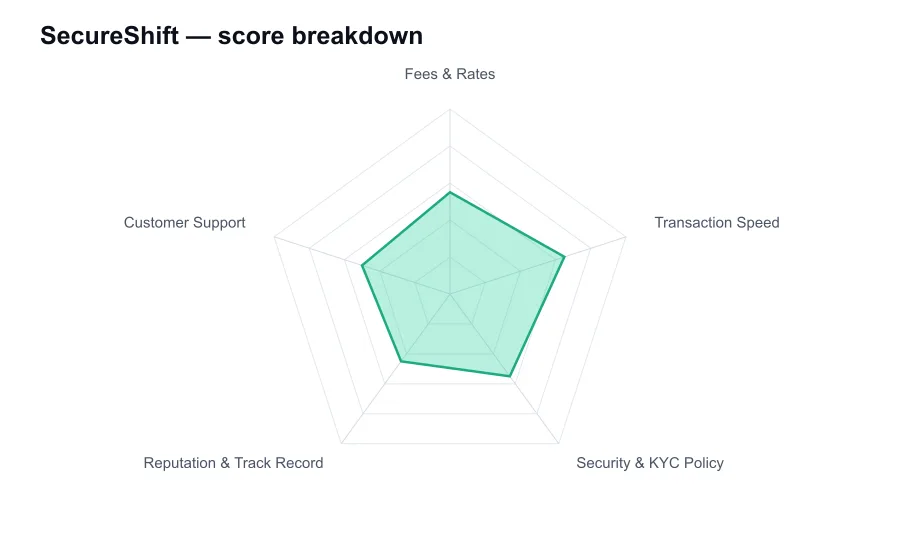
| Criterion | Score | Note |
|---|---|---|
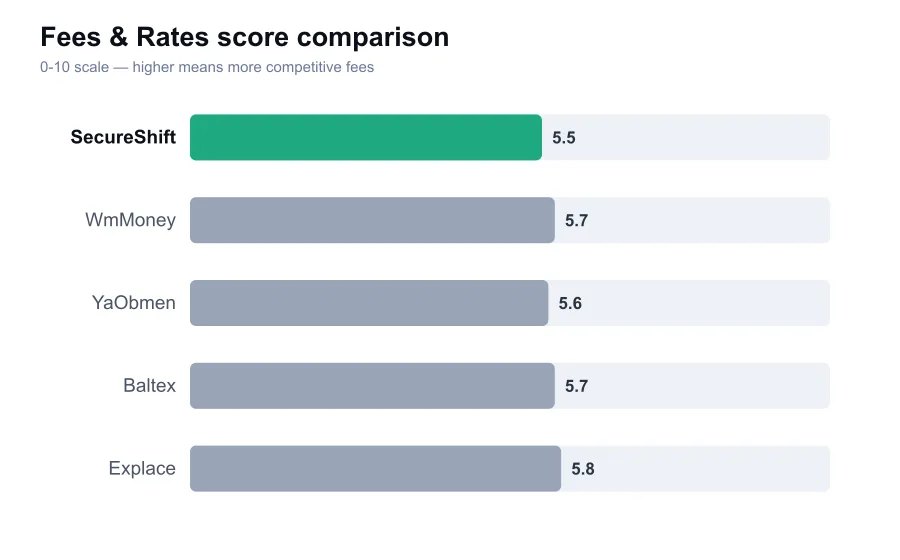
| Fees & Rates | 5.5 | Rates can include an opaque spread and route-dependent costs. |
| Transaction Speed | 6.5 | Fast after confirmations, but network and liquidity delays matter. |
| Security & KYC Policy | 5.5 | No standing account, but each swap requires a custodial handoff. |
| Reputation & Track Record | 4.5 | Less independently established than leading instant-swap brands. |
| Customer Support | 5.0 | Online case handling is crucial if a swap is delayed. |
SecureShift presents itself as an instant cryptocurrency exchange, a category built for people who want to swap one asset for another without opening a full trading account or learning an order-book interface. The attraction is obvious. Pick the coin you have, pick the coin you want, provide a receiving address, and send funds. There is no portfolio dashboard demanding constant attention. The problem is that instant exchanges are only as good as their rate transparency, liquidity partners, and handling of the rare transaction that does not go exactly as planned.
This is a very different proposition from a regulated custodial exchange. SecureShift is designed around single conversions, not around holding cash, earning yield, or trading perpetual futures. Users generally retain control of the destination wallet, while the service coordinates the conversion after receiving the deposit. That can reduce the need to keep funds on an exchange account, but it does not eliminate trust. For the period between deposit and payout, users rely on SecureShift and its underlying exchange infrastructure to complete the swap correctly.
The no-account feel is the main draw. A user can move from bitcoin to ether, stablecoins to another network asset, or one altcoin to another without a lengthy registration flow. For a privacy-minded user, that is more pleasant than uploading documents for a small, ordinary conversion. But no-account does not mean no compliance. Like other instant swap platforms, SecureShift can request identification or source-of-funds information if automated screening flags a transaction. Users who cannot tolerate that possibility should not send funds expecting absolute anonymity.
Fee disclosure is where I am least enthusiastic. Instant exchanges often say that fees are included in the displayed rate, which is technically understandable but not especially user-friendly. The customer sees a quoted output, while the service's compensation may be embedded in the exchange rate alongside network costs and liquidity-provider pricing. SecureShift should be judged by the number of coins delivered, not by a vague claim of low fees. Compare its quote with SimpleSwap, Changelly, ChangeNOW, and a liquid exchange before committing a large amount.
A fixed-rate option, where available for a route, can be useful because it limits the chance that a fast-moving market changes the payout before settlement. Variable-rate conversions can return more or less than the initial estimate depending on the market and the time needed for confirmations. Neither model is automatically superior. A fixed quote may include a wider margin, while a variable quote can be better in a stable market. The important thing is reading which rate mode has actually been selected, rather than assuming the first number is guaranteed.
Network fees are another frequent source of disappointment. Bitcoin, Ethereum, and other chains have different confirmation times and different fee conditions. SecureShift cannot make a slow bitcoin deposit confirm instantly, and a user who sends an insufficient network fee may face a delay before the exchange can safely process the deposit. The service can be fast after the inbound transaction is recognized, but the full clock starts when the user broadcasts the transaction, not when they click the exchange button.
For uncomplicated swaps on fast networks, the experience can be quick. A Solana, Litecoin, or many stablecoin transfer may be processed in minutes once deposits are confirmed. Bitcoin and Ethereum conversions can take much longer, particularly during congestion. More importantly, a multi-step route may depend on external liquidity. If the selected asset has poor market depth or a provider pauses withdrawals, the advertised estimate becomes less meaningful. Speed is good for common routes, but it is not the platform's strongest guarantee.
SecureShift's security model requires a careful distinction between custody and transaction risk. It does not function like a deposit-taking exchange where users keep a standing account balance. That is a positive for users who prefer to hold assets in their own wallets. Yet the conversion itself is still a custodial handoff. You send coins to an address controlled for the exchange process, then wait for a payout. There is no smart-contract escrow that makes every dispute automatically reversible.
Basic operational security matters more than people admit. Use the official domain, verify the receiving asset's network, paste rather than type addresses, and beware of search-ad impersonators. A phishing page can look nearly identical to an instant exchange and steal a deposit in one click. SecureShift cannot protect users from a compromised browser extension or a malicious copied address. A small test transaction is sensible for a new route, especially with assets that use several similarly named networks.
SecureShift does not have the deep public operating history, regulatory footprint, or independently visible liquidity of a top-tier exchange. That does not mean it is fraudulent, but it does justify a more conservative approach. Reputation in the instant-swap segment is often hard to assess because reviews combine genuine successful conversions, user misunderstanding about variable rates, and angry reports from cases involving compliance holds. I would give a newer or less independently documented provider less benefit of the doubt than an established venue.
This is where SecureShift trails larger named competitors. ChangeNOW, Changelly, and SimpleSwap have broader public visibility, more accumulated reviews, and more recognizable market presence, even though each has its own criticisms. SecureShift may offer an acceptable route or better quote on a specific day, but it has not earned the same automatic confidence for a large one-off conversion. If the amount would hurt to have delayed for several days, reputation should matter more than a slightly better estimate.
Support is usually conducted through online channels rather than by phone. For routine questions, that is normal. For a missing payout, it can become stressful because the user needs someone to trace a deposit, identify the route status, and explain whether a compliance review or network problem is involved. Before using SecureShift, check that the site provides a transaction ID or status page and save every detail. A support ticket without the deposit hash, order ID, and receiving address is much harder to resolve.
The interface is likely to appeal to users who dislike exchange accounts, and that simplicity is its best feature. A clean swap screen cuts out distractions and makes wallet-to-wallet conversion accessible. Still, simple screens can conceal complicated execution. Slippage, minimum deposits, suspended pairs, confirmation requirements, and payout limits are not exciting topics, but they decide whether a swap feels smooth or turns into a support case. Read the order details before funds leave your wallet.
My view is cautious rather than hostile. SecureShift can make sense for small or medium-sized conversions where its quoted output is demonstrably good and the user understands instant-exchange mechanics. I would not choose it blindly for a large transfer, a time-critical payment, or a coin with thin liquidity. The service's convenience is genuine, but its lighter public track record and embedded-rate model mean it has to earn trust one transaction at a time. Start small, document everything, and keep alternatives open.
| Pros | Cons |
|---|---|
| Simple wallet-to-wallet conversions | — |
| No routine exchange account needed | — |
| Useful for one-off asset swaps | — |
| Potentially quick on fast networks | — |
SecureShift is best for experienced self-custody users making a small or medium one-off swap after comparing the final quote. It may suit people who don't want to create a standing exchange account. Large holders, first-time buyers, and users who need predictable compliance support should choose a more established exchange or instant-swap brand. Avoid using it for a deadline-sensitive payment unless you have tested the route.
Routine swaps may not require a conventional account, but transactions can still be screened and additional identity or source-of-funds information may be requested.
It depends on the deposit network, required confirmations, liquidity route, and the asset being sent. Fast-chain swaps can take minutes, while bitcoin and congested networks can take longer.
Instant-swap pricing is commonly reflected in the quoted exchange rate. Compare the final output against competitors because the effective spread can vary by route.
| Alternative | Score |
|---|---|
| YaObmen Review | 5.4/10 |
| WmMoney Review | 5.4/10 |
| Baltex Review | 5.3/10 |
| Explace Review | 5.8/10 |
| WxMoney Review | 5.8/10 |
| AvanChange Review | 5.8/10 |
