| Best for | Not for |
|---|---|
| Wallet-based swaps without standard account onboarding | — |
| Moonriver-native liquidity access | — |
| Potentially lower gas than Ethereum mainnet | — |
| Self-custody trading model | — |
Live market data via CoinGecko, for informational purposes only. Not financial advice.
Editorial independence: our scores and rankings are produced using the fixed criteria above and are not influenced by advertisers. This is an independent ranking site and is not operated by, or affiliated with, any provider we list.
Affiliate disclosure: some links on this page may earn us a commission at no extra cost to you. This does not affect our rankings.
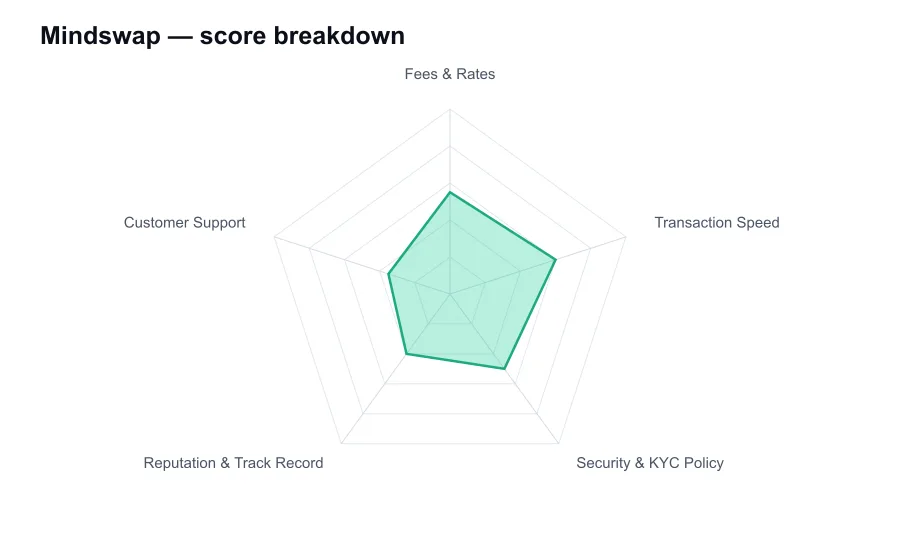
| Criterion | Score | Note |
|---|---|---|
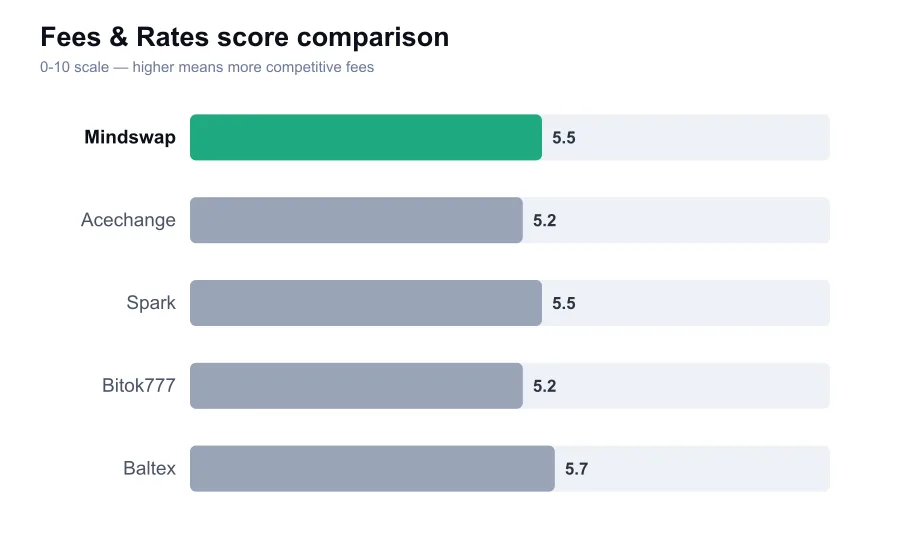
| Fees & Rates | 5.5 | Low AMM fees, but thin-pool slippage can bite |
| Transaction Speed | 6.0 | Fast local swaps, bridges can slow entry |
| Security & KYC Policy | 5.0 | Self-custody helps, smart-contract risk remains |
| Reputation & Track Record | 4.0 | Known in Moonriver, limited wider traction |
| Customer Support | 3.5 | Community support, limited recovery options |
MindSwap was a decentralized exchange and DeFi hub associated with the Moonriver ecosystem, a Kusama-based smart-contract network built to offer Ethereum-compatible functionality. Its appeal was familiar to users of smaller chains: swap tokens, provide liquidity, farm rewards, and avoid the account opening process of a centralized exchange. In its active period, it offered an accessible route into Moonriver-native assets. That niche, however, was also its biggest limitation.
A DEX is only as useful as its liquidity and community remain. MindSwap entered a market already crowded by automated market makers, and it relied heavily on the health of Moonriver and the assets circulating there. The interface and concept were not the problem. The hard part was attracting enough dependable volume to give traders tight prices and liquidity providers a return that justified impermanent loss. Smaller ecosystem DEXs rarely win that battle for long.
The fee model followed the typical automated market maker pattern rather than a centralized maker and taker schedule. A swap fee was paid through the liquidity pool structure, while users also paid Moonriver network gas. In normal conditions, onchain fees on Moonriver could be more comfortable than Ethereum mainnet costs. But a low protocol fee does not guarantee a cheap trade. On thin pools, price impact and spread can overwhelm the nominal charge.
That is the first thing a prospective MindSwap user should understand. A quoted 0.3 percent-style pool fee, common across many AMMs, is only one component of trade cost. If a pool has shallow reserves, a moderately sized order can move the price sharply. A trader who compares only visible fees may get a worse execution than on Uniswap, Sushi, or a centralized venue with deeper books. Always inspect price impact before confirming a swap.
Liquidity incentives complicate the picture further. Farms can produce eye-catching returns by distributing a platform token, but that does not make the return durable. Emissions dilute holders, token prices fall, and reward APRs can vanish as liquidity arrives or leaves. MindSwap's ecosystem was subject to the same cycle that hurt many 2021-era DeFi platforms. Yield was often a marketing number first and a reliable income stream second.
In raw transaction speed, MindSwap benefited from Moonriver's faster and less congested environment compared with Ethereum mainnet. Swaps could settle in a short sequence of blocks, and a user did not need to wait for a centralized exchange to approve an order. That is a genuine advantage for small onchain trades. But the practical speed of a transaction also depends on wallet setup, RPC reliability, bridge delays, and whether there is enough liquidity to execute the desired trade.
Bridging was often the real bottleneck. Moving assets into a niche ecosystem can take substantially longer than making the swap once there, and it introduces another set of contracts, validators, and support problems. A fast AMM cannot compensate for a bridge transfer that is delayed, a wrapped asset that lacks liquidity, or a user who sent funds on the wrong network. MindSwap was most convenient for people already active in Moonriver, not for someone entering solely to make one trade.
The security posture of a DEX like MindSwap begins with self-custody. Users connect a wallet and authorize contract interactions, which avoids the exchange insolvency risk associated with depositing coins at a centralized company. That benefit is real. It is also paired with an unforgiving model: there is no password reset for a lost seed phrase, and an approved malicious token contract can drain a wallet if a user is careless.
MindSwap's contracts and public materials should be evaluated in the context of the period in which they were deployed. Audits, where available, reduce but do not eliminate smart-contract risk. A healthy audit report cannot protect against a compromised frontend, an unsafe wallet approval, oracle problems, liquidity withdrawal by other users, or a project team abandoning maintenance. For smaller-chain DeFi, operational continuity can be just as important as code quality.
KYC was not generally part of the ordinary DEX experience. A wallet could interact with public pools without the identity checks expected at regulated centralized exchanges. Privacy-minded users may see that as a benefit. I would not treat it as a security feature. No-KYC access means fewer gatekeepers, but it also means users must handle tax records, sanctions restrictions, scams, and irreversible transactions without a compliance team standing behind them.
MindSwap's reputation is modest and highly tied to its ecosystem's cycle. It had more substance than a random token with no product, yet it never achieved the broad, battle-tested standing of Uniswap or the durable brand recognition of PancakeSwap. Activity in smaller DeFi ecosystems can decline quickly after incentives fade. A project may still have a website and social accounts while the pools that once made it usable have become too thin for serious trading.
Support should be judged with that reality in mind. Community channels, documentation, and Discord-style assistance were typical for the project category, but they are not equivalent to a regulated exchange support desk. A support volunteer cannot reverse an onchain approval or retrieve tokens from an incorrect address. If the official channels are quiet, a user must assume that recovery options are extremely limited and should verify current activity before connecting a wallet.
For a technically capable Moonriver user, MindSwap can still be understood as a piece of ecosystem infrastructure, not as a broad market gateway. Its original purpose was sensible: provide local swaps and liquidity tools with low-friction wallet access. But the market has moved toward deeper multi-chain venues, aggregators, and exchanges that can offer better execution. Niche DEXs live or die by current liquidity, not by what they offered at launch.
My take is blunt. MindSwap is interesting historical and ecosystem-specific DeFi infrastructure, but it is not where I would send a large trade today without independently confirming active pools, contract addresses, frontend status, and trading depth. Small experimental transactions may make sense for users already on Moonriver. Everyone else will usually get safer routing, better price discovery, and more reliable support from a larger venue or aggregator.
| Pros | Cons |
|---|---|
| Wallet-based swaps without standard account onboarding | — |
| Moonriver-native liquidity access | — |
| Potentially lower gas than Ethereum mainnet | — |
| Self-custody trading model | — |
MindSwap suits experienced Moonriver users who already hold network assets and can verify current pool liquidity themselves. It may work for small, ecosystem-specific swaps or liquidity experiments. New DeFi users, large traders, and anyone who needs human support should use a deeper exchange or a major DEX aggregator instead.
A public DEX normally uses wallet connections rather than exchange account verification. Users still need to follow applicable laws and confirm current interface restrictions.
Network gas can be relatively low, but total cost depends on pool fees, price impact, and the cost of bridging assets into Moonriver.
No. Onchain swaps and token transfers are generally irreversible, so verify the network, token contract, and wallet approvals before confirming.
| Alternative | Score |
|---|---|
| Acechange Review | 5.1/10 |
| Spark Review | 4.9/10 |
| Bitok777 Review | 4.8/10 |
| Baltex Review | 5.3/10 |
| YaObmen Review | 5.4/10 |
| WmMoney Review | 5.4/10 |