| Best for | Not for |
|---|---|
| May offer a simple trading interface | — |
| Potentially accessible for small experimental use | — |
| Less complex than institutional platforms | — |
| — | Poor choice for fiat or long-term custody |
Live market data via CoinGecko, for informational purposes only. Not financial advice.
Editorial independence: our scores and rankings are produced using the fixed criteria above and are not influenced by advertisers. This is an independent ranking site and is not operated by, or affiliated with, any provider we list.
Affiliate disclosure: some links on this page may earn us a commission at no extra cost to you. This does not affect our rankings.
| Criterion | Score | Note |
|---|---|---|
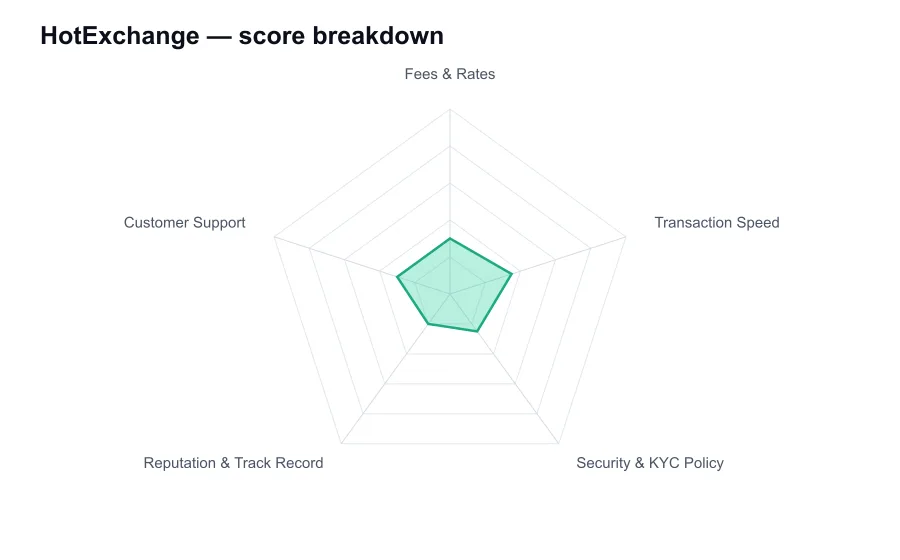
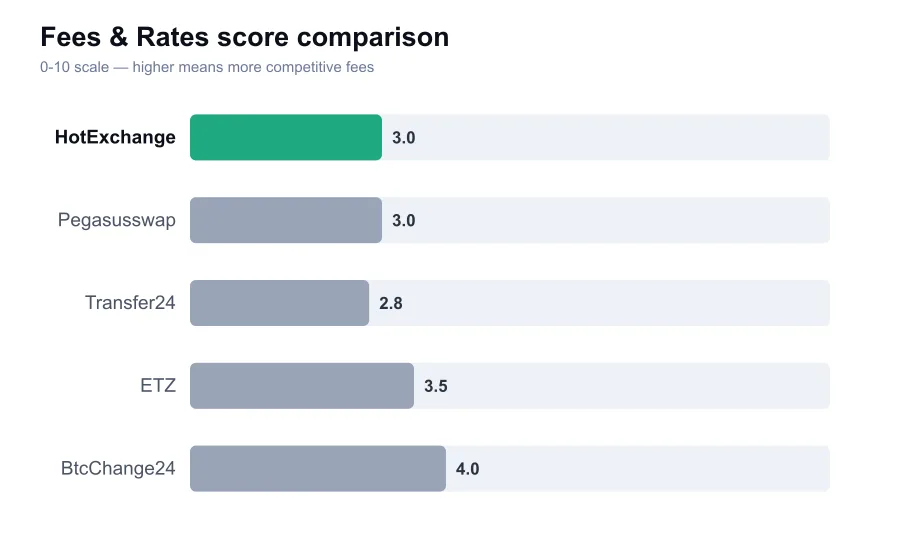
| Fees & Rates | 3.0 | No dependable public fee and spread disclosure found |
| Transaction Speed | 3.5 | Withdrawal performance is not well documented publicly |
| Security & KYC Policy | 2.5 | Insufficient visible evidence of exchange security controls |
| Reputation & Track Record | 2.0 | Does not have a readily verifiable long-term footprint |
| Customer Support | 3.0 | Verify support through a small pre-deposit query |
HotExchange is one of those crypto brands that raises a harder question than whether its interface can place a trade. The real question is whether a prospective customer can establish exactly who operates it, where it is regulated, and what protection exists if something goes wrong. That may sound severe, but it is the correct starting point for a little-known exchange in a market with a long history of lookalike sites and vanished platforms.
The name itself has very little distinguishing power. Searchability matters in financial services because users need to separate a genuine company from impersonators, phishing pages, affiliate landing pages and unrelated services with a similar label. Established venues spend years creating a public record, including licensing disclosures, executive accountability, product announcements and credible user feedback. HotExchange has not achieved that level of identifiable market presence.
A trading platform should make several facts easy to locate before it asks for a deposit. Those include the legal entity, registered address, governing terms, restricted jurisdictions, fee schedule, withdrawal policy and a reliable support channel. If any of those are missing, inconsistent or only delivered through private messages, stop there. A good-looking dashboard cannot substitute for an accountable counterparty.
The fee question is especially important because obscure exchanges often advertise low or zero trading fees while recovering revenue through wide spreads, withdrawal charges or awkward conditions on cashing out. I could not confirm a reliable public maker and taker schedule for HotExchange that I would treat as authoritative. That prevents a fair comparison with transparent platforms such as Kraken, Coinbase Advanced, Binance where available, or Independent Reserve for Australian dollar trading.
Low fees also mean little without liquidity. On an active order book, a small quoted fee can be the main cost. On a thin venue, the spread between the best bid and offer can exceed the advertised fee by a wide margin, and a market order can move the price sharply. Traders should inspect order-book depth, recent trade activity and the actual withdrawal cost before funding an account. If the platform does not expose those basics clearly, it is not a serious venue for active trading.
Speed needs the same distinction. An exchange can claim fast execution because its internal matching engine updates instantly, while withdrawals still wait for risk checks, manual approval or blockchain confirmations. Fast chart movements are not the relevant test. The relevant test is whether a customer can deposit, trade, withdraw and receive assets without unexplained holds. HotExchange does not have enough independently verifiable operational reporting for me to score that process confidently.
That is particularly concerning for arbitrage traders and people trying to move funds between exchanges. They are the users most harmed by a delayed withdrawal, a changed limit or an unavailable support desk. A platform without a public, well-tested withdrawal reputation should never be the weak link in a trade that depends on timing. Keep settlement risk out of your strategy rather than hoping a new venue will behave like a mature one.
Security is not just two-factor authentication on a login page. Serious exchanges discuss cold storage practices, withdrawal address controls, device management, incident procedures, proof or explanation of reserves, penetration testing and staff access controls. Even then, customers should remain skeptical. With HotExchange, I could not establish enough public evidence about these controls or an independent security history to give it the benefit of the doubt.
KYC policy deserves close attention too. A service that appears permissive at sign-up may still demand verification before the first withdrawal, particularly if it detects unusual activity. That is not automatically improper, since compliance checks are part of operating a financial service. The issue is whether the process is defined in advance and administered by an identifiable company. Unclear verification rules can turn a routine deposit into a stressful support dispute.
The safest personal security practice is to assume no exchange is a wallet. Do not store long-term holdings on HotExchange, do not reuse passwords, enable app-based two-factor authentication where it exists, and whitelist addresses only after checking them carefully. More importantly, do not upload identity documents until you have verified the operator through authoritative corporate or regulatory sources. Personal data is also an asset, and it should not be handed to an uncertain counterparty casually.
HotExchange's reputation score is low because I could not find the durable, independently visible track record that should accompany a platform trusted with customer assets. Silence is not proof of fraud, and reviewers should not casually make that accusation. But a responsible review also should not translate absence of evidence into trust. A customer has many alternatives, so the unknown provider must make a positive case for itself. HotExchange has not made that case convincingly.
Support is where weak exchanges often fail their first real test. A deposit problem requires a ticket number, a traceable correspondence history and a team able to read transaction hashes and network details. Social media messages, Telegram administrators and generic email replies are not enough. Before depositing, ask a specific question about deposits, KYC timing or withdrawal limits. The quality and source of the response will tell you more than promotional claims.
For customers who want fiat access, this platform is a particularly poor fit unless its banking relationships and legal status are independently confirmed. Fiat rails introduce chargebacks, fraud screening, payment-provider rules and local licensing obligations. An established local exchange may feel less exciting, but it usually provides clearer deposits, records and tax reporting. That is the boring infrastructure most users need.
I would also avoid being persuaded by sign-up bonuses, referral rewards or a supposedly exclusive account manager. Those tactics are not proof that a platform is unreliable, but they are regularly used to divert attention from the things that matter, such as withdrawal terms and legal identity. A sound exchange earns trust through ordinary, verifiable operations. It does not need customers to rush.
My view is straightforward: HotExchange does not currently clear the transparency threshold I would apply before funding an exchange account. There is no reason to accept elevated counterparty risk when better-known services publish more information and have years of observable operations. Until its legal structure, fee model, security practices and withdrawal record can be independently confirmed, I would pass.
| Pros | Cons |
|---|---|
| May offer a simple trading interface | — |
| Potentially accessible for small experimental use | — |
| Less complex than institutional platforms | — |
| — | Poor choice for fiat or long-term custody |
HotExchange is not a recommendation for ordinary retail traders, investors, businesses or anyone needing reliable fiat withdrawals. At most, highly experienced users might investigate it with a tiny amount after independently verifying the exact site and operator. Beginners should use a regulated local exchange. Active traders should use a venue with demonstrated liquidity and a public withdrawal record.
I would not use a lightly documented exchange for long-term holdings. Keep assets in self-custody or at a provider with a much clearer security and regulatory record.
Check an official fee page, inspect the final trade quote and test a small withdrawal. If those details are not publicly clear, do not assume a low headline fee is the full cost.
Only after independently verifying the legal operator and official domain. Do not send identity documents through social channels or to unverified support contacts.
| Alternative | Score |
|---|---|
| Pegasusswap Review | 2.8/10 |
| Transfer24 Review | 2.8/10 |
| ETZ Review | 3.4/10 |
| BtcChange24 Review | 3.6/10 |
| Goexme Review | 3.6/10 |
| 1WM Review | 3.7/10 |
