| Best for | Not for |
|---|---|
| May advertise convenient transfer flows | — |
| Could suit only a very small test transaction | — |
| Generic service concept is easy to understand | — |
| — | Not appropriate for custody or large transfers |
Live market data via CoinGecko, for informational purposes only. Not financial advice.
Editorial independence: our scores and rankings are produced using the fixed criteria above and are not influenced by advertisers. This is an independent ranking site and is not operated by, or affiliated with, any provider we list.
Affiliate disclosure: some links on this page may earn us a commission at no extra cost to you. This does not affect our rankings.
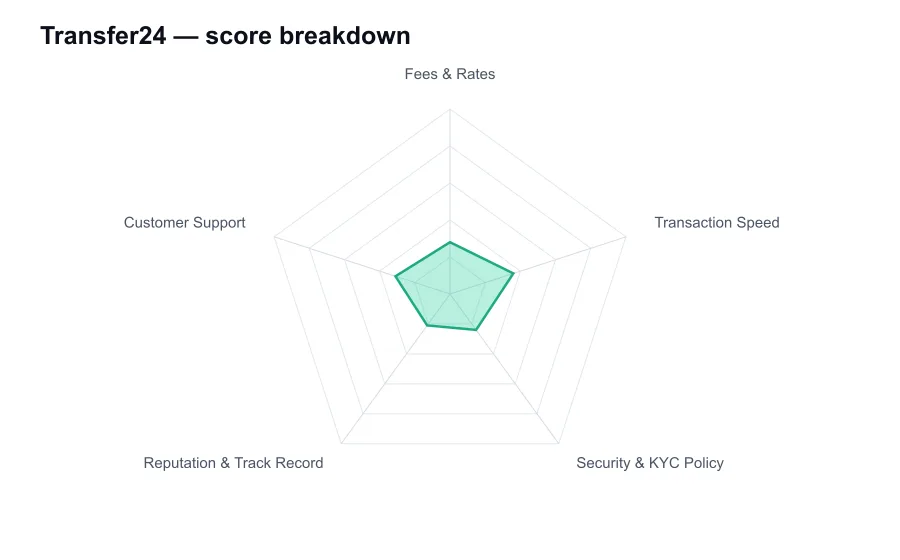
| Criterion | Score | Note |
|---|---|---|
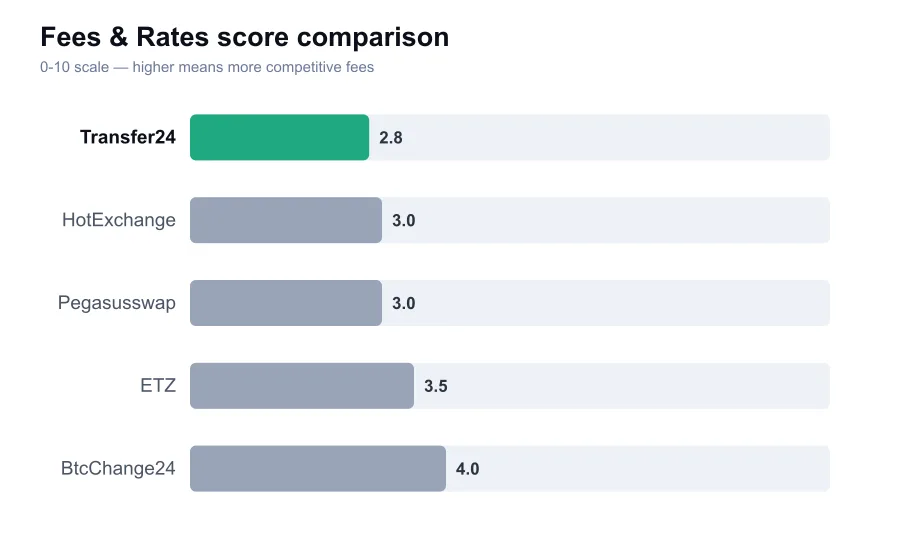
| Fees & Rates | 2.8 | No sufficiently verifiable public all-in fee framework |
| Transaction Speed | 3.6 | Settlement claims need independent proof and transaction hashes |
| Security & KYC Policy | 2.4 | Insufficient public evidence of custody and security controls |
| Reputation & Track Record | 2.1 | Identity and long-term independent track record are unclear |
| Customer Support | 3.1 | Accountable escalation channels are not clearly established |
Transfer24 is the most difficult provider in this group to assess responsibly because the name is generic and the public identity behind it is not sufficiently clear. That is not a minor inconvenience. In crypto, a service's legal operator, domain history, licensing claims, physical location, and support channels are part of the product. If those basics cannot be independently confirmed, a reviewer should not pretend it belongs beside established exchanges.
A polished website, a fast chat response, or an attractive exchange quote does not establish credibility. Fraudulent crypto operations regularly copy the language of legitimate payment platforms, advertise instant transfers, and use names that sound familiar or institutional. Transfer24 may be a real service in a particular market, but prospective users should first establish which entity they are dealing with. There is not enough reliable public evidence for me to endorse it as a broadly trusted provider.
The official web address itself should be confirmed independently rather than taken from a search advertisement, messaging-app link, or unsolicited recommendation. Look for a registered legal company name in the terms, an address that corresponds to that company, and a privacy policy naming the data controller. If the site has no meaningful legal disclosure, or if its claimed registration cannot be matched with the relevant corporate registry, that should end the process.
Fees are impossible to score highly without a public, stable fee policy. A provider might claim zero commission while earning money through a wide exchange spread, a poor conversion rate, a payout charge, or a withdrawal restriction. The only number that matters is the amount of crypto that actually reaches your wallet, or the amount of fiat that reaches your bank, after every charge. Anything less is marketing.
I would compare any Transfer24 quote with at least two liquid alternatives at the same time. For a crypto swap, use a major exchange or a well-known aggregator as a reference. For a fiat conversion, compare the final bank payout, not simply the displayed market rate. If the difference is substantial and the provider cannot explain it clearly, there is no reason to proceed. Cheap-looking quotes are often where the risk begins.
Speed claims require the same skepticism. Instant can mean the company has received your payment, not that crypto has been sent on-chain. It can mean an internal ledger update, not a completed bank transfer. It can also conceal a review period that starts only after money has been deposited. A credible service states cut-off times, required confirmations, supported payment rails, and what happens if the transfer needs manual compliance review.
Crypto transfers offer a simple test of honesty. Once a withdrawal is said to be complete, the company should provide a transaction hash that can be checked in a block explorer. It should not demand an extra release fee, tax payment, wallet activation charge, or refundable deposit before allowing withdrawal. Those requests are classic danger signals. Legitimate providers take disclosed fees from the transaction, they do not invent escalating payments after the fact.
Security claims are not meaningful without specifics. Two-factor authentication, encrypted web traffic, and cold storage are phrases anyone can put on a landing page. Serious operators explain account protection, withdrawal controls, custody arrangements, incident contacts, and their process for handling compromised accounts. They also make clear whether they custody assets at all. Transfer24 does not have enough transparent, independently confirmed technical and operational information to earn confidence here.
KYC is another point where vagueness becomes risky. A regulated financial service may reasonably ask for identity, address, or source-of-funds documentation. It should tell you this before accepting money, state why the data is needed, and provide a privacy policy with a real legal entity behind it. A site that markets itself as anonymous but asks for extensive documents only after deposit is not offering privacy, it is creating leverage over the customer.
Reputation is Transfer24's weakest category. Established providers accumulate a visible history, including criticism, outages, regulatory notices, community discussions, and independent security scrutiny. A thin or confusing record offers none of those signals. Positive reviews alone do not solve the problem, especially if they are generic, recent, or concentrated on sites with little verification. Trust should be earned through evidence, not through a reassuring name.
Support deserves caution too. Fast pre-sale replies are common. The important question is whether a user can reach the same accountable organization after a delayed transfer or blocked withdrawal. Check whether support uses a domain-based email address, whether ticket numbers are issued, whether there is a formal complaints process, and whether the company identifies a regulator or ombudsman where appropriate. A Telegram-only support model is not adequate for meaningful sums.
I would not recommend Transfer24 for a large purchase, a recurring trading relationship, or the custody of digital assets. There are too many better-documented alternatives. Even users who are comfortable with risk should avoid sending a large first payment. If someone insists on testing the service, the amount should be genuinely disposable and the entire withdrawal cycle should be completed immediately.
That may sound harsh, but a cautious standard is appropriate. The crypto industry has enough failures without granting the benefit of the doubt to opaque providers. Transfer24 could improve this assessment by publishing verifiable company details, a full fee schedule, specific custody information, formal support procedures, and evidence of a sustained operating history. Until then, uncertainty is the defining feature of the offer.
My final view is simple: lack of verifiable information is itself a risk signal. Transfer24 has not demonstrated the transparency required to justify trust with significant funds. The safest decision is to use a well-known exchange or a reputable noncustodial service instead. If you cannot independently establish exactly who operates a crypto provider, do not send them money.
| Pros | Cons |
|---|---|
| May advertise convenient transfer flows | — |
| Could suit only a very small test transaction | — |
| Generic service concept is easy to understand | — |
| — | Not appropriate for custody or large transfers |
Transfer24 is not a recommended choice for ordinary crypto users based on the public information that can be reliably established. Experienced investigators might conduct a tiny test only after verifying the exact legal entity and official domain. New users, high-value customers, businesses, and anyone needing dependable support should avoid it. Better-known exchanges offer far more accountability.
I would not consider it adequately verified for meaningful funds. Confirm the exact legal entity, official domain, custody model, fee terms, and withdrawal process before considering even a small test.
Do not send more money. Requests for extra tax, activation, insurance, or unlock payments before withdrawal are major fraud warning signs. Preserve records and contact your bank or payment provider.
Ask for the transaction hash and check it on the correct blockchain explorer. A screenshot, internal account balance, or chat assurance is not proof of an on-chain withdrawal.
| Alternative | Score |
|---|---|
| HotExchange Review | 2.8/10 |
| Pegasusswap Review | 2.8/10 |
| ETZ Review | 3.4/10 |
| BtcChange24 Review | 3.6/10 |
| Goexme Review | 3.6/10 |
| 1WM Review | 3.7/10 |