| Best for | Not for |
|---|---|
| Simple swap-focused proposition | — |
| Potentially less complex than a trading terminal | — |
| May suit a very small test transaction | — |
| Does not appear designed around leveraged trading | — |
Live market data via CoinGecko, for informational purposes only. Not financial advice.
Editorial independence: our scores and rankings are produced using the fixed criteria above and are not influenced by advertisers. This is an independent ranking site and is not operated by, or affiliated with, any provider we list.
Affiliate disclosure: some links on this page may earn us a commission at no extra cost to you. This does not affect our rankings.
| Criterion | Score | Note |
|---|---|---|
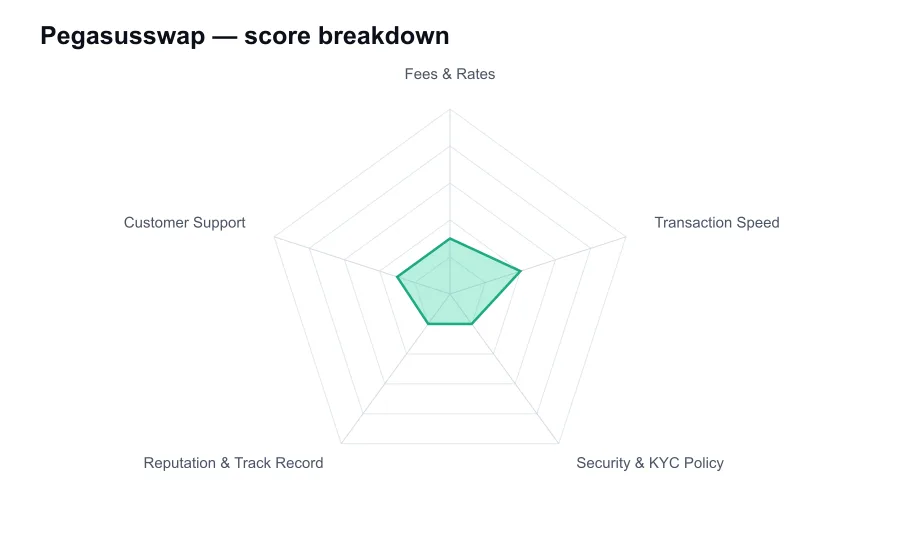
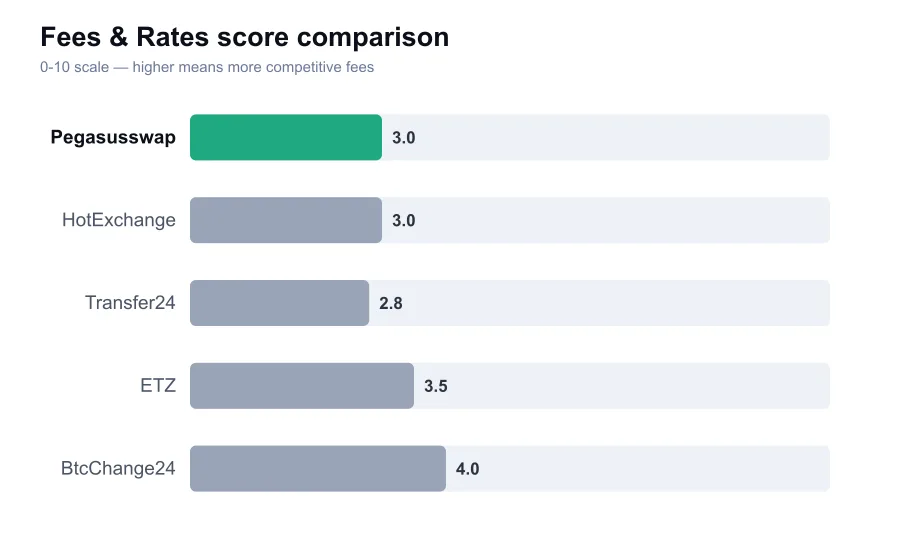
| Fees & Rates | 3.0 | Pricing transparency is too limited to assess confidently. |
| Transaction Speed | 4.0 | Settlement claims need independent, real-world verification. |
| Security & KYC Policy | 2.0 | Limited verifiable disclosure on custody and controls. |
| Reputation & Track Record | 2.0 | Thin public track record and limited accountability. |
| Customer Support | 3.0 | Test support before sending any meaningful amount. |
Pegasusswap is the sort of name that should make a careful crypto user pause before depositing anything. It has far less public visibility than established centralized exchanges, regulated regional brokers, or major decentralized protocols. A small swap service is not automatically dangerous, and new businesses need a chance to earn users. But in crypto, obscurity is a risk factor because there is little operating history to inspect when something goes wrong.
The first difficulty is basic verification. Publicly available information about Pegasusswap's corporate identity, licensing, custody arrangements, management team, and independently reviewed security controls is thin compared with what a serious customer should expect. A service that handles transfers should make it easy to identify the legal entity, governing terms, support channels, and jurisdiction. If those points are hard to establish, users should regard that as a warning, not a minor paperwork issue.
Its apparent proposition is straightforward crypto swapping rather than a deep trading venue. That can be useful in theory. Many people want to exchange one asset for another without charts, order books, margin, or account complexity. The problem is that a simple front end tells us almost nothing about execution quality. The important questions are where liquidity comes from, whether a quote is fixed or floating, and what happens if the market moves before settlement.
I would not assume low fees merely because a site does not show a conventional trading commission. Instant exchangers often place their compensation inside the exchange rate, and a vague rate is difficult to audit. Without a transparent fee schedule, an identifiable liquidity model, or a clear comparison to reference market prices, it is impossible to give Pegasusswap high marks for value. A user can test a tiny amount, but that is not the same as evidence of competitive pricing.
The practical method is to compare the exact receive amount against at least two known alternatives before sending funds. Use the same asset, network, and transaction size. Include withdrawal charges and network fees, not just the headline rate. If the quote is materially worse, convenience is not a defence. If a provider will not disclose whether a rate is locked, assume market movement may affect the result until its written terms say otherwise.
Speed is similarly difficult to judge from marketing alone. A swap can look instant at the interface while the actual transaction waits for blockchain confirmations, an external liquidity partner, manual review, or a compliance hold. Bitcoin and Ethereum transfers can take longer during busy periods, while networks such as Tron or Solana may confirm faster but introduce different wallet and address risks. A credible service explains these distinctions rather than promising universal instant settlement.
There is a key difference between a non-custodial interface and a no-risk service. Even a platform that sends swapped funds directly to a destination address may temporarily control the inbound transaction or rely on third-party liquidity. Users should verify the receiving address carefully, save transaction IDs, and never send a first test from an exchange account that cannot accept return transfers. Recovery options are often limited after a swap has begun.
The security picture is where Pegasusswap falls well short of established providers. I could not find the kind of broad, independently verifiable disclosure that would support confidence in cold-storage practices, penetration testing, insurance arrangements, proof of reserves, or a mature incident-response process. Absence of public evidence does not prove an incident occurred. It does mean customers have no solid basis to rely on claims that their assets are protected.
A relaxed verification policy can sound appealing, particularly to users who dislike handing identity documents to another crypto company. Yet vague KYC rules create their own problem. Many swap providers reserve the right to request documents after a transfer has already been sent if monitoring systems flag it. Before using Pegasusswap, read its anti-money-laundering policy line by line. Find out whether it can freeze a transaction, what documents it may request, and how disputes are handled.
Reputation cannot be built from a polished landing page or a few anonymous review snippets. The important evidence would be years of traceable operation, a named company, responsive public communication during outages, independent technical scrutiny, and a realistic pattern of feedback across several sources. Pegasusswap does not have the depth of public track record that lets me place it beside ChangeNOW, FixedFloat, Kraken, or a leading decentralized exchange.
That does not mean every user report will be negative. Small services can process ordinary swaps without trouble, especially in calm markets and for common assets. The danger arrives with a delayed transaction, an incorrectly selected network, a blocked compliance check, or a dispute over the quoted amount. Those are the moments that reveal whether a provider has competent operations and accountable support. I see too little public evidence to be comfortable predicting that outcome here.
Support should be tested before money is at risk. Ask a specific question about a supported chain, rate locking, or a failed deposit, then judge whether the reply is prompt and specific. A chatbot, a generic mailbox, or a social-media account is not enough for a provider handling irreversible transfers. If there is no clear escalation process, no published legal contact, and no reliable response trail, avoid making a significant deposit.
For users who still decide to try Pegasusswap, the only sensible approach is a small, disposable test transaction from a self-custody wallet. Do not use life savings, borrowed funds, or a large stablecoin conversion. Screenshot the quote, verify the official domain through independent channels, check every address character, and wait for the test to complete. Do not be persuaded by a limited-time rate or a support agent urging faster action.
My assessment is blunt. Pegasusswap has not earned the trust required for meaningful balances because its public footprint and verifiable disclosures appear too limited. Crypto has no shortage of better-known venues with clearer terms, deeper liquidity, and stronger support records. Until Pegasusswap offers transparent ownership, security documentation, pricing detail, and a sustained record of resolved customer issues, I would treat it as a high-risk experiment rather than a recommended exchange option.
| Pros | Cons |
|---|---|
| Simple swap-focused proposition | — |
| Potentially less complex than a trading terminal | — |
| May suit a very small test transaction | — |
| Does not appear designed around leveraged trading | — |
Pegasusswap is only suitable for highly cautious, technically capable users who are willing to test a negligible amount and independently verify every detail. It is not a sensible choice for beginners, large conversions, business payments, or anyone needing dependable dispute resolution. Users who value transparent fees, named operators, and proven support should choose a larger exchange or a well-established swap provider.
Its safety is difficult to verify from public information. Do not treat limited public disclosure as proof of danger, but do treat it as a reason to avoid significant deposits and use a tiny test first.
I could not establish a sufficiently clear, independently verifiable fee and execution model. Compare the final receive amount with reputable alternatives before sending funds.
Read its current terms and AML policy first. Some swap providers may request verification after receiving a transfer, so understand the process before sending any crypto.
| Alternative | Score |
|---|---|
| HotExchange Review | 2.8/10 |
| Transfer24 Review | 2.8/10 |
| ETZ Review | 3.4/10 |
| BtcChange24 Review | 3.6/10 |
| Goexme Review | 3.6/10 |
| 1WM Review | 3.7/10 |