| Best for | Not for |
|---|---|
| No verified strengths suitable for a funds recommendation | — |
| Name can be researched before any commitment | — |
| Lack of evidence is clear enough to support caution | — |
| — | No demonstrated security or customer-support record |
Live market data via CoinGecko, for informational purposes only. Not financial advice.
Editorial independence: our scores and rankings are produced using the fixed criteria above and are not influenced by advertisers. This is an independent ranking site and is not operated by, or affiliated with, any provider we list.
Affiliate disclosure: some links on this page may earn us a commission at no extra cost to you. This does not affect our rankings.
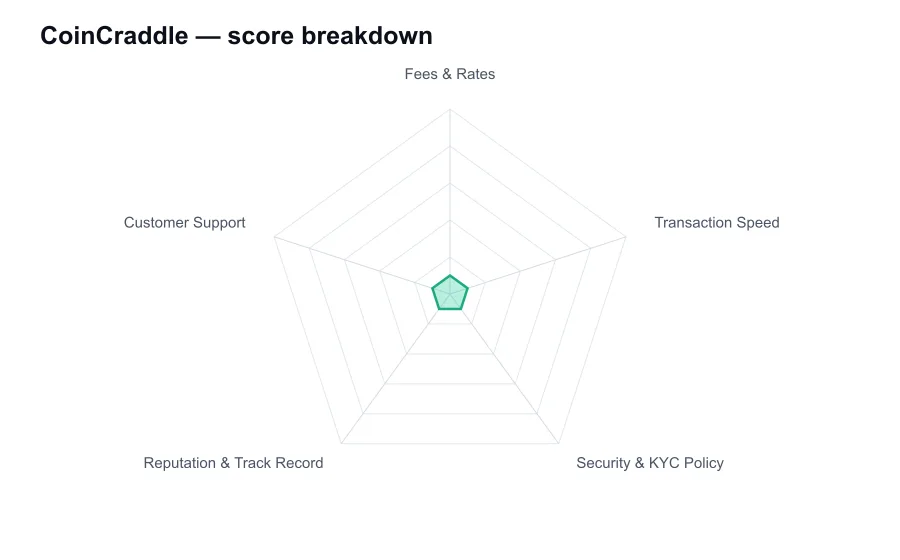
| Criterion | Score | Note |
|---|---|---|
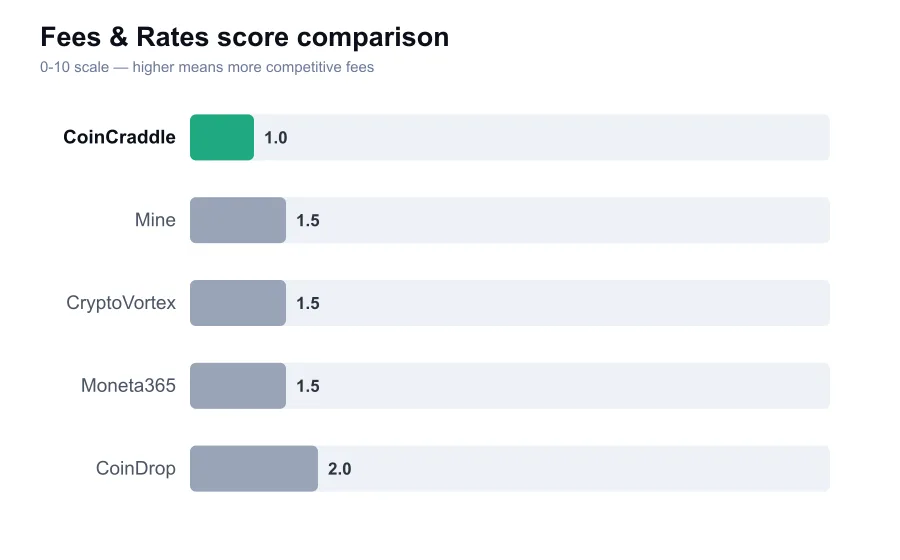
| Fees & Rates | 1.0 | No verifiable public fee or spread schedule found |
| Transaction Speed | 1.0 | No confirmed transaction or settlement performance |
| Security & KYC Policy | 1.0 | Custody, KYC, and security controls are unverified |
| Reputation & Track Record | 1.0 | No established independent operating track record found |
| Customer Support | 1.0 | No accountable support operation could be confirmed |
CoinCraddle is not a crypto provider I can verify as an established exchange, broker, wallet, payment processor, or analytics service. Searches for the exact name do not reveal the sort of durable public footprint that a financial platform should have: a clearly identified operating company, a regulatory home, detailed product terms, a documented fee schedule, and a body of credible independent coverage. That absence is the central fact of this review.
A strange or little-known name is not proof of fraud. New companies launch every day, and some begin with a small audience. But financial services have a higher burden of proof than an ordinary shopping site. If a platform invites users to send money, connect a wallet, disclose identity documents, or install software, it must make its legal identity and operating rules easy to verify before asking for trust.
I could not confidently identify an official CoinCraddle domain. Rather than attach a guessed URL to this review, I am leaving it out. That is deliberate. Publishing an unverified address can direct readers to an impersonator or a temporary promotional page. A real provider should have a stable official domain that is linked consistently from company records, app-store listings, social accounts, terms, and support material.
The inability to verify an official site makes fees impossible to assess honestly. There is no dependable public maker and taker schedule, no confirmed instant-swap spread, no published deposit or withdrawal charge table, and no verifiable minimum trade amount that I can attribute to CoinCraddle. Anyone claiming a specific low fee in its name should be asked to provide the binding terms from the verified operator, not a screenshot or chat message.
This is more serious than it sounds. Crypto platforms can advertise zero commission while earning from a wide conversion spread, network-fee markups, card-processing charges, or unfavorable fixed-rate quotes. Reputable providers disclose enough information to let customers calculate the actual cost. Coinbase, Kraken, Bitstamp, and many established swap services may differ sharply in price, but at least their published terms give users something concrete to compare.
Speed cannot be scored as a confirmed product capability either. A website may promise instant swaps, immediate withdrawals, or same-day settlements, yet those claims mean little without evidence of its liquidity partners, transaction-status system, blockchain policy, and support response. A transfer can be technically broadcast in minutes and still become a serious problem if the sender cannot obtain a transaction ID, destination address, or useful human assistance.
The security picture is where the lack of public identity becomes a deal-breaker. I found no reliable basis to confirm whether CoinCraddle has cold-storage controls, multi-signature procedures, proof-of-reserves reporting, penetration testing, insurance, segregated client funds, or even a defined custody model. Those features should not be accepted merely because they appear in a marketing graphic. They need terms, audits, or a credible operating record behind them.
KYC and privacy rules are equally unclear. A legitimate platform may require identity verification due to anti-money-laundering obligations, banking partners, transaction size, or jurisdiction. That is normal. What is not acceptable is discovering after payment that an unknown operator wants a passport, selfie, proof of address, source-of-funds statement, and extra fees before it will release an asset. Clear verification thresholds and a formal review process should be visible beforehand.
The name also raises a practical impersonation risk. Crypto scammers frequently create polished pages using invented or confusingly similar brands, then buy social-media ads or use direct messages to attract users. They may display fabricated balances, fake testimonials, or a convincing transaction progress bar. The eventual request is often for a tax, unlock fee, liquidity fee, or verification deposit. Real exchanges do not require an extra crypto payment to unlock a withdrawal.
A prospective user should verify several things independently before even considering CoinCraddle. Look for the exact legal entity in an official company registry, read the terms for governing law and dispute contact, search the domain's history, inspect whether the app publisher matches the company name, and compare wallet addresses with reputable blockchain reporting tools. If any part of that chain is missing, do not send funds to test it.
Do not be reassured by a small successful withdrawal alone. Fraudulent schemes sometimes permit a first withdrawal to encourage a larger deposit. The relevant question is whether the provider has a transparent, enforceable, long-running business model, not whether a tiny transaction happened to clear. Established venues can also have problems, but they leave a far wider trail of filings, security disclosures, known executives, public incident reporting, and independently documented users.
Customer support cannot be treated as proven simply because a chat bubble appears on a page. Support quality means accessible and accountable channels, case tracking, clear escalation, and answers that identify the company responsible for the account. Telegram-only, WhatsApp-only, or direct-message support is especially weak for a financial service. It gives a user little recourse if the conversation disappears or the representative changes their story.
CoinCraddle has no verifiable reputation or track record that justifies the risk of placing funds there. I would not infer legitimacy from a professional interface, an SSL certificate, a social following, or a claimed license badge. Those are easy to imitate. The burden belongs with the platform to show who runs it, where it operates, what it charges, how it protects assets, and how a user can complain if something goes wrong.
For people who need an exchange, there are better choices even before getting into preference. Kraken, Coinbase, Bitstamp, Gemini, and regionally licensed providers offer identifiable legal entities and substantial public documentation, though availability and fees differ by country. For self-custody swaps, choose established services carefully and send only test-sized amounts first. None are risk-free, but obscurity should never be confused with privacy or opportunity.
My recommendation is to avoid CoinCraddle unless and until the operator can be independently verified with evidence that stands outside its own promotional materials. The score is low because the information gap affects every category, not because I can substantiate a particular allegation about the name. In crypto, uncertainty about who holds your money is itself a risk. There is no compelling reason to accept that risk when transparent alternatives exist.
| Pros | Cons |
|---|---|
| No verified strengths suitable for a funds recommendation | — |
| Name can be researched before any commitment | — |
| Lack of evidence is clear enough to support caution | — |
| — | No demonstrated security or customer-support record |
CoinCraddle is not suitable for traders, investors, merchants, or anyone seeking a place to store or exchange crypto until its operator and terms can be independently verified. It is particularly unsuitable for first-time buyers, who are common targets for lookalike platforms and recovery scams. Users needing a service now should choose an exchange with a known legal entity and published policies. Researchers may only treat the name as an unverified lead, not a financial provider.
I could not verify CoinCraddle as an established exchange with a clearly identified operator, stable official domain, published trading terms, and independent track record.
No reliable public fee schedule, conversion spread, or withdrawal-fee table could be confirmed for this name. Do not rely on promotional claims without binding verified terms.
No. A small test does not establish legitimacy and can expose your wallet, payment details, or identity. Verify the legal entity and official domain first, or use a known provider.
I could not confirm a legitimate KYC policy. Do not submit identity documents to an unverified platform, especially after funds have already been sent.
| Alternative | Score |
|---|---|
| Mine Review | 1.2/10 |
| CryptoVortex Review | 1.3/10 |
| Moneta365 Review | 1.5/10 |
| CoinDrop Review | 1.8/10 |
| Magnatus Review | 1.8/10 |
| HotExchange Review | 2.8/10 |