| Best for | Not for |
|---|---|
| Generic name warrants careful independent verification | — |
| Can be screened with a small withdrawal test | — |
| Highlights the importance of domain verification | — |
| — | High risk of confusing lookalike services |
Live market data via CoinGecko, for informational purposes only. Not financial advice.
Editorial independence: our scores and rankings are produced using the fixed criteria above and are not influenced by advertisers. This is an independent ranking site and is not operated by, or affiliated with, any provider we list.
Affiliate disclosure: some links on this page may earn us a commission at no extra cost to you. This does not affect our rankings.
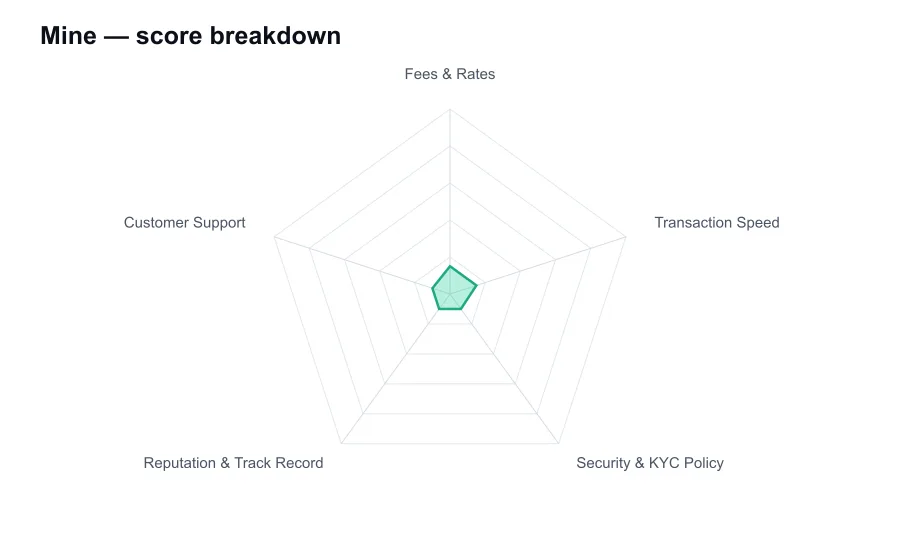
| Criterion | Score | Note |
|---|---|---|
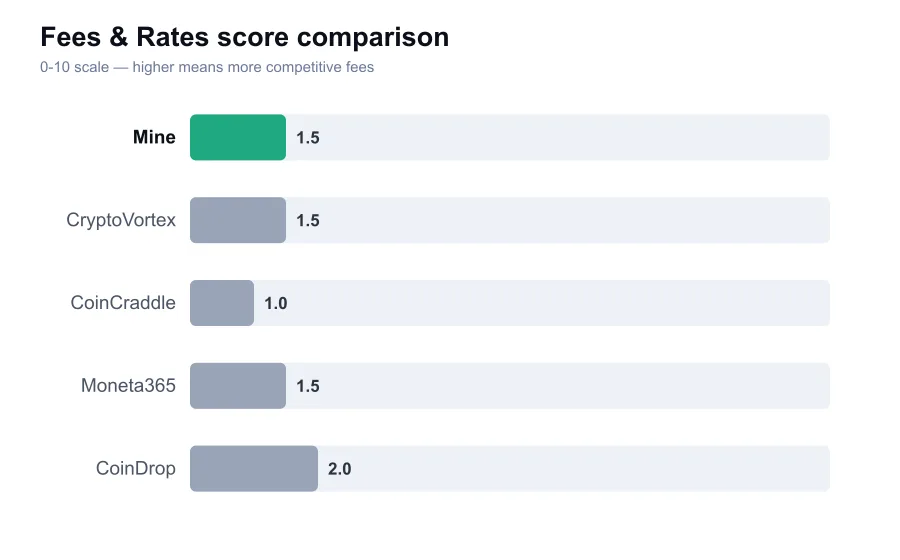
| Fees & Rates | 1.5 | No confirmed Mine fee schedule available |
| Transaction Speed | 1.5 | No verified execution or withdrawal record |
| Security & KYC Policy | 1.0 | No attributable security or KYC disclosures |
| Reputation & Track Record | 1.0 | Generic name prevents reliable attribution |
| Customer Support | 1.0 | No confirmed official support channel |
Mine is an exceptionally difficult name to assess as a crypto provider because it is generic enough to overlap with mining services, token projects, software products, and unrelated businesses. That ambiguity is not merely annoying for search results. It creates a serious due-diligence problem. I could not identify a single, clearly authoritative exchange operator under the exact name Mine with a public, verifiable product record comparable to established trading venues.
A legitimate exchange should make identity easy to confirm. Its official domain, registered company, operating jurisdictions, terms of service, fee page, and support channels should all point to the same entity. With a generic brand, users are especially exposed to lookalike domains, fake social accounts, cloned apps, and token-contract confusion. If someone sends you a Mine link through a private message, the burden is on them to prove it is the genuine service, not on you to assume that it is.
I am not prepared to invent fee figures for a provider that cannot be pinned down with confidence. That is how unreliable exchange reviews turn into advertisements for the wrong site. A real fee evaluation needs a live schedule for spot trades or swaps, withdrawal charges by asset, card and bank fees where relevant, spread policy, minimums, and any charge for expedited processing. None of that can be responsibly attributed to Mine as a distinct, confirmed exchange.
Users should be skeptical of a platform that advertises zero fees without defining its spread. Many instant-buy and swap services charge no explicit commission while earning from the exchange rate. That can be a legitimate model if it is plainly explained before confirmation. It becomes a problem when the service hides the rate source, changes the quote after deposit, or adds a network charge later. Without documentation, Mine's real all-in cost is unknown.
The same issue applies to transaction speed. Promotional claims such as instant exchange, rapid withdrawal, or same-day settlement sound reassuring but say almost nothing. A dependable provider states the expected processing stage, required confirmations, supported chains, and what happens when a transfer needs manual review. There is no dependable body of evidence I can use to confirm that Mine executes trades or withdrawals consistently, quickly, and at the quoted rate.
Speed claims deserve extra caution because crypto scams often use urgency as a tool. A fake exchange may show an immediate account balance while making withdrawal conditional on a tax payment, activation deposit, or supposed liquidity fee. Those are classic warning signs. A legitimate venue deducts disclosed fees from the transaction or explains them in enforceable terms. It does not ask customers to send additional crypto to unlock funds after the fact.
Security is the area in which uncertainty is least acceptable. I could not verify a Mine-specific security architecture describing custody, cold-wallet practices, multi-signature controls, proof of reserves, penetration testing, account recovery, or breach response. A company need not publish every technical detail, but it should provide enough information for customers to understand whether it holds their assets and how it limits unauthorized withdrawals.
Account safeguards matter too. A serious centralized platform usually offers two-factor authentication, withdrawal address whitelisting, anti-phishing codes, device management, and clear notification settings. A legitimate non-custodial swap service should explain that it does not retain deposits beyond the swap flow and should provide a transaction tracker. Because I cannot verify which Mine service, if any, is being considered, I cannot confirm the presence of either set of safeguards.
KYC policy is just as opaque. Some users seek no-KYC trading because they value privacy or have limited access to conventional finance. That does not excuse unclear compliance rules. A service can reasonably request verification under risk controls, but it must disclose the possibility before taking custody of funds. Surprise KYC after deposit, coupled with vague document demands and no escalation route, is one of the most damaging patterns in the instant-exchange market.
Mine does not have a verifiable reputation comparable with named exchanges that have years of public operating history. A few isolated online mentions, a listing in a token tracker, or a polished website are weak evidence. Reputation comes from consistent independent user reporting, transparent incident handling, recognizable leadership, legal accountability, and a visible record through difficult markets. I could not establish that record for a specific provider operating simply as Mine.
This is also why review-site star ratings should not settle the question. Generic names attract reviews that may belong to a different product, and low-quality sites can be flooded with promotional comments. Look for concrete details such as the exact domain, trade date, asset, transaction ID, support interaction, and whether the reviewer successfully withdrew funds. Even then, treat anonymous claims as one signal, not a guarantee.
Support is impossible to score generously without a confirmed official route. Customers need more than a chat bubble. They need clear response expectations, ticket records, a legitimate help center, and a way to escalate a stuck withdrawal or identity issue. In crypto, support quality becomes visible precisely when something goes wrong. An exchange that is easy to contact before deposit but silent afterward is worse than no exchange at all.
If you believe you have found a genuine Mine platform, verify it before connecting a wallet or uploading documents. Search the company registration named in its legal terms, compare the domain across official social channels, inspect its app publisher, and test its support with a basic question. Then make a tiny deposit and withdrawal, not a trade that locks up your balance. Never use borrowed money or your primary self-custody wallet for that test.
My judgment is necessarily harsh because a financial provider cannot earn trust through ambiguity. Mine may refer to a real project somewhere in the crypto market, but the evidence available under this exact name does not support a positive exchange recommendation. The downside of being wrong is too high: hidden fees, delayed withdrawals, identity theft, or outright loss. Use a provider with a clear legal identity and independently documented history instead.
| Pros | Cons |
|---|---|
| Generic name warrants careful independent verification | — |
| Can be screened with a small withdrawal test | — |
| Highlights the importance of domain verification | — |
| — | High risk of confusing lookalike services |
Mine is not appropriate for users seeking a known exchange, a reliable swap service, or a place to hold funds. Only investigators who can establish the exact legal operator and official domain should research it further, and even then they should start with a trivial amount. Beginners should use a recognizable, regulated venue or a well-established self-custody protocol.
I could not confirm one authoritative exchange operator under the exact generic name Mine. Verify the precise domain, company, and legal terms before sending funds.
No reliably attributable public fee schedule was available. Do not rely on a zero-fee claim unless the quote, spread, network cost, and withdrawal charge are clearly shown.
Not until you have independently verified the legal operator, privacy policy, official domain, and support process. Generic-name impersonation is a real risk.
| Alternative | Score |
|---|---|
| CryptoVortex Review | 1.3/10 |
| CoinCraddle Review | 1.0/10 |
| Moneta365 Review | 1.5/10 |
| CoinDrop Review | 1.8/10 |
| Magnatus Review | 1.8/10 |
| HotExchange Review | 2.8/10 |