| Best for | Not for |
|---|---|
| The name may be easy to find in crypto searches | — |
| Could suit only users who independently verify the exact operator | — |
| A small test transaction may reveal actual service behavior | — |
| — | Too little track record for a trusted deposit service |
Live market data via CoinGecko, for informational purposes only. Not financial advice.
Editorial independence: our scores and rankings are produced using the fixed criteria above and are not influenced by advertisers. This is an independent ranking site and is not operated by, or affiliated with, any provider we list.
Affiliate disclosure: some links on this page may earn us a commission at no extra cost to you. This does not affect our rankings.
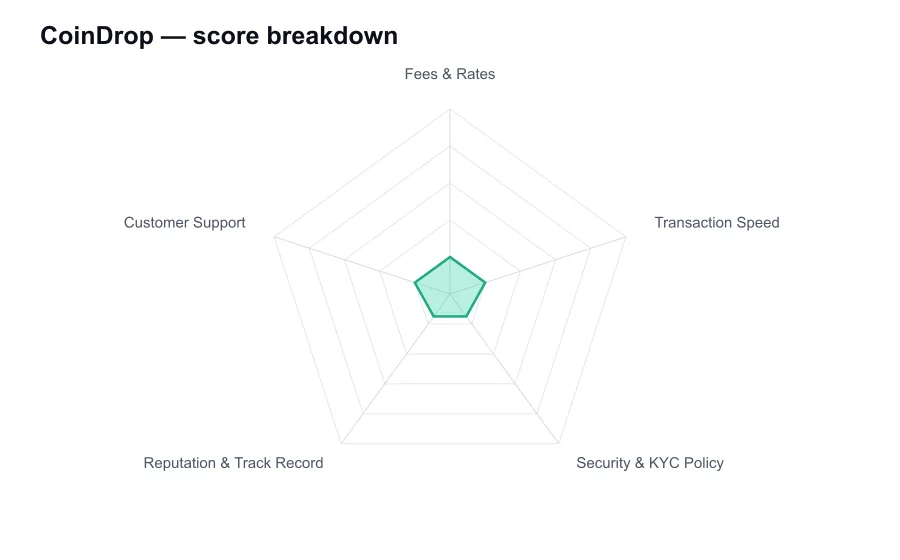
| Criterion | Score | Note |
|---|---|---|
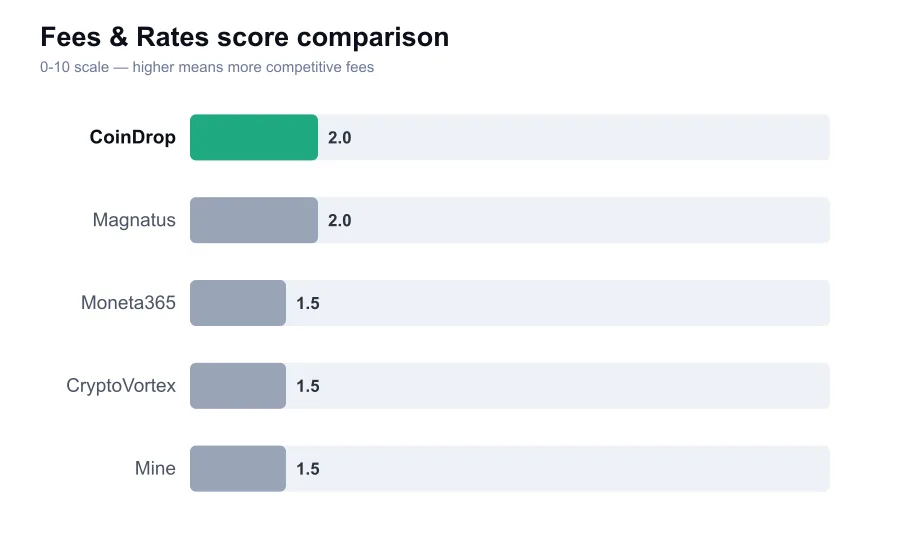
| Fees & Rates | 2.0 | No reliable, verified public fee schedule found |
| Transaction Speed | 2.0 | Settlement standards cannot be independently confirmed |
| Security & KYC Policy | 1.5 | Custody, KYC, and security controls are unclear |
| Reputation & Track Record | 1.5 | No clearly verifiable unified operating record |
| Customer Support | 2.0 | Accountable support process is not established |
CoinDrop is a name that appears in several corners of the crypto market, which is exactly the problem. I could not establish a single, clearly regulated exchange business with a consistent public corporate identity, independently verifiable operating history, and a reliable official website that can confidently be tied to the service under this name. That puts it in a very different category from a recognizable broker such as Coinmotion or an established wallet such as Coinomi.
A crypto provider does not need to be huge to deserve attention. Small regional brokers and new swap services can be perfectly legitimate. But they do need to make the basics easy to verify: the legal entity, jurisdiction, terms of service, custody arrangements, fee schedule, support channels, and a clear record of how long the operation has existed. CoinDrop's public footprint is too fragmented to support that level of confidence.
That lack of clarity matters more than flashy claims about rates or instant conversions. A user may find a site, app, promotion, social account, or referral campaign using the CoinDrop name, but a brand mention is not proof of an accountable financial service. In crypto, similar names are frequently used by unrelated businesses, inactive projects, airdrop campaigns, and outright impersonators. Treating them as one provider would be careless.
Fees are impossible to score generously where there is no dependable published schedule tied to an identifiable operator. A reasonable exchange should state whether its quoted price includes a spread, whether it charges a fixed trading fee, how network withdrawal charges are calculated, and what happens if a transaction fails. If a service simply presents one conversion figure without a transparent quote breakdown, the true cost can be hidden in the rate.
That does not mean every spread-based service is bad. Many beginner brokers use spreads because they make the purchase flow simple. The problem is that a customer needs enough information to compare the total cost against Kraken, Coinbase, Bitstamp, or a local regulated broker. If CoinDrop cannot show a stable fee policy and a completed-order receipt that separates its charge from the blockchain network fee, users have no sound basis for comparison.
Speed claims deserve the same skepticism. A crypto transfer can be broadcast quickly while still taking time to confirm, and a card or bank-funded purchase can be delayed by payment reviews, fraud controls, or withdrawal holds. Reputable providers explain which stage is instant, which stage depends on the blockchain, and whether new customers face a cooling-off period. Vague references to instant delivery are marketing, not a service standard.
Security is the decisive weakness. I found no dependable public evidence that a particular CoinDrop operator has a named security team, audited custody design, proof of reserves, mandatory two-factor authentication, address whitelisting, cold-storage policy, or formal incident disclosures. An exchange need not publish every technical detail, but it should provide enough information for customers to understand who controls their funds and what recourse exists if something goes wrong.
KYC is equally unclear. That can sound attractive to privacy-minded buyers, but uncertainty is not the same as privacy. A responsible no-KYC wallet service states plainly that it does not take custody and explains the limits imposed by its exchange partners. A responsible regulated broker explains its identity checks before accepting money. A service that leaves users guessing may later request documents after funds are already locked in a review queue.
The reputation question cannot be answered by counting anonymous review snippets. Crypto review sites are vulnerable to affiliate promotion, coordinated ratings, and complaints that are difficult to authenticate. What carries more weight is a verifiable operating company, long-running customer discussions, regulator records where applicable, identifiable founders, and a record of responding publicly to incidents. CoinDrop does not currently offer enough of that evidence under one confirmed identity.
Support is another area where users should insist on proof before depositing. A responsive Telegram account or social-media direct message is not a substitute for a support portal, ticket history, published response process, legal contact details, and a way to escalate a payment issue. The real test is simple: can a customer reach an accountable organization after a delayed withdrawal, not merely before making a deposit?
The practical risk is not only outright fraud. A poorly documented service can create painful problems even if it is operating in good faith. Funds may be held while staff ask for unexpected verification, transfers can be sent to the wrong network, exchange quotes can change without a clear dispute process, and a user might discover too late that the service was only an intermediary with limited control over the transaction.
Anyone considering CoinDrop should independently verify the exact domain, company registration, country of operation, and terms before sending even a test amount. Do not rely on a search result or a lookalike social profile. Check the destination address carefully, avoid sending funds from a wallet containing your main holdings, and never provide a seed phrase, remote-device access, or a payment to "unlock" a withdrawal. Those are classic danger signs.
There are safer routes for most people. For regulated fiat purchases, use an exchange or broker that identifies its legal entity and licensing position. For self-custody, choose a known wallet and buy through a well-documented provider. A smaller platform can still earn trust, but it must do the work publicly. At present, CoinDrop has not cleared that basic threshold for me.
My view is blunt: CoinDrop is not a provider I would recommend depositing with until its identity and operating standards are independently verifiable. The absence of trustworthy public information is itself a material risk, not a neutral blank space. A tempting rate cannot compensate for uncertainty about who receives the money, who holds the assets, or who answers if the transaction fails. Skip it unless you can establish facts that are stronger than the public record available under this name.
| Pros | Cons |
|---|---|
| The name may be easy to find in crypto searches | — |
| Could suit only users who independently verify the exact operator | — |
| A small test transaction may reveal actual service behavior | — |
| — | Too little track record for a trusted deposit service |
CoinDrop is not a sensible choice for first-time buyers, investors, or anyone moving meaningful funds. It could only be considered by highly experienced users who can independently verify the precise company, domain, and transaction terms. Most people should use a regulated local broker or a long-established exchange with documented custody and support procedures.
I could not verify one clearly identifiable exchange operator, official domain, regulatory status, and public operating record under this name. Verify the exact entity before sending funds.
There is no dependable public fee schedule I can attribute to a confirmed CoinDrop operator. Do not assume a displayed conversion quote is the final cost.
No. If you proceed after independently verifying the operator, start only with an amount you can afford to lose and confirm withdrawal behavior first.
| Alternative | Score |
|---|---|
| Magnatus Review | 1.8/10 |
| Moneta365 Review | 1.5/10 |
| CryptoVortex Review | 1.3/10 |
| Mine Review | 1.2/10 |
| CoinCraddle Review | 1.0/10 |
| HotExchange Review | 2.8/10 |
