| Best for | Not for |
|---|---|
| No verified strengths justify a deposit | — |
| Useful only as a reminder to verify provider identity | — |
| A test of transparency can reveal warning signs early | — |
| — | High risk of name confusion or impersonation |
Live market data via CoinGecko, for informational purposes only. Not financial advice.
Editorial independence: our scores and rankings are produced using the fixed criteria above and are not influenced by advertisers. This is an independent ranking site and is not operated by, or affiliated with, any provider we list.
Affiliate disclosure: some links on this page may earn us a commission at no extra cost to you. This does not affect our rankings.
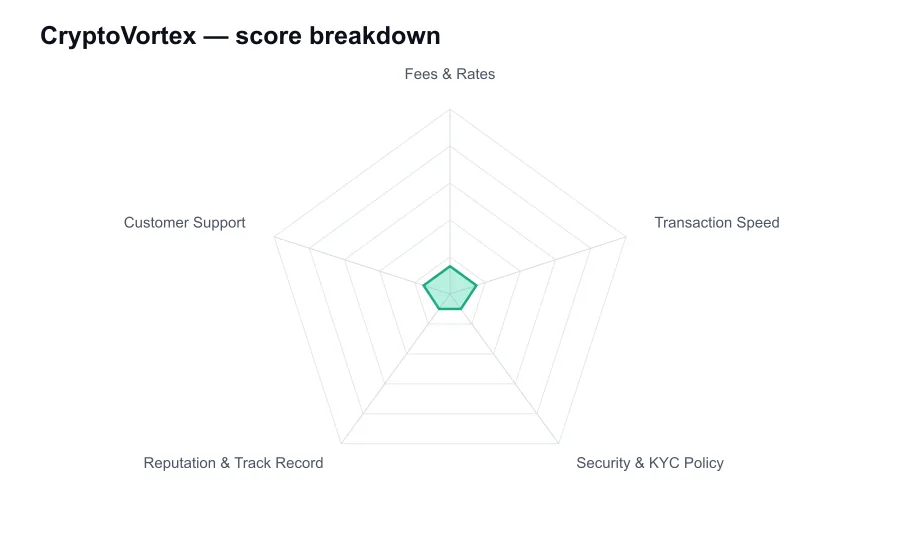
| Criterion | Score | Note |
|---|---|---|
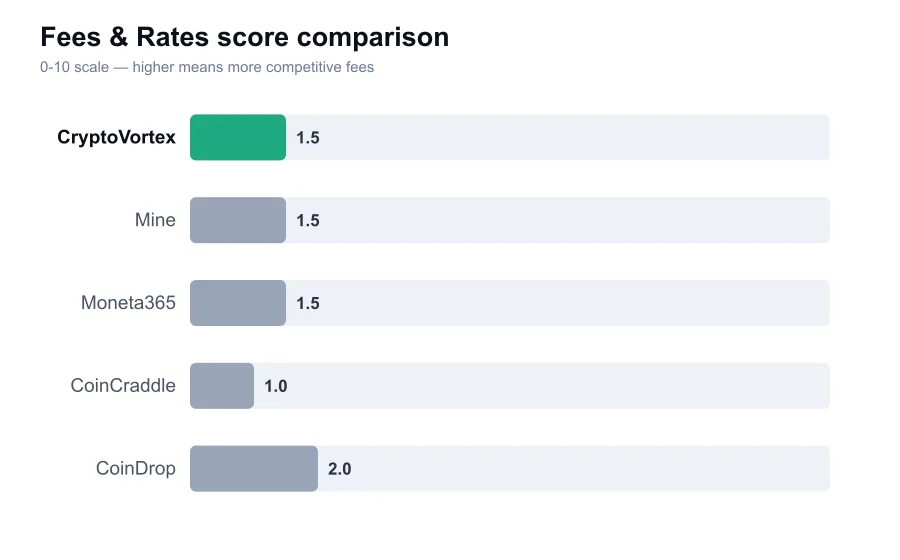
| Fees & Rates | 1.5 | No verifiable public pricing or withdrawal policy |
| Transaction Speed | 1.5 | No independently confirmed deposit or withdrawal performance |
| Security & KYC Policy | 1.0 | Security, custody, and KYC practices cannot be verified |
| Reputation & Track Record | 1.0 | No established, attributable exchange track record |
| Customer Support | 1.5 | No accountable customer-support process established |
CryptoVortex is another provider name that cannot be reviewed as a clearly identified, established crypto exchange on the available public record. I could not confidently connect the name to one official operator, a regulated entity, a documented product suite, or a long-standing exchange brand with consistent public terms. That does not prove every use of the name is fraudulent. It does mean a responsible review cannot pretend there is a verified platform behind it.
The crypto industry has a naming problem. Names that sound like trading brands are cheap to register and easy to reuse, especially words such as crypto, vortex, exchange, capital, market, and trading. A web page, a polished dashboard, or a social-media profile can be created much faster than a trustworthy financial operation. Readers should distinguish a visible brand from a provider with accountability.
I would expect an exchange calling itself CryptoVortex to provide a precise legal name, company number, business address, governing law, restricted-country policy, and clearly written customer agreement. It should also identify whether it is an exchange, broker, wallet, signal service, managed-account scheme, or affiliate funnel. Without those details, users cannot determine who is taking their money or which rules apply to their assets.
Fee analysis begins with that missing foundation. A credible provider publishes maker and taker fees, spreads for instant buys, fiat deposit charges, withdrawal minimums, blockchain withdrawal fees, and any inactivity or conversion costs. If CryptoVortex presents a profit projection, a guaranteed return, or a vague claim of zero commissions without explaining the spread, it should be treated as a warning rather than a bargain.
Some questionable platforms advertise free trading while charging through manipulated pricing, excessive withdrawal costs, or a later demand for tax, insurance, verification, or release fees. Legitimate exchanges may request identity documents, but they do not ask customers to send an extra crypto payment to unlock a withdrawal. Nor do legitimate support agents need a wallet seed phrase, private key, screen-sharing access to a banking app, or a remote-control installation.
There is no dependable evidence available to judge CryptoVortex's execution quality or withdrawal speed. A platform can show prices moving in real time without actually providing reliable market access. The only speed that matters is whether a user can deposit, trade at a disclosed price, withdraw to a self-controlled wallet, and receive the assets without surprise conditions. A balance displayed inside an unverified dashboard is not proof of custody.
Crypto transaction speed also cannot be assessed from marketing claims alone. A serious platform would disclose its withdrawal processing policy, address confirmation process, blockchain transaction IDs, required confirmations, and limits for new accounts. If users cannot verify outbound withdrawals on public block explorers, or if support repeatedly claims that a transfer is "pending approval" without a clear reason, they should stop sending money.
Security claims are empty unless supported by operational facts. I found no reliable material under the CryptoVortex name showing mandatory two-factor authentication, passkey support, withdrawal address whitelisting, cold-wallet policy, bug-bounty program, security audit, proof-of-reserves reporting, or incident-response history. None of those features alone proves safety, but their absence from a provider's public documentation makes confidence impossible.
KYC uncertainty is not a privacy feature. It is especially risky where a site permits an initial deposit with little friction, then imposes document checks only when a withdrawal is requested. That pattern can occur at legitimate regulated services in limited cases, but it is also common in scams designed to create pressure after funds are trapped. Customers deserve to know verification requirements before they fund an account.
Reputation is where CryptoVortex falls apart most clearly. I could not verify a durable, independently documented operating history comparable to known exchanges such as Kraken, Bitstamp, Coinbase, Gemini, or regional regulated brokers. Search results and review posts alone are not enough. A service needs a traceable company record and years of customer experience that can be assessed beyond promotional channels.
Be very cautious if your introduction to CryptoVortex came through a dating-app contact, an unsolicited WhatsApp or Telegram message, a social-media "mentor," or a promise of managed trading profits. Those are common routes into pig-butchering and advance-fee investment scams. The existence of a branded platform does not make the investment real. Scammers often give victims a small successful withdrawal early to build confidence before pressuring them to deposit more.
Customer support should be viewed through the same lens. An exchange can have a chat widget and still offer no meaningful recourse. Before using any provider, test whether its support team can answer basic questions about legal ownership, withdrawal fees, KYC timing, and dispute handling in writing. If the answer is only a sales pitch, a demand to communicate privately, or a promise that a manager will handle everything, walk away.
For users who may already have sent funds, the right response is to stop adding money. Save transaction hashes, wallet addresses, messages, account screenshots, and payment receipts. Contact the receiving bank, card issuer, exchange, or payment processor promptly, although blockchain transfers are difficult to reverse once confirmed. Report the matter to local consumer-protection, cybercrime, and financial-fraud authorities, especially if identity documents were also provided.
There is no compelling reason for a normal retail user to choose an unverified name like CryptoVortex over well-documented alternatives. Established providers are not flawless, and they can be more intrusive about identity verification, but at least users can inspect their rules, compare their fees, and assess their history. The burden of proof belongs to a company asking for money, not to the customer trying to prove it is safe.
My assessment is therefore a firm avoid. CryptoVortex may refer to more than one thing, but no specific accountable exchange operation is sufficiently identifiable for a positive review. Do not be swayed by screenshots of profits, testimonials, or urgency. Until a precise operator can be independently verified, the sensible decision is to keep funds in a wallet you control or use a known regulated service.
| Pros | Cons |
|---|---|
| No verified strengths justify a deposit | — |
| Useful only as a reminder to verify provider identity | — |
| A test of transparency can reveal warning signs early | — |
| — | High risk of name confusion or impersonation |
CryptoVortex is not suitable for retail investors, traders, or anyone seeking a place to buy, hold, or exchange cryptocurrency. Experienced investigators may be able to verify a specific entity using this name, but ordinary customers should not have to do that work. Choose a provider with a known legal identity, published fee schedule, and a genuine withdrawal record instead.
I could not verify a single accountable exchange operator, official domain, regulatory position, or established public track record under this name. Treat it as unverified.
Do not send more money. Save evidence, contact the payment provider immediately, and report suspected fraud to relevant local authorities. Legitimate withdrawals should not require a secret release payment.
No. Screenshots, dashboard balances, and testimonials can be fabricated. Only independently verifiable withdrawals, company records, and transparent terms provide meaningful evidence.
| Alternative | Score |
|---|---|
| Mine Review | 1.2/10 |
| Moneta365 Review | 1.5/10 |
| CoinCraddle Review | 1.0/10 |
| CoinDrop Review | 1.8/10 |
| Magnatus Review | 1.8/10 |
| HotExchange Review | 2.8/10 |
