| Best for | Not for |
|---|---|
| Simple branding may appeal to casual visitors | — |
| No proven operational strengths could be verified | — |
| Research prompts useful due diligence | — |
| — | Opaque security and KYC practices |
Live market data via CoinGecko, for informational purposes only. Not financial advice.
Editorial independence: our scores and rankings are produced using the fixed criteria above and are not influenced by advertisers. This is an independent ranking site and is not operated by, or affiliated with, any provider we list.
Affiliate disclosure: some links on this page may earn us a commission at no extra cost to you. This does not affect our rankings.
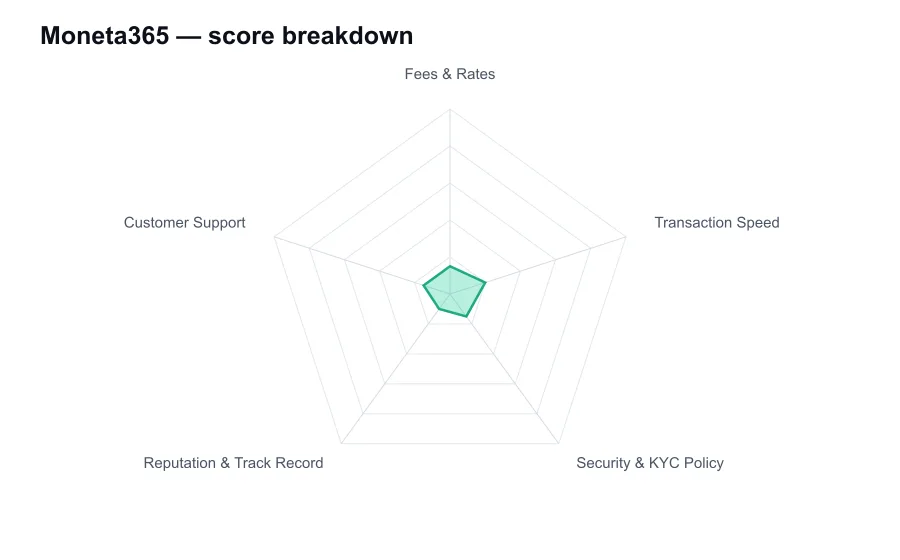
| Criterion | Score | Note |
|---|---|---|
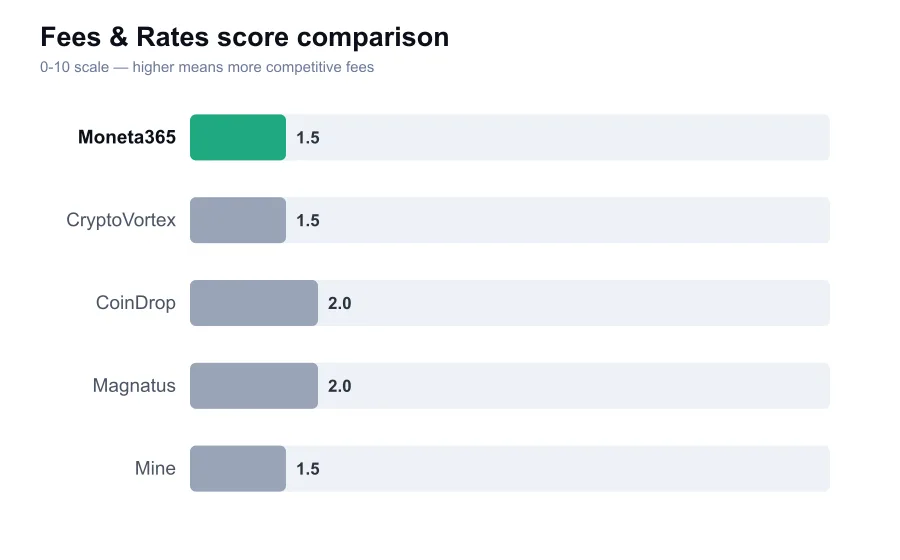
| Fees & Rates | 1.5 | Fee and spread disclosures are not adequately verifiable |
| Transaction Speed | 2.0 | No dependable public execution record |
| Security & KYC Policy | 1.5 | Security, custody, and KYC practices remain unclear |
| Reputation & Track Record | 1.0 | Insufficient independent track record |
| Customer Support | 1.5 | No credible public escalation framework |
Moneta365 is one of those crypto brands that demands more caution than enthusiasm. It has appeared in the broad category of online exchange and investment style services, but it does not have the established, independently documented market presence of serious exchanges such as Kraken, Coinbase, Bitstamp, or even long running instant swap specialists. A polished website is easy to launch. A verifiable operating history is much harder to build.
The first difficulty is identifying exactly what Moneta365 is supposed to be. Reliable exchange providers state their legal entity, registered jurisdiction, product scope, applicable restrictions, custody model, and support channels in language that can be checked. With Moneta365, public information is not sufficiently clear or consistent to establish that foundation. That leaves prospective users trying to assess a financial service without knowing who is accountable if an order, withdrawal, or personal data request goes wrong.
This is not a minor paperwork objection. Crypto exchanges hold or route assets that are usually impossible to recover after transfer. If a platform cannot be tied to a known business, a regulator, a recognized security program, or a long lived public record, the customer carries nearly all of the downside. The burden should be on Moneta365 to prove legitimacy through transparent disclosures, not on users to infer safety from branding or positive comments of unknown origin.
Fees are impossible to score generously where a provider does not publish a complete, understandable schedule. Customers need to know the deposit charge, trading or conversion fee, withdrawal fee, blockchain charge, spread policy, minimums, and any conditions attached to promotional rates. A quote that seems favorable at the start can become expensive once a hidden spread or fixed withdrawal fee is applied. Moneta365 does not provide enough dependable public information to make a like for like fee comparison.
That uncertainty is especially dangerous if a site uses a deposit first workflow. A user may see one exchange rate, send coins, then discover the amount is subject to manual review, additional payment, or a withdrawal restriction. Legitimate platforms can have compliance checks, but they explain their rules before taking funds. Any provider that asks for more crypto to release an existing balance should be treated as a serious danger signal. Fees are deducted from a transaction, not repeatedly demanded as a ransom.
I would not send a test transfer merely because a service is unfamiliar. A small test can show whether a blockchain address receives funds, but it cannot prove that the operator will honor a larger withdrawal. It can also expose a user to aggressive follow up, phishing, or requests for identity documents. The safer test is research first: locate a legal entity in an official registry, verify the domain age and history, inspect independently hosted reviews, and check whether named executives have a credible public presence.
Transaction speed has the same problem as pricing. There is no robust and independently validated service record showing ordinary execution times, withdrawal processing standards, or how Moneta365 handles exceptions. Claims of instant settlement should be read skeptically because blockchain settlement, liquidity sourcing, and compliance screening all take time. A proper exchange publishes expected processing windows and communicates outages. A vague promise of fast profits or instant release is not a technical service standard.
Security is where the review turns sharply negative. I cannot identify the level of account protection, cold storage policy, penetration testing, insurance, proof of reserves, transaction monitoring, or incident response that would allow a customer to assess the platform. There is no reason to presume those controls exist simply because they are common words in crypto marketing. Without credible technical and corporate disclosure, the responsible security score is low.
KYC policy is equally unclear. Reputable providers make it plain whether identity verification is mandatory, which countries they serve, what documents are accepted, how data is retained, and when source of funds checks apply. Unclear KYC is bad for both privacy and compliance. It can mean users send sensitive documents into an opaque system, or discover after depositing that they cannot withdraw without a verification process that was never explained.
The reputation question does not improve the picture. Moneta365 lacks the extensive third party coverage, regulatory references, established user community, and long running operational record that would counterbalance its limited transparency. I would not rely on testimonials displayed by the provider itself, Telegram screenshots, or anonymous social posts. Those are among the easiest forms of crypto marketing to manipulate. Trust has to be earned across years, including through visible handling of complaints.
Support is difficult to praise when the provider's public accountability is uncertain. An email address, chat bubble, or messaging handle is not meaningful customer protection if there is no confirmed company behind it and no escalation route. Before sharing documents or assets, ask specific questions about legal ownership, withdrawal limits, fee calculation, and refunds. If the answer is generic, evasive, or pushes you to deposit first, walk away rather than trying to negotiate after money is locked up.
Users should also be alert to the social engineering that often surrounds obscure crypto brands. Do not accept investment advice from people who direct you to a specific site, especially romantic contacts, supposed account managers, or people promising recovery of prior losses. Do not install remote access software, share a wallet seed phrase, or pay a tax, activation fee, verification fee, or liquidity fee to unlock funds. These requests are classic fraud patterns, not normal exchange procedures.
There may be a legitimate business behind the Moneta365 name, but the available public evidence is not strong enough to support that assumption. A financial provider must clear a high bar because it asks people to transfer real assets into an irreversible system. Moneta365 has not cleared it in a way I can verify. There are too many established alternatives that disclose more and have a longer history.
My recommendation is simple: avoid funding Moneta365 until independently verifiable corporate, regulatory, security, and withdrawal information becomes available. The potential upside of a slightly better quote or promotion is trivial compared with the risk of losing custody of your coins or identity data. This is not a platform I would recommend to beginners, privacy minded users, or experienced traders. In crypto, uncertainty is already expensive. There is no reason to pay extra for avoidable uncertainty.
| Pros | Cons |
|---|---|
| Simple branding may appeal to casual visitors | — |
| No proven operational strengths could be verified | — |
| Research prompts useful due diligence | — |
| — | Opaque security and KYC practices |
Moneta365 is not a provider I can recommend to any user type on the available evidence. Beginners should use regulated, well known exchanges with clear support channels. Experienced traders should use venues with published liquidity, fees, and custody controls. Anyone approached by a third party directing them to Moneta365 should stop and independently verify every claim before sending funds.
I could not verify a clear regulatory status or operating entity from dependable public information. Do not assume regulation based on website design, logos, or claims made by a promoter.
A test deposit does not establish that a platform will honor larger withdrawals. Verify ownership, legal disclosures, fee terms, and independent reputation before sending any funds or identity documents.
Do not send more crypto to unlock an existing balance. Preserve records, stop engaging through unofficial channels, and seek advice from your wallet provider, exchange, or relevant fraud reporting body.
| Alternative | Score |
|---|---|
| CryptoVortex Review | 1.3/10 |
| CoinDrop Review | 1.8/10 |
| Magnatus Review | 1.8/10 |
| Mine Review | 1.2/10 |
| CoinCraddle Review | 1.0/10 |
| HotExchange Review | 2.8/10 |