| Best for | Not for |
|---|---|
| May appeal to users researching early-stage projects | — |
| No confirmed account custody model to evaluate | — |
| Can be tested only with a very small amount | — |
| — | Limited evidence of responsive support |
Live market data via CoinGecko, for informational purposes only. Not financial advice.
Editorial independence: our scores and rankings are produced using the fixed criteria above and are not influenced by advertisers. This is an independent ranking site and is not operated by, or affiliated with, any provider we list.
Affiliate disclosure: some links on this page may earn us a commission at no extra cost to you. This does not affect our rankings.
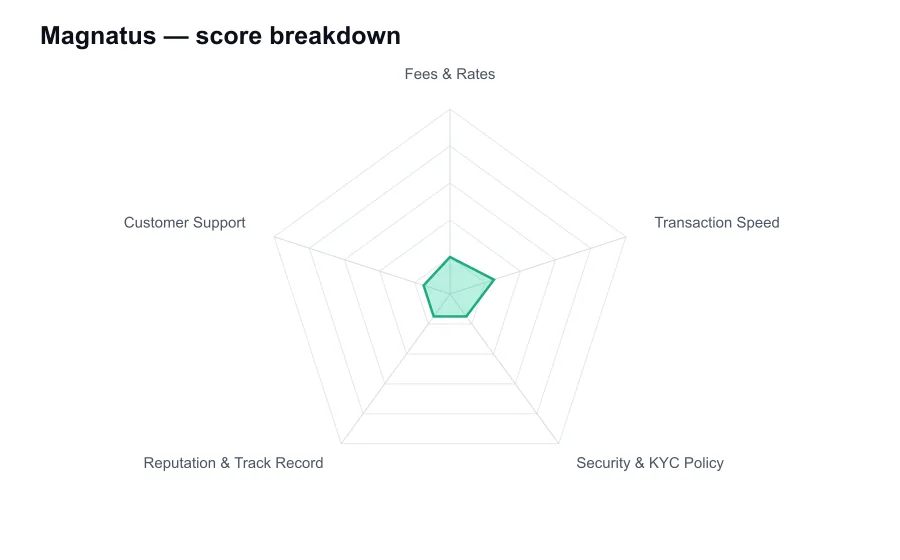
| Criterion | Score | Note |
|---|---|---|
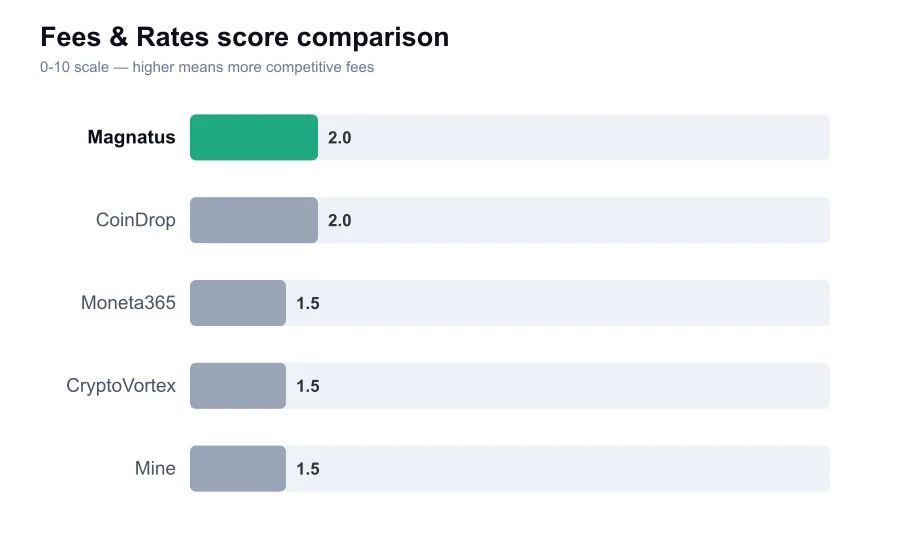
| Fees & Rates | 2.0 | No dependable public fee schedule found |
| Transaction Speed | 2.5 | Settlement performance cannot be verified |
| Security & KYC Policy | 1.5 | Security and KYC policies are unclear |
| Reputation & Track Record | 1.5 | Very limited independently verifiable track record |
| Customer Support | 1.5 | No established support operation located |
Magnatus is one of those crypto names that appears in token directories and scattered trading references without presenting the public footprint expected from a serious exchange. That matters before anyone looks at a quoted rate. I could not verify a clearly maintained official trading platform, a corporate operator, a licensing record, or a reliable product document under the Magnatus name. For a market where impersonation and abandoned sites are common, that absence is not a small administrative detail. It is the central fact of this review.
A buyer searching for Magnatus is likely to encounter vague references rather than the practical information an exchange should publish: supported countries, payment rails, custody terms, withdrawal limits, restricted assets, and a named legal entity. Established venues make those basics easy to find. Kraken publishes fee schedules and compliance disclosures. Coinbase identifies operating entities by region. Even smaller instant swap services normally disclose their terms, limits, and support route. Magnatus does not offer that same level of public accountability.
That makes any advertised fee impossible to assess honestly. A low headline spread means very little if there is no permanent fee page showing whether network costs, liquidity-provider markups, card charges, or withdrawal fees are included. The cheapest-looking swap can become expensive at execution, particularly on thin tokens where spread often exceeds a visible service fee. I would not assign Magnatus credit for low pricing merely because no clear fee is posted.
There is also no persuasive evidence of a maker and taker schedule, a fixed-rate quote policy, or a transparent variable-rate mechanism. Those distinctions are useful because they tell users who absorbs market movement between quote and settlement. Without them, a customer cannot compare a Magnatus quote with Changelly, ChangeNOW, or a conventional spot exchange. They are left trusting a number on a screen, with no dependable framework for contesting a bad fill.
Speed is similarly hard to separate from marketing. Crypto settlement has two parts: the platform's internal processing and the blockchain confirmation time. A credible service explains both, including the number of confirmations required before it releases funds. It also provides a transaction page that remains accessible after a swap. I found no dependable evidence that Magnatus has consistently delivered fast, traceable settlements at scale.
That does not mean every transaction bearing this name must be fraudulent or delayed. It means there is insufficient evidence to promise the experience a user expects from a functioning exchange. A simple wallet-to-wallet transaction may confirm quickly on a quiet network, while an intermediary can still hold it for manual checks, liquidity sourcing, or an unexplained review. The distinction is crucial, and Magnatus has not publicly documented it well enough.
Security is where the lack of detail becomes a direct risk rather than an inconvenience. There is no readily verifiable account-security documentation covering two-factor authentication, withdrawal address controls, cold-storage arrangements, incident response, or proof of reserves. A non-custodial swap tool does not need to hold user deposits for long, but it still needs clear wallet handling, transaction tracking, and fraud controls. A brand with little verifiable operational disclosure cannot earn trust by default.
The KYC position is equally unclear. Some obscure services advertise privacy but reserve the right to ask for identification after funds arrive, often through an external compliance vendor. That model can leave customers with a frozen transaction and no practical recourse. Proper terms should state what triggers review, which documents may be requested, and what happens if verification fails. I could not confirm that Magnatus provides those protections in a durable and accessible form.
Reputation is not just a collection of favorable comments. It is years of visible operation, responsive public communication, independent reporting, recognizable leadership, and a record that can be checked when something goes wrong. Magnatus does not have the kind of established history associated with major centralized exchanges or well-documented onchain protocols. The shortage of reliable third-party material means both praise and criticism should be treated carefully, but it also means prospective users lack evidence.
A new project can be legitimate, of course. It cannot demand the confidence earned by a business that has survived market stress, withdrawal surges, regulatory scrutiny, and public incidents. Crypto users have learned that lesson repeatedly. If a service is too small or too opaque to establish who operates it and how disputes are resolved, it should be approached as experimental infrastructure, not as a place to move meaningful savings.
Customer support is another weak point because I could not verify a well-established help center, ticket system, service-level commitment, or staffed public support channel. Fast support is especially important for swaps, where a wrong destination memo, a delayed confirmation, or a compliance hold can become costly. An email address alone is not enough. Users need a case number, a clear escalation path, and records that survive beyond a social media message.
There is a practical way to test any service that claims to be Magnatus: do not start with a large purchase. Verify the exact domain through an independent source, inspect its terms and company details, check whether its deposit addresses and transaction records behave as described, and use an amount you can afford to lose. Never provide identity documents or connect a primary wallet solely because an unverified account asks you to act quickly.
I would also avoid treating a token with a similar name as evidence that an exchange is legitimate. Tokens, domains, social handles, and apps are separate things, and scammers routinely borrow the credibility of one to sell another. Confirm contract addresses from an authoritative project source. If that authoritative source does not exist, the right conclusion is not that the deal is early. It is that the information standard has not been met.
Magnatus receives a poor score because transparent evidence is missing in areas where users need it most. There may be a genuine project or service behind the name, but I cannot responsibly recommend it as a proven exchange until its ownership, terms, fees, support routes, and security practices can be independently verified. The sensible move is to use a better documented venue for any material transaction and keep Magnatus on a watchlist, not a funding list.
| Pros | Cons |
|---|---|
| May appeal to users researching early-stage projects | — |
| No confirmed account custody model to evaluate | — |
| Can be tested only with a very small amount | — |
| — | Limited evidence of responsive support |
Magnatus is not suitable for beginners, active traders, or anyone moving meaningful funds. Researchers who can independently verify the exact domain and project details may monitor it, but should not treat the name alone as proof of legitimacy. Users needing predictable execution should use a regulated exchange or a documented non-custodial protocol instead.
I could not verify a durable public fee schedule showing trading, spread, network, or withdrawal costs. Do not assume a displayed quote includes every charge.
There is not enough publicly verifiable information about ownership, security controls, or customer protections to rate it as a safe established exchange.
Do not submit identity documents until you have independently confirmed the exact operator, privacy policy, compliance process, and support route.
| Alternative | Score |
|---|---|
| CoinDrop Review | 1.8/10 |
| Moneta365 Review | 1.5/10 |
| CryptoVortex Review | 1.3/10 |
| Mine Review | 1.2/10 |
| CoinCraddle Review | 1.0/10 |
| HotExchange Review | 2.8/10 |